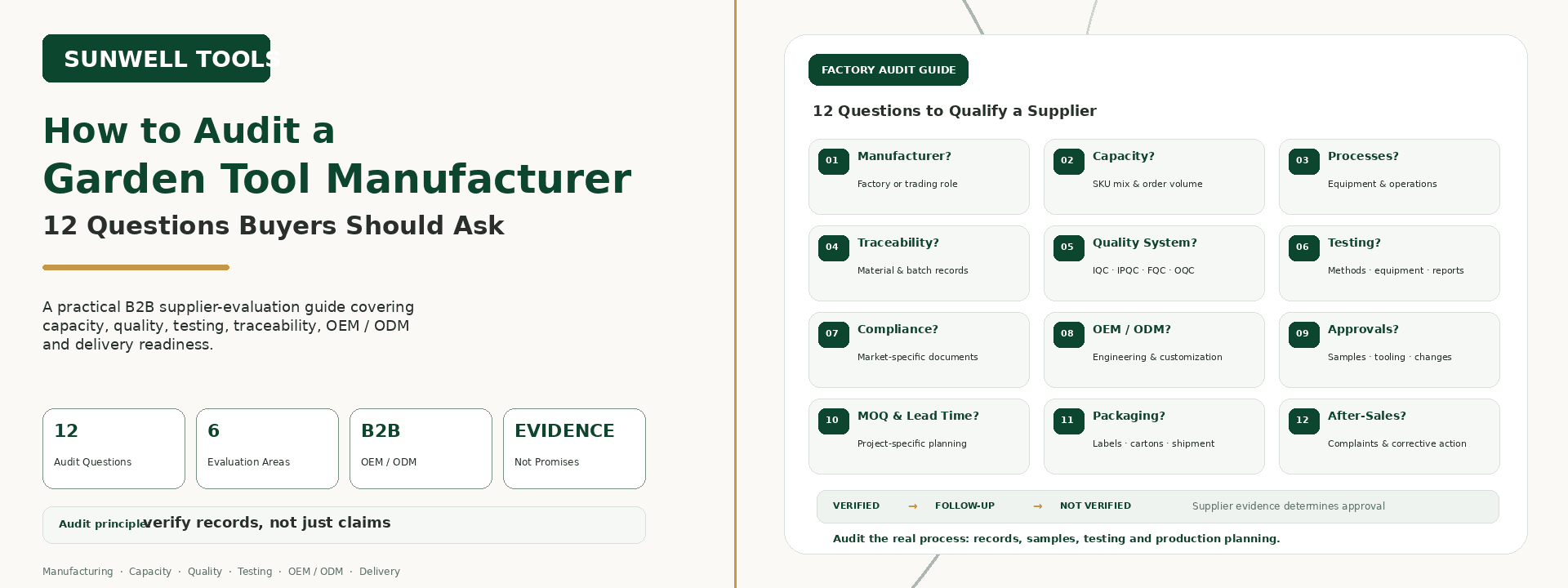
How can buyers verify a garden tool manufacturer before placing an order? Use this 12-question factory audit checklist to assess production capacity, materials, quality systems, in-house testing, OEM/ODM capabilities, lead times and supplier reliability.
How to Audit a Garden Tool Manufacturer: 12 Questions Buyers Should Ask
Finding a garden tool supplier online is easy. Verifying whether that supplier can consistently manufacture the products your business needs is considerably more difficult.
For importers, distributors, retail chains and private-label brands, a garden tool manufacturer audit should go beyond factory size, product photographs and quotation prices.
Buyers need to understand how a manufacturer controls materials, production processes, product testing, customization, quality inspection and delivery commitments.
A supplier may offer an attractive sample and competitive pricing, but those advantages have limited value if the factory cannot reproduce the approved product consistently across large orders.
This guide provides 12 practical questions that B2B buyers can use to assess a garden tool factory before starting an OEM/ODM or wholesale purchasing program.
Quick Answer: How Should Buyers Audit a Garden Tool Manufacturer?
A useful factory audit should confirm six essential areas:
- Manufacturing: What does the supplier actually produce, and which operations are outsourced?
- Capacity: Can it meet the required SKU mix, volume and seasonal schedule?
- Quality: Are materials, production and finished goods controlled through documented procedures?
- Testing: Can the supplier provide relevant test methods, equipment and records?
- OEM/ODM: Can product specifications, samples, tooling and packaging be managed systematically?
- Delivery: Are lead times, shipment requirements and problem-resolution procedures clear?
Why Should Buyers Audit a Garden Tool Manufacturer Before Placing an Order?
Garden tools are manufactured using different materials and production methods.
Manual pruning tools may require steel forming, blade grinding, heat treatment, injection-molded handles and precision assembly.
Electric garden tools add motors, control systems, battery-related components and additional functional or safety requirements.
Garden watering products may depend on plastic molding, sealing, pressure-related performance and component compatibility.
This variety makes supplier evaluation particularly important.
A factory that performs well in one category may not necessarily have the same technical capability in another.
A structured audit helps buyers identify the difference between:
- A supplier with attractive catalog products
- A supplier with documented manufacturing processes
- A supplier capable of managing a repeatable OEM/ODM production program
The objective is not to find a factory that answers every question with "yes".
It is to identify a manufacturer whose actual capabilities match the buyer's product requirements, commercial expectations and risk tolerance.
B2B sourcing principle: A factory visit is useful only when the buyer verifies evidence. Equipment photographs, general certifications and verbal promises should not replace product-specific records and sample evaluation.
1. Are You the Actual Manufacturer or a Trading Company?
One of the first questions in a garden tool supplier evaluation is to understand the supplier's role in the production process.
Manufacturers and trading companies can both participate in successful international supply chains. However, buyers should understand who controls manufacturing, quality requirements and corrective actions.
What Buyers Should Ask
- Which product categories are manufactured in your own facilities?
- Which components or processes are outsourced?
- Who owns or manages the production tooling?
- Can we review the relevant production area or process?
- Who is responsible for quality issues involving subcontracted components?
- Factory profile and relevant registration information
- Production-process overview
- Current equipment and workshop information
- Outsourced-process control procedures
Outsourcing is not automatically a weakness. Many legitimate manufacturers work with specialist subcontractors.
The key issue is whether the supplier can identify those activities and control their quality.
2. Can Your Factory Handle Our Product Mix and Order Volume?
Factory capacity should be evaluated against the buyer's actual product mix, not only a headline production number.
Producing one million simple hand tools requires a different production schedule from manufacturing the same number of multi-component electric products.
A buyer sourcing pruning shears, loppers and hose reels in the same order should also examine whether the manufacturer can coordinate different production processes.
Questions About Production Capacity
- What is your output for the relevant product category?
- How much capacity is available during our required production window?
- Can multiple SKUs be produced within the same order schedule?
- Which materials or components commonly constrain production?
- How are repeat orders scheduled?
- Product-category capacity information
- Sample production schedule
- Production-line allocation plan
- Examples of manufacturing lead-time calculations
Buyers should pay particular attention to seasonal purchasing cycles.
A factory may have sufficient annual capacity but still face a scheduling bottleneck when several customers need shipments for the same retail season.
Related reading: Garden Tool Production Capacity and Lead-Time Planning .
3. What Manufacturing Equipment and Production Processes Do You Control?
Buyers should examine the production processes most relevant to their products.
For manual cutting tools, these may include:
- Metal cutting and forming
- Stamping
- Heat treatment
- Blade grinding
- Surface finishing
- Injection molding
- Assembly and functional inspection
Electric tools and watering products introduce different production requirements, so the audit should follow the actual product category being sourced.
Why Equipment Condition Matters
The presence of a machine does not necessarily prove manufacturing capability.
Buyers should also review equipment condition, maintenance practices, operator training and process documentation.
- Equipment list for relevant operations
- Preventive maintenance records
- Work instructions for critical processes
- Process inspection and adjustment records
To understand how manufacturing processes connect from product development through production and delivery, explore Inside SUNWELL: Garden Tool Factory Tour & OEM/ODM Manufacturing Process .
4. How Do You Verify and Trace Raw Materials?
Material consistency matters because garden-tool components can be affected by mechanical loads, corrosion, repeated cutting and exposure to outdoor environments.
For example, two pruning shears may look identical but use different blade steel grades or heat-treatment specifications.
In watering products, changes in plastic material or sealing components may affect performance and assembly.
What Buyers Should Investigate
- How are incoming materials identified?
- Are supplier material specifications documented?
- Are steel grades and applicable plastic materials checked against purchasing requirements?
- Can production batches be linked to incoming material lots?
- What happens when incoming material fails inspection?
- Material specifications
- Supplier material certificates where applicable
- Incoming inspection records
- Batch identification and traceability examples
Traceability should be assessed according to the actual product risk and contractual requirements.
The objective is to establish whether the factory can investigate a material issue without relying only on memory or assumptions.
5. How Does Your Quality Control System Work During Production?
A final product inspection is useful, but it cannot replace quality controls throughout the manufacturing process.
Buyers should examine whether inspection requirements are applied at appropriate production stages.
| Quality Stage | Purpose | Example Evidence |
|---|---|---|
| IQC | Incoming material and component inspection | Incoming inspection records |
| IPQC | Process monitoring and defect prevention | Patrol and first-article inspection records |
| FQC | Finished product inspection | Product inspection reports |
| OQC | Outgoing and shipment-release inspection | Final release and packing records |
Questions to Ask the Quality Team
- Are critical product characteristics documented?
- How frequently are production samples inspected?
- What acceptance criteria are used?
- How are nonconforming products identified and separated?
- Who approves corrective actions?
- Are inspection instruments maintained and calibrated as required?
Audit warning: A supplier that says "every product is checked" should still be able to explain what is inspected, which criteria are used and how results are recorded.
Related guide: SUNWELL Quality Control: From Raw Material to Finished Product .
6. What Product Testing Can You Demonstrate Before Mass Production?
Product testing is particularly important for garden tools because real-world use can involve repeated loading, cutting, exposure to water and outdoor storage.
However, the required tests vary by product category.
Typical Tests Buyers May Need
| Product Category | Potential Test Areas |
|---|---|
| Pruning Shears and Loppers | Cutting performance, blade hardness, handle strength, lock function and repeated-use durability |
| Hedge Shears | Blade alignment, cutting performance, handle durability and corrosion resistance |
| Electric Garden Tools | Functional performance, electrical safety, operating characteristics and applicable battery-related requirements |
| Hose Reels and Watering Products | Pressure-related performance, leakage, connector fit and mechanism durability |
These examples should be adapted to the individual product specification.
Buyers should ask whether testing is performed internally or by external laboratories.
- Test procedures
- Applicable testing equipment list
- Sample test reports
- Equipment calibration information
- Failed-test investigation examples, where available
A supplier should be able to explain how test results influence sample approval and production decisions.
A test report alone is not sufficient if the reported product configuration does not match the item being purchased.
7. Can You Provide the Compliance Documents Required by Our Market?
Different export markets and product categories may require different safety, electrical, chemical or product documentation.
Buyers should define the destination country and product category before assessing applicable compliance requirements.
For example, an electric garden tool may face different requirements from a manual pruning shear.
What Buyers Should Confirm
- Which regulations and standards apply to the proposed product?
- Are the available reports relevant to the actual model?
- Do the documents cover the appropriate product configuration and market?
- Is testing current for the relevant product and requirements?
- Who is responsible for additional tests or documentation if needed?
Important distinction: A factory's management-system certification is not the same as product-specific compliance or market approval. Buyers should verify the documents needed for each destination and product.
Related reading: European Garden Tool Quality Standards .
8. What OEM/ODM Experience Do You Have With Similar Products?
A garden-tool manufacturer may be able to produce existing catalog items but have limited experience with custom product development.
For buyers planning private-label or OEM/ODM programs, the audit should evaluate the supplier's engineering and project-management process.
Key Questions for OEM/ODM Buyers
- Can you review drawings and technical specifications?
- Can you recommend suitable materials and production methods?
- How do you manage engineering changes?
- Can you develop custom handles, housings or packaging?
- Who approves product changes before production?
- How are confidential drawings and product information handled?
Buyers should also ask to review a relevant project process, ideally with confidential customer information removed.
The goal is to understand how the manufacturer converts a specification into a repeatable production process.
For SUNWELL's published process, see Garden Tool OEM/ODM Process: From Inquiry to Shipment .
9. How Are Samples, Tooling and Pre-Production Approvals Managed?
Sample approval is one of the most important control points in a customized garden-tool project.
Without a documented approval process, it may become difficult to determine which product configuration should be used for mass production.
Areas to Verify
- Sample type and identification
- Material and component specifications
- Colors and surface finishes
- Product performance requirements
- Packaging approval
- Drawing and specification revisions
- Final sample approval responsibility
Where new tooling is required, the buyer should separately confirm tooling cost, ownership, maintenance, storage and any applicable exclusivity terms.
- Sample approval form
- Engineering change record
- Tooling specification or agreement
- Approved sample identification procedure
The approved sample, drawings, quality requirements and commercial agreement should be consistent before mass production begins.
10. How Do You Confirm MOQ, Pricing and Production Lead Time?
Minimum order quantity, unit price and delivery schedule should be evaluated together rather than treated as separate promises.
Garden-tool MOQ can vary according to materials, existing tooling, customization, packaging and product category.
Lead time can also change depending on the number of SKUs, material availability and testing or development requirements.
Questions Buyers Should Ask
- What is the MOQ for each specific SKU?
- Does a custom logo or color affect MOQ?
- Are tooling and sampling costs quoted separately?
- When does the production lead time start?
- Which approvals must be completed before production?
- What happens if a key component is delayed?
A reliable quotation should clearly distinguish the unit price, relevant tooling or development charges, packaging requirements and agreed commercial terms.
Buyer reminder: Do not assume that a delivery promise applies to every product and every order size. Request a schedule specific to your intended SKU mix, customization and shipment window.
For broader purchasing questions, see Garden Tool FAQ: MOQ, Payment, Shipping & After-Sales .
11. How Do You Control Packaging and International Shipment Preparation?
Packaging is not only a branding decision.
It also affects product protection, retail presentation, labeling and logistics efficiency.
Retail chains and private-label programs may require specific packaging structures, barcodes, carton markings and delivery documentation.
Packaging Audit Checklist
- Is the approved packaging specification documented?
- Are logos, colors and printed details checked against approved artwork?
- Are carton dimensions and quantities confirmed?
- Are products protected against expected transportation conditions?
- Are labels and destination-market requirements checked?
- Are shipment quantities and packing records verified?
Buyers should also confirm the agreed Incoterm, required documents and responsibilities for shipping arrangements.
If a project uses several product categories, packaging and shipping requirements should be coordinated before final production planning.
12. How Are Quality Complaints and Corrective Actions Handled After Delivery?
Supplier evaluation should include what happens after the goods arrive at the buyer's warehouse.
Even with appropriate inspection, quality feedback may arise during distribution or end use.
A structured supplier should have a process for investigating reported defects and agreeing corrective action.
Questions to Ask Before Contract Signing
- Who receives quality complaints?
- Which product and batch information is required?
- How are possible root causes investigated?
- How are corrective actions documented?
- Who approves the commercial resolution?
- How is the issue prevented in future production?
- Complaint-handling procedure
- Corrective-action form or example
- Relevant warranty or quality agreement
- Responsibility and communication process
The buyer and supplier should confirm applicable warranty provisions and defect-resolution terms in their commercial agreement.
A reliable relationship depends not only on preventing defects, but also on responding systematically when problems occur.
Garden Tool Factory Audit Scorecard: How to Compare Suppliers
After collecting evidence, buyers need a consistent way to compare potential manufacturers.
The following practical scorecard can be adapted to the purchasing project.
| Audit Area | Evidence to Review | Suggested Status |
|---|---|---|
| Manufacturing identity | Factory role and outsourced operations | Verified / Follow-up / Not Verified |
| Production capacity | SKU-specific capacity and schedule | Verified / Follow-up / Not Verified |
| Equipment and processes | Maintenance and production records | Verified / Follow-up / Not Verified |
| Material traceability | Material specifications and lot records | Verified / Follow-up / Not Verified |
| Quality system | Inspection plans and defect management | Verified / Follow-up / Not Verified |
| Testing capability | Test methods and reports | Verified / Follow-up / Not Verified |
| Compliance | Product- and market-specific documentation | Verified / Follow-up / Not Verified |
| OEM/ODM capability | Design review and change-control process | Verified / Follow-up / Not Verified |
| Sample approval | Approved samples and tooling records | Verified / Follow-up / Not Verified |
| MOQ and lead time | Project-specific quotation and schedule | Verified / Follow-up / Not Verified |
| Packaging and shipping | Packing specifications and shipment records | Verified / Follow-up / Not Verified |
| After-sales handling | Complaint and corrective-action procedure | Verified / Follow-up / Not Verified |
How to Use the Scorecard
Mark each area as:
- Verified: Evidence has been reviewed and meets the buyer's requirements.
- Follow-up: The supplier has provided partial information or clarification is still needed.
- Not Verified: Required evidence is unavailable, insufficient or inconsistent.
These categories are a practical internal review method, not a formal certification system.
Safety-critical and legally required areas should not be treated as interchangeable with general commercial preferences.
A supplier should not be approved simply because it performs well in unrelated areas while a mandatory compliance requirement remains unresolved.
What Warning Signs Should Buyers Watch for During a Factory Audit?
Several situations may justify additional verification before placing a production order.
Potential Factory Audit Red Flags
- The supplier cannot clearly identify which production activities it controls.
- Production-capacity claims cannot be connected to specific products or production schedules.
- Material grades are unclear or change without documentation.
- Critical inspection requirements are not defined.
- Product test reports do not match the proposed product configuration.
- The approved sample cannot be linked to the production specification.
- Tooling ownership or engineering-change responsibilities are unclear.
- Delivery estimates are offered without reviewing product complexity or order requirements.
- Defect complaints have no defined investigation or resolution procedure.
One warning sign does not automatically disqualify a supplier.
However, unresolved problems involving product safety, compliance, material identity or critical manufacturing requirements can create substantial procurement risk.
Buyers should document those findings and request corrective action or additional evidence before proceeding.
How SUNWELL Supports Garden Tool Supplier Evaluation and OEM/ODM Projects
SUNWELL has focused on garden-tool manufacturing since 1988.
Its product portfolio covers manual garden tools, electric garden tools and garden watering products.
SUNWELL's manufacturing platform supports more than 2,000 product SKUs, with annual production exceeding 35 million pieces.
For B2B buyers, the important point is to connect this manufacturing scale to the specific product and purchasing program being evaluated.
Manufacturing Process Visibility
SUNWELL's published manufacturing information covers product development, mold design, metalworking, injection molding, assembly, quality inspection and shipment preparation.
Buyers can review the relevant processes through the SUNWELL Garden Tool Factory Tour .
Quality Control and Testing
SUNWELL describes a quality-control structure including incoming, in-process, finished-product and outgoing inspection.
For individual purchasing projects, the relevant tests and acceptance criteria should be confirmed according to the product specification.
Learn more about SUNWELL Quality Control and Product Testing .
OEM/ODM Development and Order Planning
OEM/ODM projects may include product selection, engineering evaluation, samples, packaging, specification approval, production and shipment coordination.
The exact scope depends on the selected product and customization requirements.
Buyers can review the SUNWELL OEM/ODM Order Process before submitting a project inquiry.
Frequently Asked Questions About Garden Tool Manufacturer Audits
What should buyers check first when auditing a garden tool factory?
Start by confirming the supplier's manufacturing role, relevant product capabilities, production capacity and quality-control process. These areas help determine whether the factory can support the buyer's intended products.
Is ISO 9001 certification enough to approve a garden tool manufacturer?
No. A management-system certification can be useful evidence, but buyers should also review product-specific manufacturing processes, inspection records, testing requirements and destination-market compliance.
Can buyers audit a garden tool manufacturer remotely?
A remote review can cover production documentation, test reports, process videos, interviews and sample evaluation. However, some risks may require an on-site visit or independent third-party verification.
What documents should buyers request before an OEM order?
Relevant documents may include product specifications, applicable material information, sample approvals, quality inspection procedures, test reports, quotation terms, tooling agreements and the production schedule.
How can buyers verify a supplier's real production capacity?
Ask for capacity information related to the specific product category, available production resources, expected SKU mix and the proposed order schedule. Annual output alone is not enough.
When should a factory audit take place in the purchasing process?
Initial supplier qualification should take place before a major production commitment. Buyers may also conduct additional reviews during sample approval, trial production, or when substantial changes occur in the supplier's operation.
Final Thoughts: Choose a Manufacturer Based on Evidence
A reliable garden-tool manufacturing partnership starts with a clear understanding of capabilities, responsibilities and expectations.
Factory size, price and product photographs can be useful starting points, but they do not provide a complete picture of supplier reliability.
A structured audit helps buyers compare manufacturers based on evidence rather than marketing claims.
The strongest supplier for a project is not necessarily the factory with the widest catalog or the lowest quotation.
It is the supplier that can demonstrate suitable manufacturing capability, defined quality controls, realistic production planning and accountability for the agreed product requirements.
Before moving from quotation to mass production, buyers should confirm the product specification, approved sample, critical testing requirements, MOQ, commercial terms and delivery schedule.
Evaluate Your Next Garden Tool Sourcing Project With SUNWELL
Looking for a garden tool manufacturer for wholesale, private-label or OEM/ODM production?
Share your target market, product categories, expected order quantity, technical specifications, testing requirements and delivery schedule.
SUNWELL can discuss relevant manufacturing processes, product options, sampling requirements and project-specific production planning.
From supplier evaluation to sample approval and mass production.
Explore OEM/ODM Solutions → Contact SUNWELL →