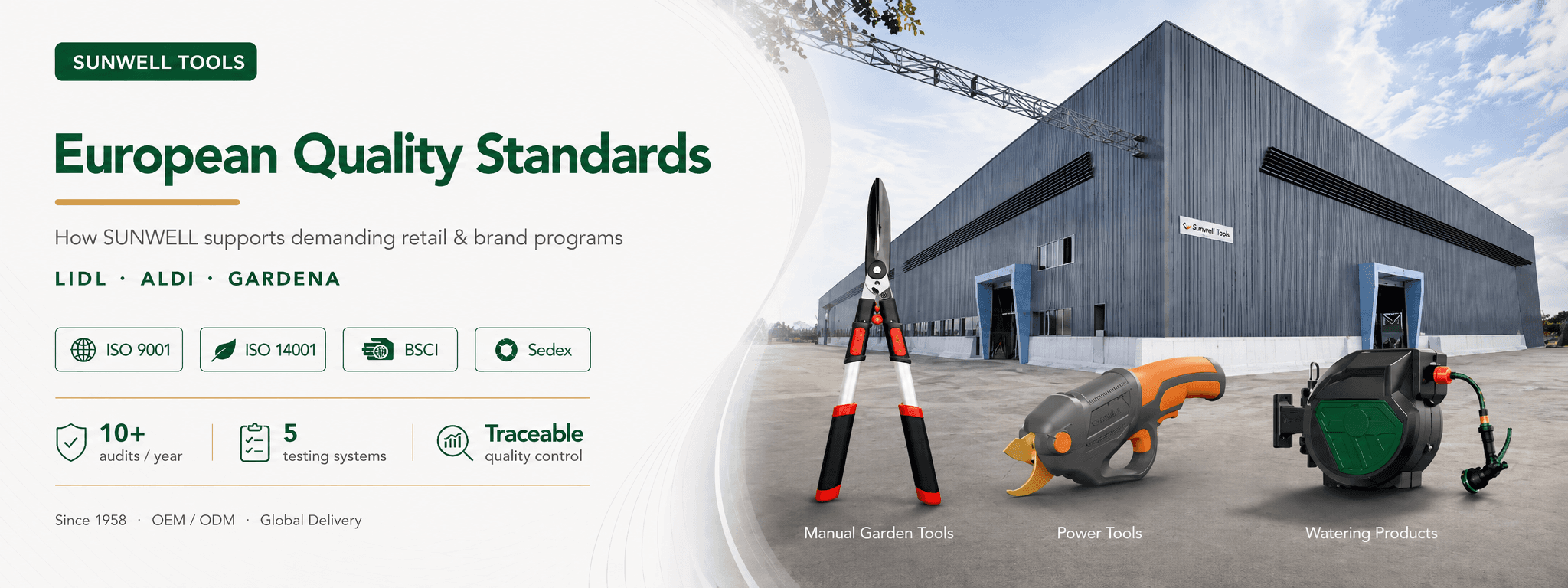
How We Serve LIDL, ALDI & GARDENA: Quality Standards Explained
In the garden tool industry, there is a widely understood truth: if a factory can pass the supplier qualification process of Europe's leading retailers, it has proven its capability to the highest standard in the world.
At SUNWELL Tools, we have been a trusted OEM/ODM partner to companies like LIDL, ALDI, GARDENA, and FISKARS for decades. We cannot disclose confidential details of our partnerships — and we would never want to. What we can share is something far more valuable: a transparent look at the standards, certifications, and processes that any factory must meet to supply these organizations.
Whether you're a brand owner sourcing garden tools, a procurement manager evaluating suppliers, or simply curious about what separates a good factory from a great one, this article will give you a clear picture.
Why European Retailers Set the Global Benchmark for Supplier Quality
Europe is, without question, the most demanding market for consumer goods. The regulatory environment is stringent. Consumer expectations are high. And the retail chains that dominate the market know it.
LIDL and ALDI, two of Europe's largest discount supermarket chains, operate thousands of stores across the continent and beyond. Their business model depends on offering exceptional value — but never at the expense of quality or safety.
Their private-label garden tools compete directly with branded products in the minds of consumers, which means the quality bar for their suppliers is extraordinarily high.
GARDENA, part of the Husqvarna Group, is Europe's premier gardening brand. Their products are recognized for innovative design, ergonomic excellence, and long-term durability. Supplying GARDENA means meeting standards that most factories simply cannot reach.
FISKARS, Finland's iconic tool brand with over 380 years of history, demands functionality and reliability in every product that bears their name.
What these companies share in common is an uncompromising approach to supplier qualification. They do not simply place orders with any factory that offers a competitive price. They build partnerships with manufacturers who can demonstrate — through documented systems, third-party certifications, and continuous audit performance — that they can deliver consistent quality at scale.
This is not a market you can enter by showing a glossy brochure. You earn your place through years of proven capability.
The Multi-Layer Audit System: What It Takes to Get Approved
Before a single garden tool is ever produced for a European retailer, the factory itself must pass a series of rigorous evaluations.
Think of it as a multi-stage gate system. At each stage, the requirements become more demanding.
Stage 1: Initial Supplier Screening
The process begins with a comprehensive questionnaire covering:
- Company history, scale, and financial stability
- Manufacturing capabilities and equipment inventory
- Quality management system documentation (ISO 9001 or equivalent)
- Environmental management practices
- Existing certifications and client references
This stage alone eliminates a significant percentage of applicants. European retailers and premium brands do not work with factories that cannot demonstrate organized, documented operations.
Stage 2: On-Site Factory Audit
Once initial screening is passed, an on-site audit follows — often conducted by the retailer's own quality team or a reputable third-party inspection company such as SGS, Bureau Veritas, or TÜV.
The factory audit covers:
- Production facilities and equipment condition: Are machines well-maintained? Is the production line organized? Is there evidence of preventive maintenance?
- Quality control processes: Is there an in-line QC system? What are the AQL (Acceptable Quality Level) standards? How are non-conforming products handled?
- Testing capabilities: Does the factory have an in-house testing lab? Can they perform tensile strength tests, hardness tests, salt spray tests, and other critical evaluations?
- Traceability: Can every batch of raw material be traced from receipt through production to finished goods?
- Warehouse and logistics: Are finished products stored properly? Is there a FIFO (First In, First Out) system? Are packaging materials controlled?
Stage 3: Trial Order and Sample Approval
No European retailer places a full-volume order with a new supplier immediately.
The process typically involves:
- Sample submission and approval, often through multiple rounds
- A pilot or trial order at reduced volume
- Full quality inspection of the trial batch
- Performance review before volume orders are released
This staged approach ensures that the factory's capabilities are validated under real production conditions, not just in a controlled sample environment.
Stage 4: Ongoing Annual Audits
Here is where many factories fall short. Passing an initial audit is one thing. Maintaining compliance year after year, shipment after shipment, is an entirely different challenge.
European retailers conduct annual re-audits — often unannounced — to ensure that standards are being consistently maintained.
A decline in audit scores can result in reduced order volumes or, in serious cases, removal from the approved supplier list.
At SUNWELL, we have maintained our approved supplier status with these clients for decades. That is not an accident. It is the result of building quality into our DNA.
Breaking Down the Standards: Materials, Performance, Packaging & Compliance
Let us now look at the specific areas where compliance is non-negotiable.
Material Safety: REACH, LFGB, and Beyond
The European Union's REACH regulation — Registration, Evaluation, Authorisation, and Restriction of Chemicals — is one of the most comprehensive chemical safety frameworks in the world.
It applies to every consumer product sold in the EU, and garden tools are no exception.
For garden tools, this means:
- Handles and grips must be tested for restricted substances including phthalates, heavy metals such as lead, cadmium, mercury and hexavalent chromium, and PAHs.
- Metal components must comply with restrictions on nickel release for applicable products and specific heavy-metal limits.
- Coatings and paints must be free from prohibited substances, and powder coating or electroplating processes must meet applicable environmental standards.
- Plastic components must comply with relevant material-safety requirements.
For products sold in Germany, additional LFGB testing may be required depending on the product and component requirements.
At SUNWELL, we maintain a complete REACH compliance program. Materials are sourced with relevant compliance documentation, while third-party testing is used where required to verify applicable material requirements.
Product Performance Testing
A garden tool must perform reliably under the conditions it will encounter. European retail programs can require documented testing across multiple parameters.
For cutting tools such as secateurs, loppers, shears, and pruning saws:
- Blade hardness testing
- Cutting performance testing
- Spring fatigue testing for applicable products
- Handle ergonomics and grip assessment
- Corrosion resistance and salt spray testing
For digging tools such as spades, forks, trowels, and rakes:
- Tensile strength of handle-to-head connections
- Impact resistance testing
- Shaft bending strength and deflection testing
- Surface-treatment adhesion testing
- Load-bearing capacity
For watering products such as hoses, spray guns, and connectors:
- Pressure testing under operating and burst conditions
- UV resistance testing
- Connection integrity through repeated-use cycles
- Material flexibility at low temperatures
Every product type has its own set of performance parameters. Applicable certification and compliance requirements should be confirmed against the relevant product specification and target market.
Packaging Requirements
Packaging is far more than an afterthought in the European market. It can be required to satisfy multiple retail, environmental, transport and labeling requirements.
- Retail-ready presentation: Products should have clear product identification, usage instructions and applicable safety information.
- Sustainability compliance: Packaging materials need to meet applicable European requirements and retailer-specific sustainability policies.
- Transport protection: Packaging must protect products throughout warehousing and distribution.
- Labeling accuracy: Barcodes, applicable conformity markings, country of origin, importer information and other required information must be accurate.
- FSC/PEFC certification: Some European retail programs increasingly request certified paper-based packaging materials.
Documentation and Traceability
European retail programs can require complete documentation for the products they sell.
- Applicable third-party test reports
- Declarations of Conformity where required
- Material documentation where applicable
- Batch traceability from raw materials to finished products
- Production and inspection records
This documentation burden is significant. It requires factories to maintain organized systems and production records that can withstand customer and third-party review.
Social Responsibility: Beyond Product Quality
European retailers do not only evaluate the products — they also evaluate how those products are made and who makes them.
BSCI and Sedex: The Social Compliance Framework
The Business Social Compliance Initiative, now part of amfori, and Sedex/SMETA are two widely used social-compliance frameworks within international retail supply chains.
These audits assess areas such as:
- Freedom of association and collective bargaining rights
- No discrimination in the workplace
- Fair compensation and working-hour compliance
- No child labor or forced labor
- Occupational health and safety, including fire safety, machine guarding, personal protective equipment, emergency procedures and chemical handling
- Environmental management
- Ethical business behavior, anti-corruption and transparency
The audit process can involve:
- Document review
- Factory walkthroughs
- Worker interviews
- Corrective-action plans for identified non-conformities
Social compliance has therefore become an important part of supplier qualification alongside product quality and commercial capability.
Our Commitment
SUNWELL maintains BSCI-related social-compliance systems and has undergone multiple social-compliance audits to support customer requirements.
We believe ethical manufacturing is not simply a compliance obligation. Safe working conditions, responsible management and stable manufacturing processes are also closely connected to long-term product quality.
From Audit to Ongoing Partnership: How We Maintain Standards Every Day
Passing audits is important, but the real test is day-to-day consistency.
Here is how SUNWELL works to maintain its manufacturing and quality systems.
What This Means for Your Brand
1. Proven Quality Capability
Working with international retailers and garden-tool brands requires organized manufacturing, documented quality processes and the ability to respond to customer-specific requirements.
2. Compliance Infrastructure Already in Place
REACH-related material management, social audits, testing capabilities and documentation systems are part of the infrastructure required to support European retail programs.
For B2B buyers, this can reduce the amount of supplier-development work required when launching a new garden-tool program.
3. Scalability Without Compromise
Serving high-volume retail programs requires manufacturers to maintain production consistency as quantities increase.
SUNWELL's manufacturing and quality systems are designed to support both OEM/ODM development and scaled production.
4. A Partner Who Understands European Markets
European-market experience influences more than compliance documentation.
Material selection, product finish, packaging, labeling, quality expectations and delivery planning all need to be considered according to the destination market and customer program.
Ready to Work with a Proven European-Grade OEM Partner?
Not every garden tool factory is prepared for the audit processes, compliance requirements, testing protocols and social-responsibility expectations associated with European retail programs.
At SUNWELL Tools, decades of manufacturing experience have helped us develop the systems required to support international garden-tool customers across different product categories and markets.
Whether you are an established brand looking for a more reliable OEM partner, or an emerging brand building a new product range, SUNWELL can evaluate your product specifications, customization requirements, compliance needs and production plan.
The same manufacturing and quality systems developed for demanding international programs support every SUNWELL partnership.
Contact SUNWELL →