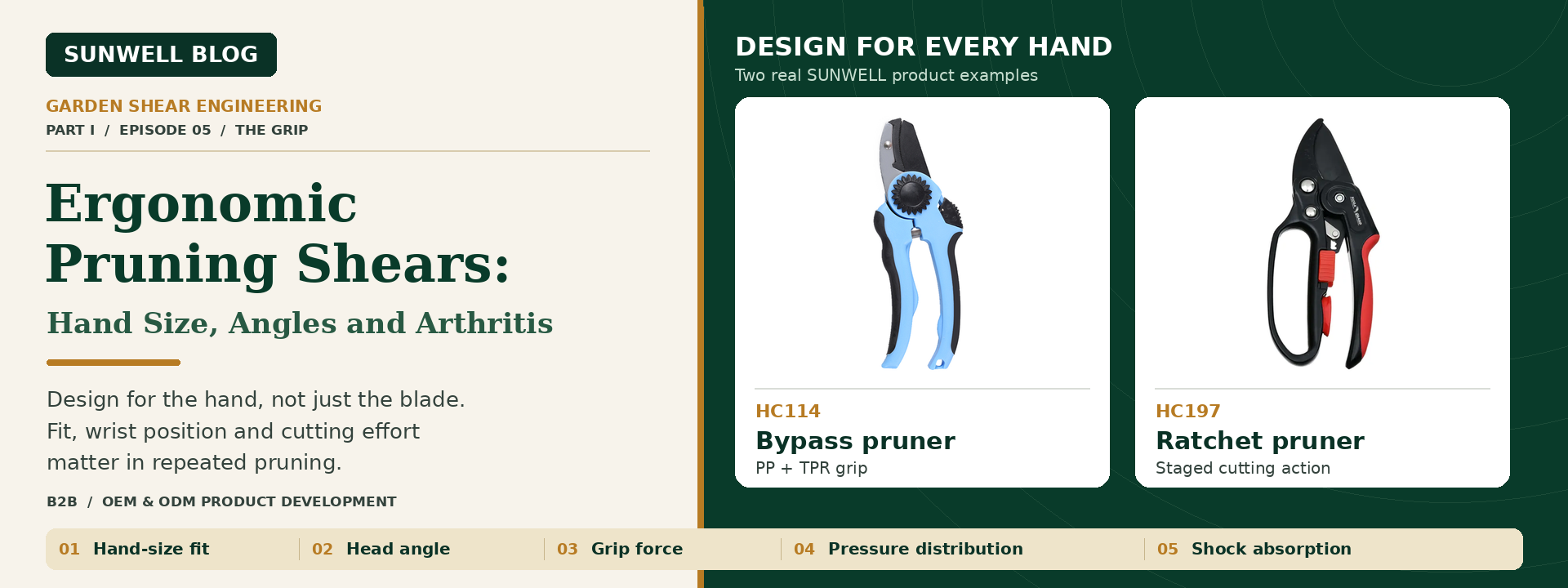
What makes pruning shears genuinely ergonomic? Explore hand-size fit, handle geometry, head angles, ratchet mechanisms, rotating grips and shock absorption, with practical design specifications for B2B buyers developing OEM/ODM garden shear ranges.
SUNWELL | GARDEN SHEAR ENGINEERING
PART I · EPISODE 05 · THE GRIP
Ergonomic Pruning Shears: Hand Size, Angles and Arthritis
“Too big for my hands” is one of the most important complaints in the garden-tool category. It is not necessarily a complaint about quality — the tool may be excellent — it is a complaint that the product was designed for a hand that is not the customer's.
Part I · The fifth of six details your customers judge
Fit
Handle spread and grip circumference — not just colour.
Head Angle
Designed to support a more neutral wrist position during repeated cutting.
Force
Ratchet or compound linkage for users with reduced grip strength.
Pressure
A rotating lower handle helps distribute pressure across the palm.
Shock
Bumpers help absorb impact at the end of each cut.
Quick Answer
Ergonomic pruning shears are built around five important design decisions:
- Hand-size fit — compact, standard and large frames, changing handle spread and grip circumference, not just colour.
- Head angle — supporting a more neutral wrist position during cutting.
- Force multiplication — ratchet or compound linkage mechanisms.
- Pressure distribution — a rotating lower handle where appropriate.
- Shock absorption — cushioning bumpers that help reduce closing impact.
The market reason is demographic: in Europe, more than one in five people is aged 65 or older, according to population estimates referenced in the United Nations World Population Prospects .
Older gardening users and people with reduced grip strength represent important considerations for product development. Their requirements should be treated as part of the design specification, rather than as an afterthought.
Ergonomics is a design specification. Handle dimensions, cutting force, wrist position and component interaction should be evaluated together when developing a pruning shear range.
Why Fit Comes Before Everything
A handle that is too wide forces the hand into a more open position and can increase strain during repeated cutting.
The user may experience fatigue during a gardening session, but describe the tool as “uncomfortable” or “too big”.
This is why the complaint should not be treated simply as a preference: it may indicate a mismatch between the handle design and the intended user.
Fit involves three related design decisions: frame size, handle spread and grip circumference.
| Size | Handle Spread | Grip Circumference | Fits |
|---|---|---|---|
| Compact | Narrowest | Smallest | Smaller hands, users with reduced grip span, and those who prefer a compact handle. |
| Standard | Medium | Medium | General adult hand sizes; a typical core SKU in a retail range. |
| Large | Widest | Largest | Larger hands, gloved users, and those who prefer a fuller grip. |
Changing only the colour of a handle does not create a genuine size range.
Handle spread and grip circumference both need to be considered. Different frame sizes may also require dedicated tooling or modifications to an existing product platform.
This creates a manufacturing and investment consideration for brands developing compact, standard and large pruning shear options.
For a brand, hand-size coverage matters. A product range that serves only one hand size may exclude customers who would otherwise be satisfied with its cutting performance.
Offering suitable handle sizes can help reduce fit-related complaints and improve product range differentiation.
Head Angle: The Invisible Strain
A slight forward tilt of the cutting head can help the user maintain a more neutral wrist position — the hand aligned with the forearm rather than bent upward or sideways.
Neutral Wrist vs Bent Wrist: Understanding Pruning Shear Head Angle
The effect of wrist position can become more noticeable over time rather than during a single cut.
During extended gardening tasks, such as deadheading roses, a handle and cutting head designed around a more natural wrist position may help improve user comfort.
Head angle is therefore an important ergonomic design opportunity: it can be incorporated during product development and tooling design, rather than added as a separate component.
Buyer consideration: Evaluate head angle together with handle geometry, cutting orientation and the intended gardening application. There is no single head angle that is appropriate for every user or every cutting task.
Force Multiplication: The Ratchet
A ratchet mechanism cuts in stages: squeeze, click, squeeze again.
Each stage allows the cutting mechanism to advance through the branch, dividing the cutting action into several shorter squeezes rather than requiring one continuous high-force squeeze.
For users with arthritis or reduced grip strength, a ratchet mechanism may make certain pruning tasks easier to perform.
This is an important accessibility consideration when developing garden cutting tools for a wider range of users.
The Trade-Offs of Ratchet Pruning Shears
- Slower on Soft Growth. For thin green stems, the staged action of a ratchet may be unnecessary and less efficient than a direct-action bypass pruner.
- More Parts. A ratchet mechanism introduces additional components and assembly requirements. Manufacturing tolerances and mechanism durability therefore require careful evaluation.
- Product Positioning. Some buyers associate ratchet pruners with accessibility and reduced-effort gardening, rather than with high-speed professional pruning. This should be considered when positioning each SKU within a retail range.
The usual product range decision is to offer ratchet pruning shears as a distinct SKU for the intended user segment, rather than making ratchet action the default mechanism across the entire range.
Blade geometry and mechanism selection should also be considered together. For more information about cutting mechanisms and edge design, see Bypass vs Anvil Pruning Shear: Blade Geometry Explained .
Pressure and Shock: The Two Invisible Features
The Rotating Lower Handle
As the fingers close, a rotating lower grip moves with them rather than remaining completely fixed against the skin.
This design can help distribute pressure and reduce friction at certain contact points on the hand.
The potential benefits are most relevant during repeated cutting tasks, where handle movement, grip pressure and user comfort become increasingly important.
Actual ergonomic performance depends on handle fit, rotation resistance, grip material and the user's cutting technique.
The Bumper
At the end of a cut, the closing action of the handles can transmit an impact through the tool and into the user's hands.
Rubber or other suitable cushioning materials can help absorb part of that impact at the point where the handles meet.
This feature is particularly relevant for tools used in repeated cutting, including pruning shears, hedge shears and loppers.
Bumper material, thickness, positioning and durability should be evaluated during product development.
Handle Material
Handle material influences the overall weight, balance, strength and feel of a garden tool.
Forged aluminium can provide a useful balance between structural strength and reduced weight, depending on the design.
This is especially important for tools held away from the body, such as long-handled shears and loppers.
Steel and reinforced polymer handles may also be appropriate, depending on target product weight, manufacturing requirements, intended use and retail positioning.
Design consideration: Ergonomics should be evaluated as part of the entire tool structure, including springs, locks, pivots and handle assemblies.
Read our related guide: Pruning Shear Springs, Locks and Pivots: What Fails First .
Certifications and Claims
Third-party ease-of-use evaluation and certification programmes can help manufacturers and retail buyers assess product accessibility.
The Arthritis Foundation's Ease of Use programme is one example of a third-party approach to evaluating products intended to be easier to use.
For garden tool buyers, such programmes may provide additional support for product positioning where the relevant product has been independently evaluated and meets the applicable programme requirements.
Two important considerations should be kept in mind:
Certification Is Not a Substitute for Fit. A certified tool in the wrong size may still be uncomfortable for a particular user. Handle spread, grip circumference and required cutting force must remain part of product evaluation.
Ergonomic Claims Need Evidence. If a product listing claims that a tool reduces hand fatigue, buyers or marketplaces may ask what evidence supports that claim. Measured grip force, handle geometry, comparative testing and user evaluation can provide a more defensible basis.
For OEM/ODM buyers: Agree on the testing method and supporting documentation before making specific ergonomic or accessibility claims in retail packaging or product listings.
Third-party certifications should only be claimed for products that have actually received them.
What to Specify
For the ergonomic design section of a pruning shear RFQ, buyers should define the following product requirements:
- Size Range — compact, standard or large, with target handle spread and grip circumference.
- Head Angle — degrees of forward tilt and the intended wrist position during typical cutting applications.
- Mechanism — direct action, compound linkage or ratchet mechanism, specified for each SKU.
- Handle Interface — rotating lower grip, where required, together with bumper material and thickness.
- Handle Material — forged aluminium, steel or reinforced polymer, together with the target tool weight.
- Claim Substantiation — the testing and documentation required to support ergonomic, reduced-effort or accessibility claims.
These requirements should be evaluated together with blade materials, cutting capacity, structural durability and intended retail positioning.
Confirming ergonomic requirements before tooling and sample approval can help reduce later design changes and improve product consistency.
For a broader OEM purchasing framework, see the Garden Tool RFQ Checklist .
Frequently Asked Questions
What Size Pruning Shears Should I Buy?
Match the handle spread and grip circumference to your hand size.
A compact frame may suit smaller hands, a standard frame may suit general adult hand sizes, and a larger frame may be appropriate for larger hands or gloved use.
If the handles cannot be operated comfortably through their intended motion, the frame may be too wide or otherwise unsuitable for your hand.
Are Ratchet Pruners Better?
Ratchet pruners can be useful for people with reduced grip strength because the staged mechanism divides the cutting action into several shorter squeezes.
For light and frequent cutting of green stems, a direct-action bypass pruner may be faster and simpler to operate.
The better mechanism depends on the user, branch type and intended application.
Do Ergonomic Shears Actually Reduce Fatigue?
Appropriate handle fit, head angle and shock absorption may help reduce strain during repeated cutting tasks.
The actual benefit depends on the complete tool design, the user's hand size and the gardening application. Specific fatigue-reduction claims should be supported by suitable testing.
Are There Pruning Shears Designed for Arthritis?
Yes. Some pruning shear designs incorporate features intended to make operation easier for users with arthritis or reduced grip strength.
These features may include ratchet mechanisms, rotating handles, cushioned grips and appropriately sized frames.
Some products may also carry third-party ease-of-use certification. However, individual comfort and suitability vary, and no particular mechanism is appropriate for every user.
Why Are Compact Pruners Harder to Find?
Different frame sizes may require dedicated tooling and additional manufacturing investment.
Brands may therefore launch a product range with a standard frame and introduce compact or large variants as demand develops.
For B2B buyers, compact pruning shears can represent an opportunity to serve users whose hand sizes are not adequately covered by existing product ranges.
Covering Every Hand in Your Range
A well-developed garden shear range should consider more than blade material and cutting capacity.
Hand-size coverage, handle geometry, cutting mechanisms and user comfort are important elements of product development for international retailers, distributors and private-label brands.
SUNWELL supports OEM/ODM garden shear product development, with ergonomic design considerations including compact, standard and large frames, head-angle options, ratchet mechanisms, rotating-handle concepts and different handle materials.
Tooling and manufacturing requirements can be evaluated together according to the specific product design, target market and intended user segment.
Tell us the hand sizes, gardening applications, product requirements and user segments your range needs to serve.
Our team can discuss suitable frame designs, handle materials, cutting mechanisms and product development options for your next OEM/ODM project.