Why can pruning shear blades with the same HRC 54 rating perform differently? Explore quenching, tempering, batch variation, hardness inspection and the five questions B2B buyers should ask suppliers.
SUNWELL | GARDEN SHEAR ENGINEERING
PART I · EPISODE 02 · THE CRAFT
Pruning Shear Heat Treatment: Why HRC 54 Isn't Enough
Two shears leave the same factory with the same grade and the same number on the box. One is scrap by August. The number was never the specification.
Part I · The six details your customers judge
Quench Window
800–850 °C
Austenitise, then oil-quench. Locks martensite — hard, and brittle as glass.
Temper Window
±2 HRC
Reheat to release stress. The blade becomes usable — if the window holds on every piece.
Quick Answer
Heat treatment is what turns a steel grade into a blade. Quenching locks the steel into a hard, brittle structure; tempering gives back the toughness that lets an edge survive a garden.
Hardness is set by how precisely those two windows are controlled — and, in volume production, by how little the result varies from blade to blade.
An “HRC 54” claim describes one blade. A supplier worth qualifying can show per-blade hardness records inside a stated window — at SUNWELL, ±2 HRC, measured on every cutting blade rather than sampled from the basket.
What Do Quenching and Tempering Actually Do?
Two steps, in sequence. Neither is exotic. Both are unforgiving.
Quenching — Make It Hard
The blade is heated past roughly 800 °C until the steel's crystal structure transforms into austenite, then plunged into oil.
The sudden cooling traps the steel in a structure called martensite: extremely hard, and brittle as glass.
At this point the blade is unwearable — it would chip the first time it met wood.
Tempering — Make It Usable
The blade is reheated to a few hundred degrees, held, and cooled.
Tempering releases the internal stress locked in by quenching and restores toughness.
Hardness drops slightly; usability appears.
Everything a buyer cares about — edge retention, chipping resistance, whether a blade survives a twist — is decided inside this second window.
Temperature–Time Path of a Quench-and-Temper Cycle
A schematic of the cycle, not a production recipe: heat to austenitise, quench to lock martensite, temper to restore toughness. Both holds are narrow, and the numbers that matter are the ones your supplier can document per batch — and per blade.
Both windows are narrow. A few degrees, or a few seconds, in the wrong direction and the blade drifts — quietly, because a drifted blade still looks exactly like a blade.
A hardness number is an output. Quench temperature, soak time, quench speed, temper temperature and temper time are the inputs. A supplier who quotes only the output is asking you to trust the part you cannot see.
What Happens When the Window Drifts?
Each way of missing the window produces a different defect — and a different complaint.
Five Drifts, Five Failure Modes
| Drift | What Happened in the Steel | What the Customer Experiences | What to Test |
|---|---|---|---|
| Too Hot in Quenching | Coarse grain growth. | The edge feels sharp, then chips or crumbles. | Edge-impact test on a dry hardwood dowel. |
| Too Cool, or Too Slow | Incomplete transformation; soft spots. | Rolls its edge on the first branch. | Hardness check across the blade. |
| Over-Tempered | Hardness falls below the window. | Rapid dulling; resharpening every few weeks. | Hardness at tip, mid and root. |
| Under-Tempered | Residual stress retained. | Cracks at the edge or around the pivot hole. | Visual and dye-penetrant inspection on samples. |
| Uneven Across the Blade | Mixed structure from tip to root. | The same cut behaves differently along the edge. | Three hardness points per blade. |
None of these show up in an incoming inspection of raw steel.
All of them show up in the reviews six to twelve months later, once the first growing season has finished — which is usually after the container has been paid for.
Why Is Batch Variation the Real Enemy?
Because a specification is written for a blade, and a factory produces thousands.
Blade #1 can be perfect. The question that decides a programme's review score is blade #10,000 — same hardness, same grain, same edge angle.
In mass production, three things move:
Furnace Position
A blade at the edge of the chamber sees a different thermal profile from one in the centre.
Multi-zone furnaces with a fixed heating curve per zone are the standard answer — but only if the zones are calibrated and the curve is respected when the line is busy.
Load Density
More blades in the basket means slower, less even heating.
Overloading to hit a shipping date is one of the quietest ways to lose a hardness window — nothing on the paperwork changes.
Quench Condition
Oil temperature, agitation and contamination drift through a shift unless they are controlled and logged.
A quench that worked at 08:00 is not automatically the same quench at 20:00.
Furnace design addresses the first two; logging and per-blade verification address the third.
Without both, “HRC 54” is an average with a wide spread — and it is the spread, not the average, that arrives in the customer's hands.
The failure that damages a brand is rarely a bad batch. It is a good batch followed by a bad one — the season when the reviews turn, and nobody can say why.
How Is Hardness Actually Measured?
With a Rockwell tester: a diamond cone is pressed into the steel under a known load, and the depth of the indentation is converted into a hardness value.
It is fast, direct and per-piece — which is exactly why the sampled-versus-per-blade distinction matters so much.
Three Levels of Proof
| Method | What It Proves | What It Misses |
|---|---|---|
| Certificate of Material | The steel chemistry. | Whether this blade was hardened correctly at all. |
| Batch Sampling (e.g. 1 in 50) | The batch average is in range. | A soft pocket between the sampled pieces. |
| Per-Blade Inspection | Every blade is inside the window. | Nothing — but it costs inspection time. |
Per-blade inspection is not free, and there is no point pretending otherwise.
It is the right choice for mid-range and professional programmes, where one soft blade in a retail carton becomes a returned product and a one-star review.
For high-volume value lines, a documented sampling plan backed by tight furnace control is a defensible alternative — as long as the buyer knows which of the two they are buying.
“±2 HRC” is not a marketing figure. It is a tolerance — and a tolerance only means something when it comes with a frequency (“every blade”) and a record (“per-blade data with shipment”).
What Does This Change for a Buyer?
Three practical consequences:
Ask for the window, not the number. “HRC 54” and “HRC 54 ±2, per blade, records available” are different products at different costs. Only the second is auditable.
Test the failure mode you are worried about. A hardness check finds soft blades; an edge-impact test finds brittle ones. The specification should name both, because they fail in opposite directions.
Put the acceptance criteria in the purchase order. Hardness range, inspection frequency, record format, and what happens to out-of-window blades. That is the difference between a claim and a control.
The cost of getting this right is measured in cents per blade. The cost of getting it wrong is measured in returns, freight, and a review that stays on the page for years.
Which blade should the supplier test?
Identify the model and the cutting blade in the RFQ. On the HC109 bypass shear, the cutting blade passes the counterblade. On the HC178 anvil shear, it closes against an anvil. For each model, ask the supplier to mark the hardness test location on a blade drawing and provide the acceptance range and inspection record for the quoted production lot.


Five Questions That Audit a Heat-Treatment Claim
Ask any pruning shear supplier these, in writing:
What is the acceptance window for blade hardness, in HRC?
Is it checked per blade or sampled — and at what frequency?
What records accompany the shipment — a batch certificate, or per-blade data?
How is the furnace profile controlled and logged across zones and shifts?
What happens to blades outside the window — rework, scrap, or reclassification into a lower grade?
A supplier who answers all five is running a process. A supplier who answers with a certificate is running a purchase.
The answers also belong in your quality agreement. See SUNWELL Quality Control and Testing for related manufacturing inspection information.
Frequently Asked Questions
Does Heat Treatment Change the Steel Grade?
No. It changes the microstructure of the same grade. That is precisely why two shears can both say “SK5, HRC 54” and behave completely differently in the garden.
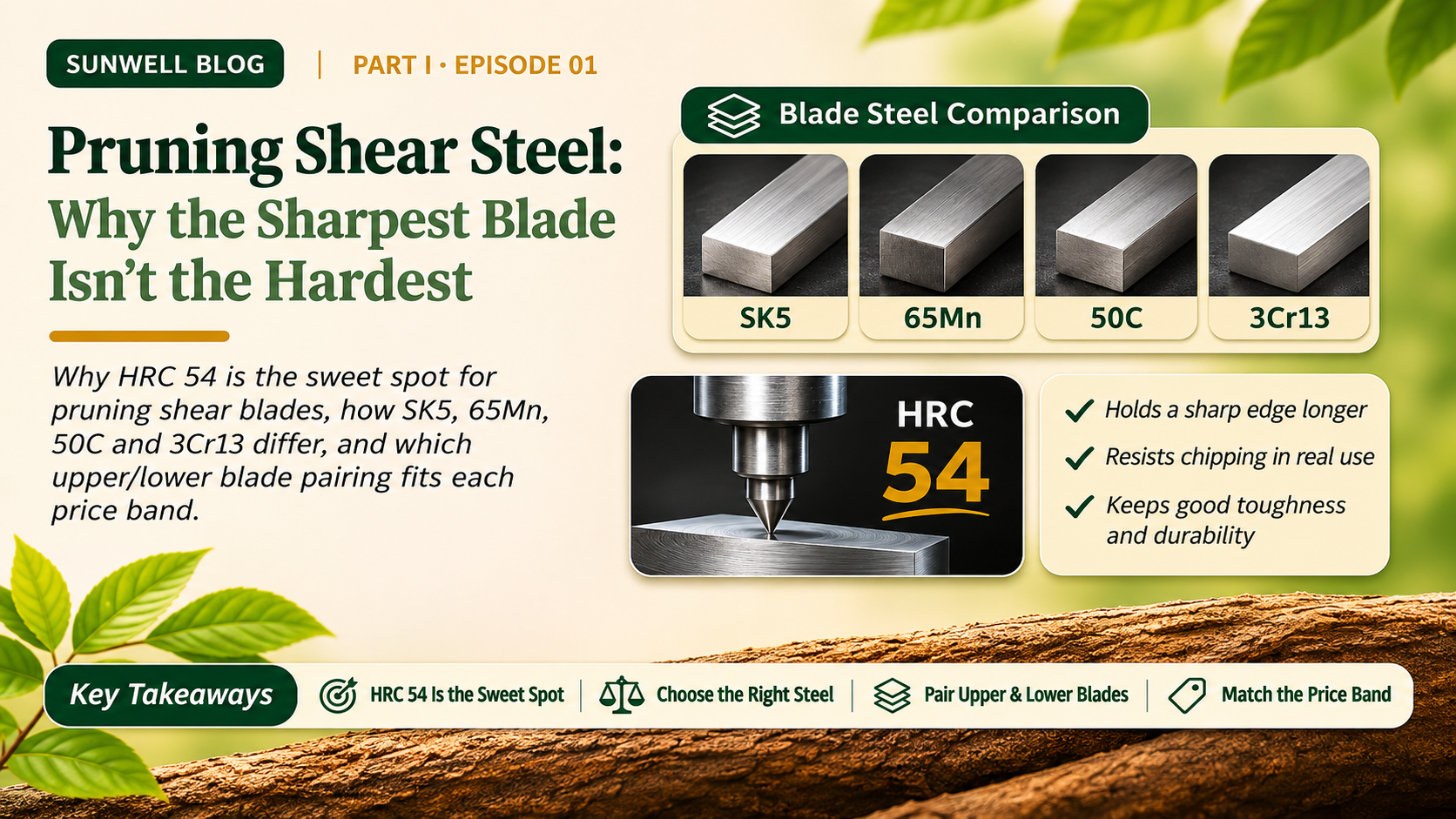
Which grade belongs on which blade position is a separate decision. See The Steel: Why the Sharpest Blade Isn't the Hardest.
Can Hardness Be Checked Without Damaging the Blade?
Rockwell testing leaves a small indentation, normally placed in a non-critical area of the blade or on a coupon from the same batch.
Destructive sectioning — cutting a blade open to look at the grain — is used for process validation, not for routine inspection.
Why Do Some Blades Chip Instead of Dulling?
Chipping usually means hardness above the intended window, coarse grain from overheating, or an edge angle too thin for the material being cut.
The first two are heat-treatment issues; the third is a geometry issue — and it is worth knowing which one your supplier is blaming.
Is a Higher HRC Always a Longer-Lasting Blade?
No. Beyond roughly HRC 56–58, chipping becomes the dominant failure mode and effective edge life falls even as the number rises. Hardness is a trade-off curve, not a score.
Does Per-Blade Inspection Slow Down Delivery?
It adds inspection time to each batch. In most programmes it is absorbed into the production schedule rather than the lead time — the cost shows up in unit price, not in weeks.
What If My Target Retail Price Cannot Carry Per-Blade Inspection?
Then specify a sampling plan and demand the furnace log instead. A value line can be honestly made with sampling, as long as nobody describes it as per-blade inspection in the marketing.
Verifying Hardness, Blade by Blade
SUNWELL has run in-house heat treatment for decades: continuous furnaces with a fixed curve per zone, and Rockwell inspection on every cutting blade to a ±2 HRC window.
Hardness records can travel with the shipment for programmes that require them.
If you are qualifying a new supplier — or auditing an existing one — send us the specification you are working to.
We will tell you which parts of it are testable, and which parts are still a claim.
NEXT IN THE SERIES
The Structure — why a spring that flies out writes its own one-star review.
Upcoming topic: Pruning Shear Spring, Lock and Pivot.