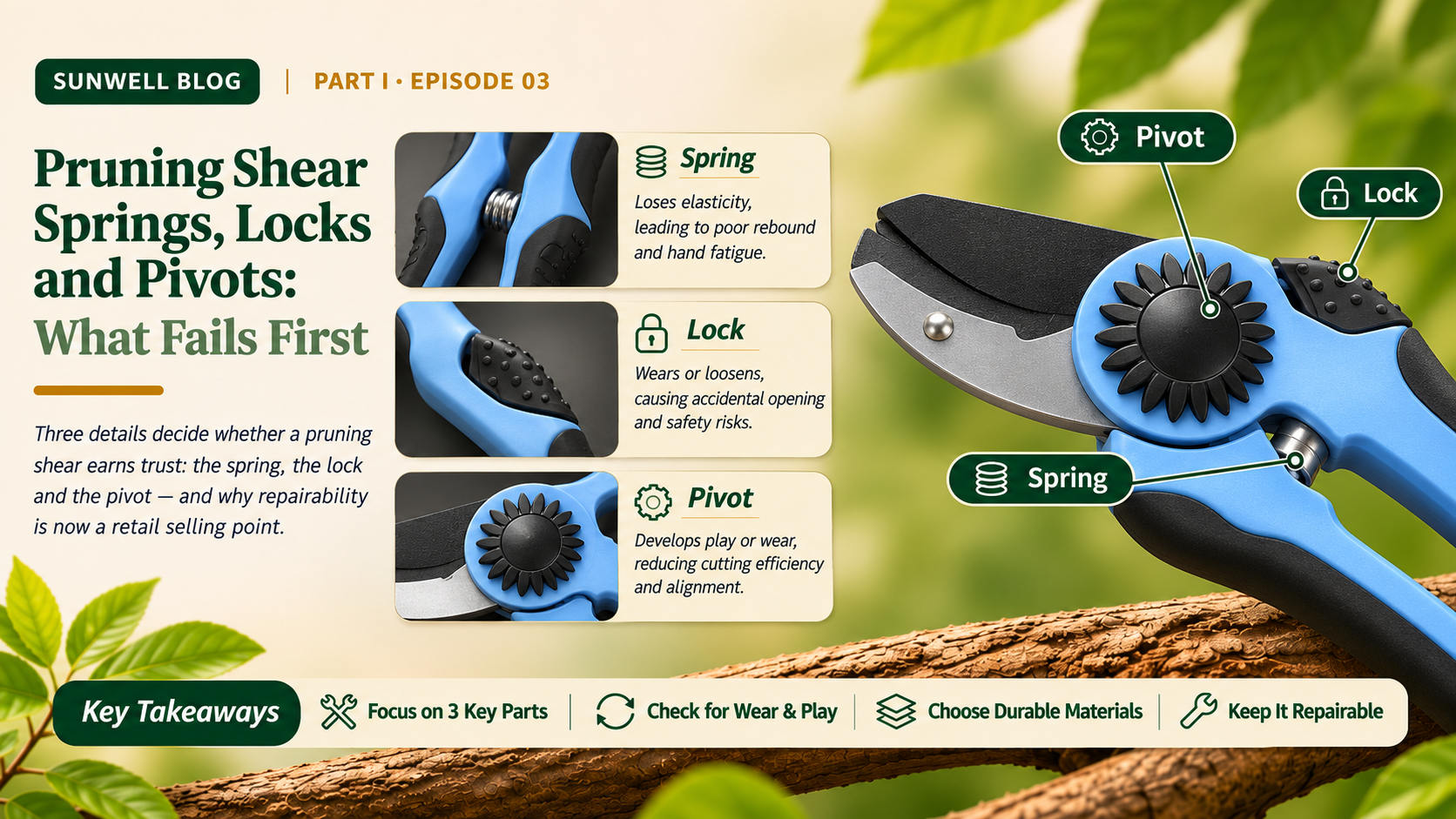
What makes pruning shears reliable beyond blade sharpness? Compare spring designs, safety locks, pivot assemblies and repairability, with a practical checklist for B2B buyers and OEM/ODM sourcing.
SUNWELL | GARDEN SHEAR ENGINEERING
PART I · EPISODE 03 · THE STRUCTURE
Pruning Shear Springs, Locks and Pivots: What Fails First
A spring that pops out into the grass writes a one-star review by itself. Nobody has ever praised a lock that worked; thousands have described one that opened inside a bag.
Part I · The third of six details your customers judge
Spring
Pops out under tension and is lost in grass — a two-cent part ends the tool.
Lock
Opens inside a bag, then refuses to stay shut mid-task.
Pivot
Gap drifts by microns; stems get crushed instead of sliced.
Quick Answer
Three structural details decide whether a pruning shear keeps its reputation: the spring (internal, sealed, or external and losable), the lock (one-handed, blind-operable, and unable to open by accident), and the pivot (a blade gap thinner than a credit card, held by a thread-locked assembly).
The fourth detail is the one that sells in Europe: can it be taken apart and repaired?
Replaceable blades, springs and bumpers turn a one-season tool into a ten-year tool — and turn spare parts into a reason to buy the brand again.
Detail One: The Spring
There are two ways to return a shear to the open position, and they behave very differently in the garden.
Two Ways to Return a Shear
| Aspect | External Coil Spring | Internal Volute Spring |
|---|---|---|
| Position | Hangs between the handles, fully exposed. | Housed inside the handle. |
| Exposure | Sap, soil and grit collect in the coils. | Sealed from debris. |
| Failure Mode | Pops out under tension and is lost in grass; or fatigues and stops returning. | Rarely fails; protected from impact. |
| Serviceability | Easy to replace — which is also why it is expected to be replaced. | Replaceable as a handle assembly on repairable designs. |
| User Perception | "Cheap", "the spring keeps flying off". | Invisible, therefore never reviewed. |
The external spring is not a manufacturing mistake; it is a cost decision.
It is also one of the most frequently quoted complaints in the category — and the complaint is not about performance, it is about an event: the moment the tool becomes unusable because a two-cent part is now somewhere in the lawn.
An internal volute spring — a tapered coil that compresses into itself — solves the event.
It also changes the feel: a tapered coil provides a more even return force through the stroke, which matters for users cutting for an hour rather than a minute.
Detail Two: The Lock
A shear lock has two jobs and they pull in opposite directions: it must open easily when the user wants it, and never open when the user does not.
What a Usable Lock Looks Like
- Thumb-operated slide. One hand, mid-task, no looking, no gripping the handles together to release it.
- Positive detent. It clicks into open and closed positions instead of relying on friction.
- Recessed or shielded. Nothing in a tool bag can catch the tab and slide it.
- Serviceable. If it wears, it should be replaceable, not a reason to discard the tool.
What an Unusable Lock Looks Like
A small metal loop that engages after every few cuts and must be manually released, or a friction tab that opens when the shear is dropped into a bag.
Both appear in published reviews of otherwise well-made tools — which tells you that the lock is designed late, as an accessory, rather than early, as part of the structure.
Design consideration: The locking mechanism should be considered during product development, not added only after the blade and handle structure has been finalized.
Detail Three: The Pivot
The pivot is where precision actually lives.
It sets the gap between the blades — thinner than a credit card — and that gap decides everything about how the tool cuts.
The Blade Gap and What Users Report
| Gap Condition | What Happens | What the User Reports |
|---|---|---|
| Too Tight | Blades bind and grind; the spring cannot return them. | "Stiff", "hard to open", "the spring is weak". |
| Too Loose | Blades separate under load; stems are crushed rather than sliced. | "Crushes stems", "chews the branch". |
| Correct, but Unsecured | Gap drifts over weeks of use. | "Was great for a month". |
The fix is unglamorous: a precision bolt, a locking nut or nylon insert, and thread-locker applied at assembly — so the gap survives tens of thousands of cuts.
On cheaper tools the bolt is a plain rivet or a bolt without a locking element, and the tool develops play.
On better tools it is a serviceable assembly the user can adjust with a coin or a hex key.
Useful Sample Evaluation Test: Cut 200 mixed branches, then check for play at the pivot and re-check the blade gap.
Most pivot problems appear in the first afternoon of real use, not in the first cut.
The Fourth Detail: Can It Be Taken Apart?
In Europe this has moved from a nice-to-have to a purchasing criterion.
Around 70% of European consumers say they consider environmental impact when buying home and garden products (Statista, cited via MarketDataForecast ) — and repairability is the most concrete way a garden tool can express it.
The commercial logic is well established in this category: one professional brand has built three decades of loyalty on a catalogue of replaceable parts, and a user can keep the same pair of shears for decades by replacing blades, springs and bumpers as they wear.
Four Benefits of Repairable Design for Private-Label Brands
A Longer Relationship. The customer returns to the brand for parts, not to a competitor for a new tool.
A Retail Story. "Serviceable, spare parts available" is a shelf message that competitors using sealed rivets cannot copy quickly.
A Returns Buffer. A blade that dulls in year three is a spare-part sale, not a warranty claim.
A Compliance Head Start. Repairability requirements for consumer products are tightening across the EU, and a design that already separates blades and springs is easier to document.
The cost is real: modular parts mean more tooling, tighter assembly tolerances, and a packaging decision (does the carton explain the parts programme?).
It is a strategic choice, not a free upgrade — but it is one of the few structural choices that shows up in both review scores and margin.
B2B Purchasing Consideration: A repairable pruning shear design should be evaluated alongside spare-parts availability, warranty arrangements, tooling investment and the intended retail market.
What to Specify
For the structure section of a pruning shear RFQ:
- Spring Type — external coil or internal volute, and expected cycle life.
- Lock Action — thumb slide, detent positions, and a drop/bag test criterion.
- Pivot Assembly — bolt grade, locking method, thread-locker, and target blade gap with tolerance.
- Serviceability — which components are user-replaceable, with what tools, and whether spares will be offered.
- Cycle Test — a stated number of cuts followed by a play and gap check.
Buyers should confirm these requirements with the supplier before approving product samples or mass production.
Frequently Asked Questions
Why Does My Pruner's Spring Keep Popping Out?
Because it is an external coil spring held under tension between the handles. Once it slips past its seat it is gone.
Internal volute springs are sealed inside the handle and do not have this failure mode.
Can a Worn Spring Be Replaced?
On repairable designs, yes — as a spring or handle-assembly part.
On sealed designs the tool is usually discarded, which is why the spring type belongs in the specification.
How Tight Should the Pivot Bolt Be?
Tight enough that the blades meet along their full length with a gap thinner than a credit card, and free enough that the spring returns them without assistance.
The setting should be repeatable and locked, not adjusted by feel on the line.
What Causes a Pruner to Crush Stems Instead of Cutting Them?
Usually a pivot that has developed play, or a lower blade that no longer meets the upper blade along its length.
Blade geometry matters too. See the related guide on bypass and anvil pruning shear designs.
Is a Repairable Shear More Expensive to Make?
Yes, typically: more parts, tighter tolerances and a spare-parts programme.
It is usually offset by lower warranty exposure and a stronger retail proposition in markets where repairability is valued.
Designing a Structure That Survives the Review Page
SUNWELL develops shear structures from the failure modes backwards — internal spring options, one-thumb locks, thread-locked pivots and modular assemblies that can be serviced rather than scrapped.
Tooling and product development are handled in-house, so a structural change can be evaluated together with its cost.
Tell us the failure modes your current range receives in reviews, and we will map them to structural changes.