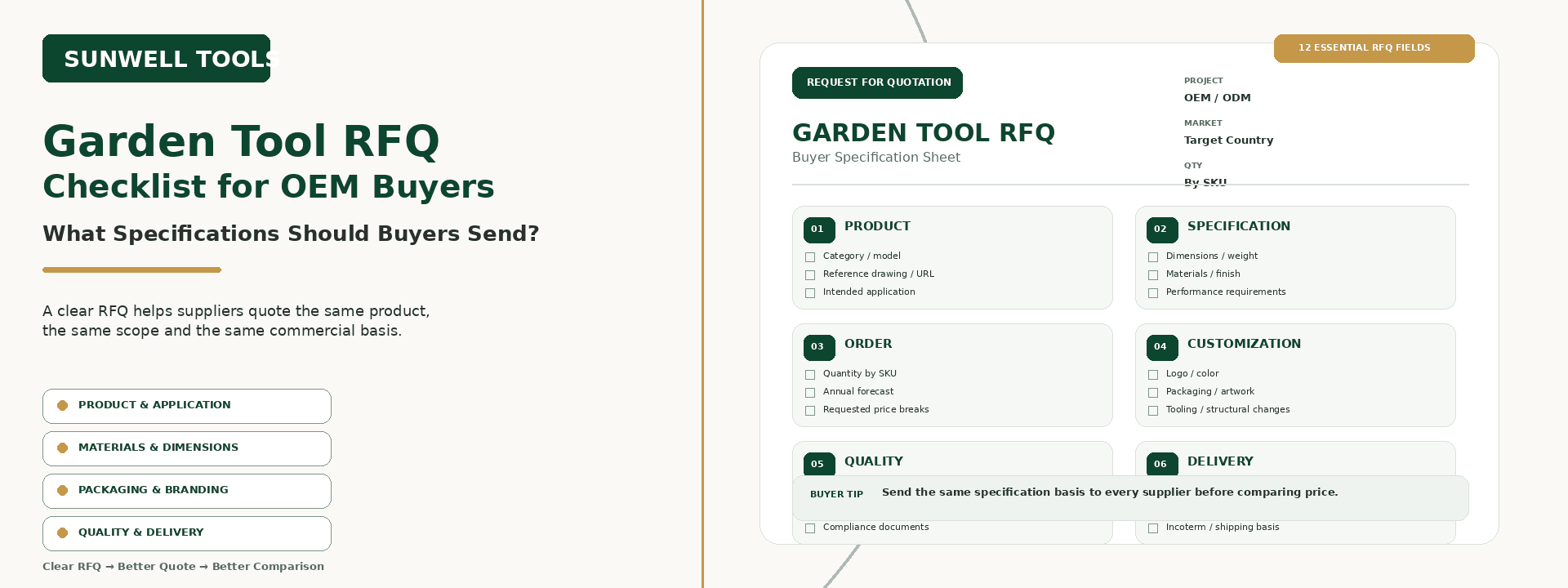
What information should buyers send when requesting a garden tool quotation? This practical B2B RFQ checklist covers product specifications, materials, order quantities, OEM/ODM customization, packaging, testing, delivery requirements and a ready-to-use supplier inquiry template.
Garden Tool RFQ Checklist: What Specifications Should Buyers Send?
A supplier cannot prepare an accurate garden tool quotation from a product photograph and a target price alone.
For importers, distributors, retail chains and private-label brands, a well-prepared garden tool RFQ helps manufacturers understand the product, evaluate manufacturing requirements and identify the information needed before providing a quotation.
However, many sourcing inquiries still arrive with unclear specifications, missing quantities, incomplete packaging requirements or unspecified quality expectations.
These gaps can create quotations that are difficult to compare. They may also lead to additional engineering discussions, sample revisions or unexpected cost adjustments.
This guide provides a practical garden tool RFQ checklist, category-specific specification tables, a ready-to-use inquiry template and a framework for comparing supplier quotations.
Quick Answer: What Should Buyers Include in a Garden Tool RFQ?
A complete RFQ should clearly describe:
- Product name, category and intended use
- Drawings, reference samples or product links
- Dimensions, materials and technical specifications
- Expected order quantity and SKU breakdown
- OEM/ODM customization requirements
- Packaging, branding and labeling requirements
- Applicable testing and quality expectations
- Destination market and required delivery schedule
- Commercial terms and quotation format
The more precisely these details are defined, the easier it is for manufacturers to assess feasibility and prepare comparable quotations.
Why Does a Complete Garden Tool RFQ Matter for B2B Buyers?
An RFQ, or Request for Quotation, is a structured request sent to a manufacturer or supplier to obtain pricing and project information for a defined purchasing requirement.
In garden-tool sourcing, different specifications can lead to substantially different manufacturing costs.
Consider two pruning shears with similar external appearances.
One may use a different blade steel, handle material, surface treatment or locking mechanism from the other. Those differences may affect production methods, tooling, testing and unit pricing.
If a buyer simply requests "your best price for pruning shears", suppliers may quote products with different materials or performance levels.
The resulting prices cannot be compared fairly.
What a Well-Prepared RFQ Helps Achieve
- More consistent supplier quotations
- Faster identification of missing specifications
- Better alignment between product requirements and production processes
- Clearer sample-development expectations
- More accurate production planning
- Reduced risk of misunderstandings after order placement
B2B sourcing principle: The objective of an RFQ is not only to obtain a low price. It is to make sure every supplier is quoting the product and commercial requirements the buyer actually needs.
For an overview of how a quotation becomes an OEM/ODM manufacturing order, see SUNWELL Garden Tool OEM/ODM Process: From Inquiry to Shipment .
The 12 Essential Information Fields in a Garden Tool RFQ
The following checklist can be used as the starting point for most garden-tool purchasing projects.
| RFQ Field | Information to Provide | Why It Matters |
|---|---|---|
| 1. Product Category | Pruning shears, loppers, saws, watering tools, electric tools or other category | Identifies the appropriate product and manufacturing process |
| 2. Product Reference | SKU, model, drawing, photo, sample or reference URL | Reduces uncertainty about the intended product |
| 3. Intended Application | Target user, cutting task, working environment or product function | Supports appropriate model and material selection |
| 4. Dimensions | Length, width, thickness, weight, capacity and critical tolerances | Determines product design and manufacturing requirements |
| 5. Materials | Steel grade, plastic resin, grip material, surface treatment | Affects performance, cost and consistency |
| 6. Quantity | Order quantity by SKU, estimated annual demand and forecast | Supports pricing and capacity evaluation |
| 7. Customization | Logo, color, handle, structure or new-tooling requirements | Defines the OEM/ODM development scope |
| 8. Packaging | Retail packaging, master carton, barcode, artwork and labeling | Affects cost, presentation and logistics |
| 9. Quality Requirements | Inspection criteria, testing requirements and approved standards | Sets measurable acceptance expectations |
| 10. Target Market | Destination country or region and applicable requirements | Helps identify market-specific compliance needs |
| 11. Delivery | Required shipment or arrival date, destination and shipping basis | Supports a realistic production schedule |
| 12. Commercial Request | Currency, price breaks, tooling charges and requested quotation validity | Creates a consistent basis for comparison |
Not every project requires every detail at the first inquiry.
For a standard catalog product, a model number, quantity, packaging and target market may provide enough information to begin the discussion.
A completely new OEM design usually requires a more detailed technical package.
What Drawings and Product References Should Buyers Send With an RFQ?
The type of reference material depends on whether the buyer is sourcing an existing product or developing a new one.
For Existing Garden Tool Models
Buyers may provide:
- Supplier model number or SKU
- Link to the relevant product page
- Product photographs from several angles
- Requested color or material variations
- Reference sample information
- Expected quantity for each version
If the request is based on an existing manufacturer model, the buyer should identify which specifications must remain unchanged and which details may be customized.
For Custom OEM Product Development
A technical RFQ may require:
- 2D engineering drawings
- 3D files, such as STEP files, when available
- Bill of materials (BOM)
- Critical dimensions and tolerances
- Materials and performance specifications
- Assembly requirements
- Surface finish and appearance references
- Expected production quantity
What if the Buyer Does Not Have Complete Drawings?
Buyers can still begin discussions using reference samples, clear photographs, target dimensions and a written description of the required function.
However, the manufacturer may need to complete additional technical evaluation before confirming feasibility and final pricing.
For projects involving new tooling, read Garden Tool Mold Development: From Design to Mass Production .
Product-Specific RFQ Requirements: Pruning Tools, Hand Tools, Electric Tools and Watering Products
Different garden tool categories require different technical information.
A manufacturer may need blade specifications for pruning shears, motor and electrical information for power tools, or pressure and sealing information for watering products.
| Product Category | Important RFQ Specifications | Additional Questions |
|---|---|---|
| Pruning Shears & Loppers | Cutting mechanism, blade material, cutting capacity, overall length, handle material and locking mechanism | Is the tool intended for live or dry wood? Are specific cutting tests required? |
| Garden Hand Tools | Head material, thickness, dimensions, handle construction, surface treatment and weight | Is the product for general gardening, professional landscaping or a specific task? |
| Electric Garden Tools | Rated voltage, power source, motor-related requirements, battery configuration if applicable, working performance and accessories | Which market requirements, plugs, chargers, manuals and safety tests apply? |
| Hose Reels & Watering Products | Hose length, hose diameter, working-pressure requirement, connection type, housing material, retraction mechanism where applicable | Which connector standard, leakage criteria, temperature conditions and packaging requirements apply? |
Example: RFQ for Pruning Shears
A pruning shear RFQ should describe more than the product name or a reference photograph.
Useful information includes:
- Bypass, anvil or ratchet mechanism
- Required cutting capacity
- Blade steel and surface finish
- Handle material and grip design
- Overall dimensions and weight target
- Safety lock and spring requirements
- Intended customer and retail market
Buyers can also explore the SUNWELL Pruning Shears Collection when selecting reference models.
Example: RFQ for Electric Garden Tools
Electric products often need a more detailed technical and compliance review.
In addition to model and quantity, the inquiry should identify the intended power source, relevant operating specifications, target market and accessory requirements.
If the product uses a battery, the buyer should confirm the intended battery configuration, charger requirements and applicable transport or safety documentation.
Important: These category specifications are RFQ guidance, not a claim that every available SUNWELL model supports every listed configuration. Product-specific capabilities should be confirmed before quotation.
How Should Buyers Specify Materials and Product Performance?
Material selection can affect a garden tool's functionality, durability, appearance, manufacturing process and cost.
Buyers should identify which requirements are mandatory and which allow the manufacturer to recommend alternatives.
Material Information to Include
- Required material grade, when specified
- Material thickness or dimensions
- Heat-treatment requirements for applicable components
- Surface coating or finish
- Color and visual appearance
- Required mechanical or functional performance
- Applicable environmental or corrosion-resistance requirements
For example, a buyer may request a specific steel grade for a pruning shear blade or may instead provide a cutting-performance requirement and ask the supplier to recommend an appropriate material.
These two purchasing approaches should be clearly distinguished.
Fixed Specification vs Performance-Based Specification
Fixed specification: The buyer identifies the exact material or component that must be used.
Performance-based specification: The buyer defines the required function or test result and allows the manufacturer to propose a suitable solution.
Both approaches can be valid, but the quotation should state which requirements are fixed and which alternatives may be considered.
What OEM/ODM Customization Details Should Be Included in the RFQ?
Private-label buyers often need products that reflect their brand identity or retail positioning.
However, not all customization has the same manufacturing impact.
Common Customization Requirements
- Logo placement and marking method
- Product color or Pantone reference
- Handle or grip material
- Surface finish or coating
- Packaging design
- Product instructions or languages
- Component or structural modifications
- New mold or tooling requirements
A logo or packaging change to an existing product may require less development than redesigning the structure of a cutting mechanism or housing.
For that reason, buyers should separate cosmetic customization from functional modification.
| Customization Type | Information to Send | Potential Project Impact |
|---|---|---|
| Logo | Vector artwork, dimensions and position | Marking method and approval |
| Color | Color reference and affected components | Material matching and sample verification |
| Packaging | Artwork, packaging structure and labeling | Printing, setup and purchasing requirements |
| Material Change | Required grade, function or test specification | Engineering and performance evaluation |
| Structural Change | Revised drawing or reference sample | Tooling, sampling and validation |
Before requesting a quotation, buyers should also identify which customization elements are essential to the launch and which can be considered in a later product revision.
How Should Buyers Define Quality, Testing and Compliance Requirements?
A supplier quotation should reflect the quality requirements of the actual product, not only its appearance.
Buyers should describe any special inspection criteria, performance tests and documentation expected before shipment.
Information to Provide
- Destination country or market
- Applicable product requirements identified by the buyer
- Required performance tests
- Critical dimensions and tolerances
- Appearance and finish requirements
- Inspection and sampling requirements
- Third-party inspection requirements where applicable
- Required test reports or compliance documentation
Example: Quality Requirements for Manual Cutting Tools
A pruning shear program may specify cutting performance, blade alignment, handle strength, lock function, surface condition and durability criteria.
Where the buyer needs a particular testing method or acceptance threshold, that information should be documented in the RFQ or an attached specification.
Compliance reminder: Product requirements vary by destination market and product category. Buyers should identify the relevant requirements and verify that any supplied reports correspond to the actual product configuration.
Learn more about inspection and testing in SUNWELL Quality Control: From Raw Material to Finished Product .
How Should Buyers Present Order Quantities and Pricing Requirements?
Quantity information helps manufacturers evaluate material purchasing, production planning and pricing.
Instead of providing only a combined order volume, buyers should indicate the expected quantity for each product or SKU.
Recommended Quantity Information
- Initial order quantity by SKU
- Number of color or packaging variations
- Expected repeat-order quantity
- Estimated annual demand, if available
- Requested price breaks for alternative quantities
- Target order schedule
Example of a Quantity Breakdown
| Item | Product | Initial Quantity | Requested Quote |
|---|---|---|---|
| A | Bypass pruning shear | 1,000 pcs | 1,000 / 2,000 pcs |
| B | Garden lopper | 500 pcs | 500 / 1,000 pcs |
| C | Garden hand tool | 1,000 pcs | 1,000 / 2,000 pcs |
The quantities above are illustrative RFQ examples, not SUNWELL's confirmed minimum order quantities.
Buyers should request confirmation of MOQ for each exact model and customization level.
Quotation comparisons should also identify whether suppliers include packaging, special testing, tooling or other project-specific costs.
How Should Buyers Specify Packaging and Labeling Requirements?
Packaging is an important part of garden-tool product development, particularly for retail and private-label programs.
Different packaging formats may have different material, printing and assembly requirements.
Packaging Information to Include
- Retail packaging type
- Product quantity per retail pack
- Logo and approved artwork
- Barcode and item identification
- Required language versions
- Instructions and safety information
- Inner-carton and master-carton requirements
- Carton labeling
- Any agreed packaging tests
For example, a garden tool intended for a retail chain may require a specific hanging-card design, barcode placement and multilingual packaging.
A distributor may instead prefer simpler packaging for warehouse distribution.
If the final artwork is not yet available, buyers should identify the packaging concept and request a separate confirmation before approval.
Practical Packaging Tip
Packaging should be included in the quotation discussion from the beginning.
Changing from a simple bulk package to a printed retail package after pricing can affect cost, MOQ, sampling and production planning.
What Delivery and Shipping Information Should Be Included in a Garden Tool RFQ?
A product quotation should be connected to the buyer's purchasing and delivery schedule.
For seasonal garden tools, delayed production can affect the planned retail launch period.
Buyers should therefore distinguish between the required factory shipment date and the required arrival date at the destination.
Delivery Information to Include
- Destination country and location
- Preferred shipment method
- Requested Incoterm and named place or port
- Target factory shipment date
- Target warehouse arrival date, if applicable
- Expected inspection schedule
- Packing and shipment documentation requirements
- Any restrictions on partial deliveries
Buyers should also clarify which approvals are needed before the production schedule can be finalized.
For a new OEM/ODM product, development, tooling and sample approval can affect the total project timeline.
For more information about production coordination, see SUNWELL Production Capacity and Lead-Time Planning .
Ready-to-Use Garden Tool RFQ Template for OEM/ODM Buyers
The following template can be copied into an email or adapted into a purchasing spreadsheet.
It is suitable for importers, distributors, retailers and private-label brands requesting a quotation from a garden-tool manufacturer.
Subject: RFQ – Garden Tools OEM/ODM Project – [Company Name]

Dear Sales Team,

We are sourcing garden tools for our
[market/country] business and would like
to request a quotation.

Please review the requirements below.

1. COMPANY INFORMATION

Company:
Country:
Business Type:
Target Market:
Contact Person:

2. PRODUCT INFORMATION

Product Category:
Product Name / Model:
Reference Link or Drawing:
Intended Application:
Required Dimensions:
Required Materials:
Key Performance Requirements:

3. ORDER QUANTITY

Initial Quantity per SKU:
Number of SKUs:
Estimated Annual Volume:
Requested Price Breaks:

4. CUSTOMIZATION

Logo Requirements:
Product Colors:
Handle or Structural Changes:
Special Materials or Finishes:
New Tooling Required (if known):

5. PACKAGING

Retail Packaging Type:
Logo / Artwork:
Barcode:
Required Languages:
Master Carton Requirements:

6. QUALITY & COMPLIANCE

Destination Market:
Required Product Standards:
Testing Requirements:
Inspection Requirements:
Required Documents:

7. DELIVERY

Requested Shipment Date:
Destination:
Preferred Incoterm and Named Place:
Shipping Method:

8. QUOTATION REQUEST

Please confirm:

- Available product options
- Product specifications
- MOQ per SKU
- Unit price at requested quantities
- Tooling or development charges
- Sample availability and cost
- Estimated sampling schedule
- Production lead time
- Packaging costs
- Quotation validity
- Payment terms

We can provide additional drawings,
samples or technical specifications
if required.

Please let us know if any information
needs clarification before quotation.

Best regards,

[Name]
[Company]
[Email]
Buyers developing products with confidential drawings may wish to agree on suitable confidentiality arrangements before sharing detailed proprietary technical information.
How to use this template: Replace the bracketed fields, attach the relevant drawings or references, and remove requirements that do not apply to the product.
How Should Buyers Compare Garden Tool Supplier Quotations?
A quotation comparison should not focus only on the lowest unit price.
Suppliers may quote different materials, packaging formats, quantity assumptions or manufacturing scopes.
Those differences can make one quotation appear cheaper even when the products are not equivalent.
| Comparison Item | What to Confirm | Risk if Unclear |
|---|---|---|
| Product Specification | Same dimensions, materials and functions | Different products being compared |
| Unit Price | Price based on the same quantity and terms | Misleading cost comparison |
| MOQ | Minimum quantity by SKU and variation | Unexpected order requirements |
| Tooling | Included or separately quoted | Unplanned development expense |
| Packaging | Same agreed packaging specification | Additional costs or revisions |
| Testing | Tests and documentation included | Compliance or inspection gaps |
| Sampling | Sample type, charges and approval process | Project delays |
| Lead Time | Starting point and production assumptions | Unrealistic delivery expectations |
| Shipping Basis | Incoterm, named location and responsibility | Different logistics costs |
What if Two Suppliers Quote Different Specifications?
Buyers should request clarification rather than immediately comparing the quoted prices.
If a supplier proposes an alternative material or manufacturing method, the buyer should assess whether the change meets the required performance and quality expectations.
Alternative proposals can be useful, but they should be clearly identified and approved separately from the original specification.
Common Garden Tool RFQ Mistakes Buyers Should Avoid
Even experienced sourcing teams can lose time when important information is omitted from an inquiry.
1. Sending Only a Product Photograph
A photo may not show the exact material, dimensions, component structure or performance requirements.
2. Requesting a Price Without Quantities
The supplier needs an estimated quantity to evaluate manufacturing and purchasing requirements.
3. Using Unclear Material Descriptions
Terms such as "high-quality steel" or "premium plastic" are not sufficiently precise for a technical quotation.
4. Forgetting Packaging Requirements
Retail packaging, color printing and labeling can affect the quotation and production schedule.
5. Omitting the Target Market
Suppliers need to know where the product will be sold to discuss applicable compliance and labeling requirements.
6. Changing Requirements Without Updating the RFQ
A revised material, dimension or package should be reflected in an updated specification.
7. Comparing Prices With Different Commercial Terms
Quotations based on different Incoterms, quantities or tooling assumptions should not be treated as directly equivalent.
A clear RFQ is especially important for repeat orders.
Maintaining an approved specification and change history can help prevent differences between production batches.
How to Prepare an OEM/ODM Garden Tool RFQ for SUNWELL
SUNWELL has focused on garden-tool manufacturing since 1988.
Its product categories include manual garden tools, electric garden tools and garden watering products.
For international B2B buyers, the company supports discussions covering product selection, technical specifications, customization, sampling, quality requirements and production planning.
Step 1: Identify the Product
Buyers can start from an existing SUNWELL product or provide their own reference model or drawing.
The inquiry should identify the desired product category, intended application and any mandatory specifications.
Step 2: Define the Purchasing Scope
Provide the expected quantities, number of SKUs, customization requirements, packaging information and target market.
If some technical details have not yet been finalized, identify them as open requirements instead of presenting assumptions as confirmed specifications.
Step 3: Confirm Quality and Production Requirements
Identify any special performance tests, documentation needs, inspection requirements and delivery expectations.
The project team can then review the requirements and clarify the scope before commercial terms are finalized.
Step 4: Review Samples and Approved Specifications
When sampling is required, buyers should confirm the sample configuration, approval criteria and any changes needed before mass production.
The approved specification should remain consistent with the quotation and subsequent purchase order.
Frequently Asked Questions About Garden Tool RFQs
What is an RFQ in garden tool sourcing?
An RFQ is a request for quotation that describes a buyer's product, quantity, customization, quality and commercial requirements so suppliers can prepare pricing and project proposals.
Can I request a garden tool quotation without technical drawings?
Yes. Buyers can often begin with an existing model number, product link, photographs or a physical reference sample. Complex custom projects may require additional drawings before final pricing.
Should I include the target order quantity in my RFQ?
Yes. Quantity is important for material purchasing, production planning and quotation calculations. Buyers should provide estimated quantities by SKU whenever possible.
What is the difference between an OEM RFQ and a standard wholesale inquiry?
A standard wholesale inquiry often refers to an existing product with defined specifications. An OEM RFQ may include custom drawings, materials, tooling, branding or development requirements.
Should packaging be included before requesting a quotation?
Yes. Packaging can affect pricing, MOQ, labeling requirements and production planning. Buyers should provide at least the intended packaging format when final artwork is not yet available.
How can I compare garden tool quotations from different suppliers?
Compare quotations using the same product specification, quantity, packaging, testing requirements, delivery basis and commercial assumptions. Clarify any differences before making a purchasing decision.
Final Thoughts: A Clear RFQ Is the Foundation of a Reliable Garden Tool Order
A successful garden-tool sourcing project starts with clear purchasing and technical information.
The more precisely buyers define their product specifications, quantities, customization, packaging, quality expectations and delivery requirements, the easier it becomes to evaluate manufacturing options.
A complete RFQ also makes supplier quotations more transparent and easier to compare.
For standard products, buyers can begin with the appropriate model, quantity and packaging details.
For custom OEM/ODM projects, additional drawings, material specifications, samples and testing criteria may be necessary.
In both cases, the goal is the same: establish a clear, documented product requirement before committing to mass production.
Send Your Garden Tool RFQ to SUNWELL
Planning a wholesale, private-label or OEM/ODM garden-tool project?
Share your product category, drawings or reference models, materials, quantities, customization, packaging requirements, target market and delivery schedule.
SUNWELL can review the requirements, discuss suitable product and manufacturing options, and clarify the information needed for a project-specific quotation.
Start with clear specifications. Build toward consistent production.
Request a Quotation → Explore OEM/ODM Solutions →