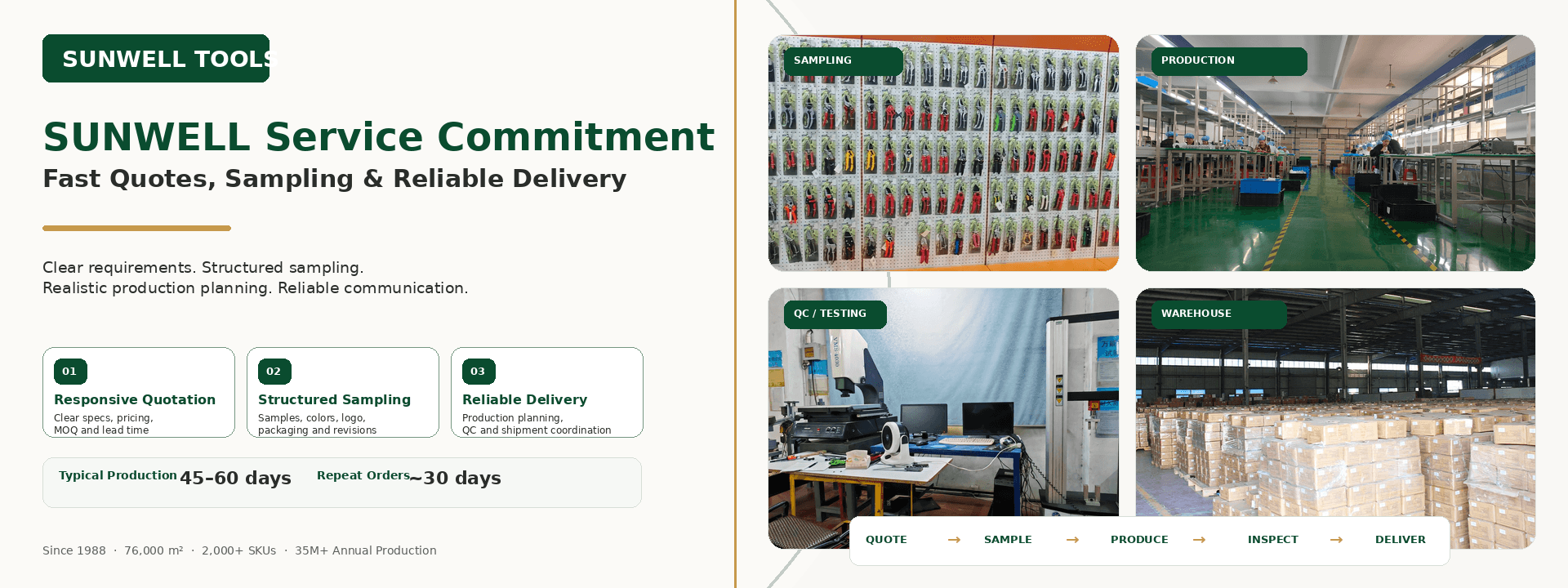
Garden Tool Supplier Service: What B2B Buyers Can Expect from RFQ to After-Sales
On This Page
For B2B garden-tool buyers, product specifications and price are only part of a successful sourcing program.
Quotation communication, sampling, production visibility, quality coordination, shipment preparation and after-sales follow-up can all influence whether a project moves smoothly from RFQ to final delivery.
SUNWELL has focused on garden-tool manufacturing since 1988 and supports retailers, distributors, importers and private-label brands across manual garden tools, electric garden tools and garden watering products.
This guide explains what buyers can expect from SUNWELL's garden tool supplier service during an OEM, ODM or private-label project.
The focus is not simply on how an order moves through a factory, but on how communication, specifications, production information and quality requirements are coordinated throughout the sourcing relationship.
Quick Answer: What Should B2B Buyers Expect from a Garden Tool Supplier?
A reliable garden tool supplier should provide more than a product quotation.
Buyers should be able to receive clear commercial information, structured sample coordination, confirmed product specifications, production-status communication, quality and inspection coordination, shipment preparation support and follow-up for repeat orders or quality feedback.
The exact timing and level of support depend on the product and project, but the objective should remain the same: keep the buyer informed and keep the approved product requirements aligned from RFQ through delivery.
Six Core Service Expectations for B2B Garden Tool Buyers
Service Expectation #1 — Clear RFQ & Quotation Communication
A useful B2B quotation should make it clear what product and specification the buyer is actually being quoted.
If important product details are missing, a supplier may need to clarify the requirement before preparing a final commercial proposal.
Information Buyers Can Provide
- Product name or reference image
- Target market or destination country
- Estimated order quantity
- Required materials or product specifications
- Logo and branding requirements
- Color requirements
- Packaging requirements
- Applicable testing or compliance requirements
- Target price position
- Target delivery period
What a Quotation May Need to Clarify
- Proposed product model
- Pricing basis
- MOQ
- Material specifications
- Customization scope
- Tooling cost where applicable
- Sample requirements
- Packaging
- Production planning
- Trade terms
- Payment terms
Service Expectation #2 — Structured Sampling & Specification Control
Sampling allows the buyer to evaluate the physical product before mass production.
The required sample process depends on whether the project uses an existing product, a private-label modification or a newly developed OEM/ODM product.
Common Sample Types
- Standard reference samples
- Color samples
- Logo samples
- Packaging samples
- Existing products with selected modifications
- Customized prototypes
- Pre-production samples where applicable
What Can Be Confirmed During Sampling?
- Product dimensions
- Materials
- Color
- Logo placement
- Surface finish
- Function and performance
- Packaging artwork
- Labels and instructions
- Applicable accessories
Once a sample or final specification is approved, it can become an important reference for production.
Service Expectation #3 — Production Progress Visibility
After an OEM/ODM order enters production, buyers may need more than a promised completion date.
For applicable projects, the responsible sales or order-management team can coordinate production-related information between the buyer and manufacturing departments.
Production Information Can Include
The exact level and frequency of updates depend on the project, but production visibility is especially useful for seasonal programs or launches with a fixed retail window.
Service Expectation #4 — Quality & Inspection Coordination
Quality requirements should be discussed before products are ready for shipment.
Different garden-tool categories have different inspection priorities, so the applicable requirements should be based on the product specification and buyer expectations.
Quality Coordination May Cover
- Raw-material requirements
- Dimensions and appearance
- Cutting or functional performance
- Assembly
- Surface treatment
- Electrical or battery-related checks where applicable
- Hose or connector performance where applicable
- Packaging integrity
- Labels and barcodes
- Order quantity and SKU mix
Depending on the project and buyer procedure, third-party inspection can also be arranged.
Service Expectation #5 — Shipping & Delivery Coordination
Production completion and final delivery are not the same stage.
Once applicable production and inspection requirements are complete, the order still needs packaging, shipping documents and logistics coordination.
Shipment Preparation Can Include
- Final packaging confirmation
- Shipping marks
- Carton preparation
- Commercial invoice
- Packing list
- Bill of lading where applicable
- Applicable certificate documentation
- Inspection documents where required
- Coordination with nominated or agreed logistics providers
What Can Affect the Delivery Schedule?
- Order quantity
- Number of SKUs
- Material availability
- Customization level
- New tooling
- Testing requirements
- Packaging readiness
- Factory production scheduling
- Carrier schedules
- International logistics conditions
For this reason, production and delivery timing should be confirmed according to the specific project rather than relying on one fixed lead-time figure for every product.
What Should Happen When a Timeline Changes?
Manufacturing projects do not always follow the original schedule without adjustment.
A timeline may change because of:
- Raw-material availability
- Product-design revisions
- New tooling changes
- Sample revisions
- Unexpected quality findings
- Packaging artwork delays
- Third-party testing
- Production scheduling changes
- Shipping or logistics changes
When a schedule risk is identified, the most useful service response is clear and early communication.
Buyers Should Be Able to Understand
- What changed
- Why it changed
- Which part of the schedule is affected
- Whether an alternative solution is available
- What the updated timing is expected to be
Seasonal Planning for Garden Tool Buyers
Garden-tool demand can be seasonal, particularly for pruning, lawn-care and watering programs.
Buyers working toward a spring or summer retail launch should allow enough time for product selection, sampling, packaging confirmation, manufacturing and international transportation.
| Planning Stage | Recommended Buyer Action |
|---|---|
| Product Planning | Select key categories, target price positions and priority SKUs before peak ordering periods. |
| Sampling | Allow time for product evaluation and applicable revisions. |
| Packaging | Confirm artwork, barcodes, labels and retail requirements before mass production. |
| Production | Discuss the required completion target based on the intended retail launch. |
| Shipping | Allow sufficient international transit and customs time before the selling season. |
| Repeat Orders | Maintain approved specifications and packaging files to simplify future orders. |
Earlier planning can provide more flexibility when a project includes product development, packaging revisions, multiple SKUs or additional testing requirements.
Service Expectation #6 — After-Sales & Repeat-Order Support
A B2B sourcing relationship does not necessarily end when the shipment leaves the factory.
For ongoing programs, post-shipment communication may be important for both quality management and repeat orders.
After-Sales Support Can Include
- Quality-feedback investigation
- Corrective-action coordination
- Claim handling according to agreed commercial terms
- Product or packaging issue review
- Repeat-order specification management
- Packaging-file retention
- Follow-up on future product development
Why Repeat-Order Records Matter
When an approved product specification, packaging file and order history are retained, repeat orders can often avoid unnecessary reconfirmation of previously approved details.
If a specification changes, the revised requirement should be identified clearly before the next order enters production.
SUNWELL Manufacturing Support for B2B Buyers
SUNWELL has focused on garden-tool manufacturing since 1988.
SUNWELL supports manual garden tools, electric garden tools and garden watering products for international B2B, private-label and OEM/ODM programs.
The objective is to coordinate product requirements, sampling, production information, quality expectations, packaging and shipment preparation through one manufacturing organization.
Learn more about SUNWELL: 38 Years of Garden Tool Manufacturing →
Frequently Asked Questions About Garden Tool Supplier Service
Looking for a Garden Tool Supplier for Your B2B Program?
Whether you are comparing existing products, developing a private-label range or planning an OEM/ODM project, SUNWELL can help evaluate the product and sourcing requirements.
Tell us your target product, destination market, expected order quantity, customization requirements, packaging needs and planned delivery period.
Our team can then review suitable products and coordinate the applicable quotation, sampling, production and quality requirements for the project.
Clear communication. Structured sampling. Production visibility. Quality coordination. Ongoing sourcing support.
Explore SUNWELL Products → Request a Quote →