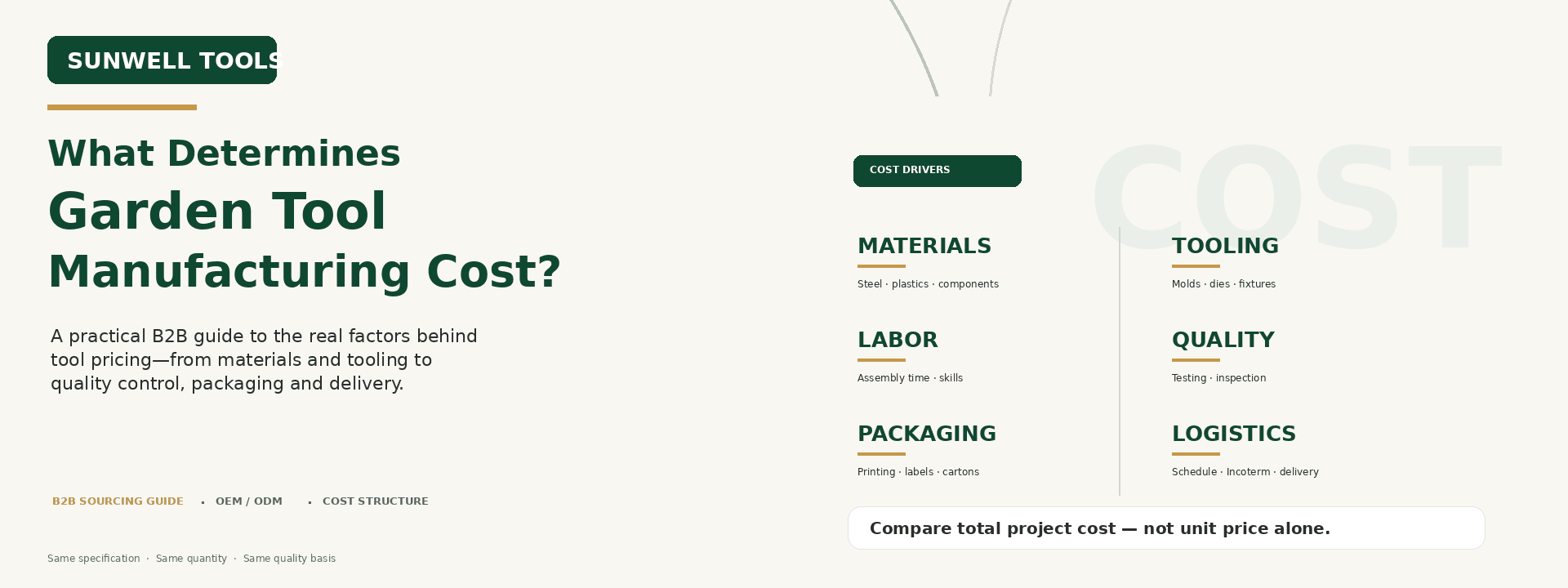
Why do garden tools with similar designs have different manufacturing costs? This B2B guide explains how raw materials, production processes, tooling, order volume, OEM/ODM customization, quality testing and packaging affect supplier quotations—and how buyers can compare costs more effectively.
What Determines Garden Tool Manufacturing Cost?
Why can two garden tools with nearly identical appearances receive very different manufacturing quotations?
For importers, distributors, retail chains and private-label brands, the answer involves much more than raw material prices.
Garden tool manufacturing cost depends on product design, materials, production processes, tooling, order volume, labor, customization, quality requirements and packaging.
A pruning shear using a different blade steel or heat-treatment process may require different manufacturing costs even when its appearance is similar.
Likewise, two retractable hose reels with comparable external designs may differ in hose specifications, internal components, retraction systems and performance requirements.
Understanding these factors helps B2B buyers evaluate quotations, control project expenses and avoid choosing products based on unit price alone.
This guide explains the major manufacturing cost drivers, how MOQ and order volume influence pricing, and how buyers can improve cost efficiency without sacrificing essential quality.
Quick Answer: What Determines Garden Tool Manufacturing Cost?
The main manufacturing cost factors are:
- Materials: Steel, plastics, motors, components and surface treatments.
- Production processes: Stamping, heat treatment, injection molding, machining, assembly and finishing.
- Tooling: Molds, dies, fixtures and development work.
- Order volume: MOQ, setup efficiency and purchasing quantities.
- Customization: Logos, colors, structural changes and private-label requirements.
- Quality: Inspection, testing and applicable compliance requirements.
- Packaging: Materials, printing, labeling and assembly.
- Delivery: Scheduling, shipping terms and logistics arrangements.
The actual cost breakdown varies by product category, specification and order requirements.
How Is Garden Tool Manufacturing Cost Calculated?
Manufacturing cost is the combined expense of producing a finished product according to an agreed specification.
It is different from the final supplier quotation, which may also reflect the supplier's commercial pricing structure and terms.
It is also different from the buyer's total landed cost, which may include international freight, insurance, import duties, taxes and other destination expenses.
A Simplified Manufacturing Cost Structure
Development, tooling, logistics and other project-specific expenses may be included or quoted separately.
For a basic manual garden tool, material and metal-processing costs may represent important cost components.
For a battery-powered garden tool, purchased electronic components, motors, batteries and electrical testing may have a greater influence.
For a retractable hose reel, the hose specification, molded housing, internal mechanism and assembly complexity may be significant cost drivers.
| Cost Component | Typical Examples | Buyer Consideration |
|---|---|---|
| Raw Materials | Steel, aluminum, plastic, rubber | Grade, quantity and material specification |
| Purchased Components | Springs, motors, batteries, fittings | Component quality and sourcing requirements |
| Processing | Stamping, molding, machining, coating | Process complexity and efficiency |
| Labor and Assembly | Manual operations and product assembly | Number of components and assembly time |
| Tooling | Molds, dies and fixtures | Initial investment and allocation method |
| Quality | Inspection, product testing and documentation | Agreed inspection and compliance scope |
| Packaging | Retail boxes, cards, labels and cartons | Packaging format and printing requirements |
Buyers should confirm which cost elements are included in the supplier's quoted unit price and which are treated as additional charges.
1. How Do Raw Materials Affect Garden Tool Manufacturing Cost?
Material selection is one of the most direct influences on manufacturing cost.
However, material cost is not determined only by the price per kilogram.
Different grades and forms of material may affect processing, tooling wear, product durability and inspection requirements.
Steel Materials for Cutting Tools
Pruning shears, loppers and other manual cutting tools may use materials such as SK5 carbon steel, 65Mn steel or other product-specific steel grades.
The actual cost depends on:
- Steel grade and material specification
- Required thickness and dimensions
- Material utilization during cutting
- Heat-treatment requirements
- Grinding and sharpening requirements
- Surface treatment and coating
A material with a higher purchase price does not automatically create a better finished tool.
The correct material must be evaluated against the intended function and performance requirements.
Plastic Materials and Molded Components
Garden tool handles, housings and watering components may use different plastic materials, including grades selected for stiffness, impact resistance, grip or environmental performance.
Factors influencing cost can include:
- Resin type and grade
- Component weight
- Mold design and cavity arrangement
- Molding cycle time
- Color additives
- Scrap and rework
Motors, Batteries and Electrical Components
Electric garden tools have a different material structure from basic manual tools.
Depending on the product, important cost items may include motors, switches, control electronics, housings, batteries, chargers and safety components.
Buyers should compare the actual component specifications rather than assuming that visually similar electric tools have equivalent internal designs.
Cost evaluation tip: When comparing quotations, ask suppliers to identify any material substitutions. A lower quoted price may reflect a different material specification rather than better manufacturing efficiency.
2. How Do Manufacturing Processes Influence Product Cost?
Raw materials must pass through the manufacturing processes required to achieve the finished product specification.
The type, number and complexity of those processes influence production cost.
Metal Stamping
Metal stamping can be used to produce certain blade blanks, tool heads, brackets and other metal components.
Its economics depend on factors such as:
- Part geometry
- Material thickness
- Die design
- Setup and changeover requirements
- Production volume
- Material waste
- Tool maintenance
For suitable high-volume components, an efficient stamping process may reduce the processing cost per acceptable part.
However, the initial die investment and necessary finishing operations must also be considered.
Read more: Metal Stamping for Garden Tools: Precision, Process & OEM Manufacturing .
Heat Treatment and Blade Grinding
Cutting tools may require controlled heat treatment and grinding to achieve the intended performance.
Additional operations may affect cycle time, equipment usage, energy consumption and inspection requirements.
The buyer should therefore evaluate the agreed blade performance rather than focusing on the steel grade alone.
Injection Molding
Injection molding is used for components such as handles, grips, housings and some watering-product parts.
The cost may depend on mold design, component size, cycle time, material selection, machine requirements and production volume.
A component with a complex shape or difficult molding requirements may need more development and process control than a simpler design.
Surface Treatment and Finishing
Depending on the product, additional finishing may involve polishing, coating, plating or other surface processes.
These operations can affect appearance, corrosion resistance, functional performance and production cost.
Why the Number of Manufacturing Steps Matters
Every required process introduces resources, operating time, inspection responsibilities and possible production loss.
Reducing unnecessary process steps can improve manufacturing efficiency, provided the finished product still meets its approved specification.
3. How Do Molds, Dies and Tooling Affect OEM Garden Tool Pricing?
Tooling can be an important upfront investment in custom garden-tool development.
A project may require injection molds, metal stamping dies, assembly fixtures, inspection fixtures or other production tools.
The scale of that investment depends on the product design, expected production volume and manufacturing process.
Existing Tooling vs New Tooling
For an existing catalog product, production tooling may already be available.
This can reduce the additional development work required for a new purchasing project.
A completely new structure, handle design or molded housing may require new tooling.
Buyers should distinguish between these situations during quotation.
How Is Tooling Cost Allocated?
Tooling may be charged as a separate project expense or allocated across an agreed production volume.
Illustrative calculation only. The actual commercial allocation depends on the tooling agreement.
For example, if the same recoverable tooling expense is spread across a larger confirmed production quantity, its allocated cost per unit becomes lower.
This does not mean all tooling expenses automatically disappear after a certain order volume.
Tool maintenance, replacement and the agreed ownership arrangement may still matter.
What Buyers Should Confirm
- Initial tooling cost
- Whether tooling is charged separately
- Tooling ownership
- Tooling maintenance responsibility
- Expected useful life
- Storage and release arrangements
- Applicable exclusivity provisions
For a closer look at the development workflow, see Garden Tool Mold Development: From Design to Mass Production .
4. Why Do MOQ and Order Volume Affect Garden Tool Unit Pricing?
Minimum order quantity (MOQ) and total order volume can influence the economics of a manufacturing program.
Production involves setup, material purchasing, scheduling and inspection activities that do not always increase proportionally with the number of units produced.
When suitable production volumes increase, some of these activities can be spread across more finished units.
Fixed and Variable Cost Considerations
Some costs are largely related to the production setup, while others change with the quantity produced.
| Cost Type | Typical Examples | Volume Relationship |
|---|---|---|
| Setup-Related Costs | Tool setup, initial process adjustment, first-article verification | May be allocated across more units in a larger production run |
| Variable Costs | Materials, components, direct processing and packaging | Generally increase with the number of units produced |
| Tooling Investment | Custom mold or die development | Allocation depends on the agreed commercial arrangement |
| Logistics Costs | Packing, freight and shipping preparation | Depend on shipment structure, weight, volume and trade terms |
Does a Larger Order Always Mean a Lower Unit Price?
Not necessarily.
A larger order may support more efficient production, but the actual price change depends on:
- Product specification
- Material purchase conditions
- Number of SKUs and variations
- Production capacity
- Tooling and setup requirements
- Packaging structure
- Delivery schedule
For example, a large order containing many different product configurations may require more changeovers than a single-model order of the same total quantity.
Buyers should request quantity-based quotations for the specific SKU mix rather than assuming one universal volume discount.
Related reading: Garden Tool FAQ: MOQ, Payment, Shipping & After-Sales .
5. How Does Product Design Complexity Affect Manufacturing Cost?
Design complexity influences more than the appearance of a garden tool.
A product with more components, tighter tolerances or specialized mechanisms may require additional processing, assembly and quality verification.
Component Count
A design with more individual components may require additional purchasing, inventory management and assembly operations.
Each component may also introduce a potential source of fit or manufacturing variation.
Tolerances and Fit
Tight dimensional tolerances can be necessary for certain mechanisms.
However, unnecessary precision requirements may increase manufacturing or inspection costs.
Buyers should identify which dimensions are critical to performance and which can use standard production tolerances.
Mechanism Complexity
A basic pruning shear and a ratchet-assisted pruning shear may involve different mechanical structures.
The additional components of a more complex mechanism can affect assembly, tooling and durability testing.
Similarly, a manual hose reel and a retractable hose reel may require different internal mechanical systems.
Design-for-manufacturing principle: Simplifying unnecessary features may improve cost efficiency, but critical product functions, safety requirements and approved performance must be preserved.
6. How Do Labor and Assembly Influence Production Cost?
Assembly cost depends on the work required to turn manufactured and purchased components into a finished product.
Some garden tools have relatively simple assembly processes.
Others may require component alignment, fastener installation, tension adjustment, electrical connections or functional verification.
Factors Affecting Assembly Cost
- Number of components
- Number of assembly operations
- Required operator skills
- Need for specialized fixtures
- Inspection frequency
- Assembly cycle time
- Rework and defect rates
Better assembly efficiency does not necessarily mean reducing inspection or eliminating workers.
Improvements may come from clearer instructions, suitable fixtures, component standardization and better process organization.
For B2B buyers, a well-designed assembly process can support both production efficiency and consistency between repeat orders.
7. How Much Does OEM/ODM Customization Influence Garden Tool Cost?
OEM/ODM customization can range from simple branding changes to complete product development.
The cost impact depends on the type and scope of the modification.
| Customization | Potential Cost Drivers | Buyer Questions |
|---|---|---|
| Logo Marking | Marking method, setup and inspection | Does it use existing tooling? |
| Color Customization | Color matching, materials and sampling | Are special materials or minimum purchases needed? |
| Handle Modification | Engineering, molds and assembly | Can an existing platform be used? |
| New Product Structure | Design, prototypes, tooling and testing | Which development expenses are separate? |
| Private-Label Packaging | Artwork, printing, packaging materials | What is the MOQ for each packaging version? |
Cosmetic Customization vs Structural Customization
Cosmetic changes such as approved logo placement or a different color may be possible using an existing product design.
Structural customization can require additional engineering, prototype development and tooling validation.
Buyers should clarify these differences before comparing OEM quotations.
Why Multiple Variants Can Increase Cost
A private-label project may require several colors, packaging designs or market-specific versions.
Each additional variation may affect purchasing, inventory, setup, packaging and production planning.
Standardizing selected components across a product family may reduce unnecessary complexity.
Explore the SUNWELL Garden Tool OEM/ODM Process for an overview of development, sampling and production approval.
8. Why Do Quality Control and Testing Affect Manufacturing Cost?
Quality control is an essential part of producing reliable garden tools.
Inspection and testing require personnel, equipment, time and documentation.
However, inadequate quality control may create more expensive problems later, including rework, rejected batches, warranty claims and repeat-order disruption.
Quality-Related Manufacturing Activities
- Incoming material inspection
- First-article inspection
- In-process quality checks
- Finished-product inspection
- Functional testing
- Durability and reliability evaluation
- Packaging inspection
- Applicable third-party testing
Product-Specific Testing Requirements
Manual pruning tools may require evaluation of blade hardness, cutting performance, mechanical strength and mechanism durability.
Electric garden tools may have additional functional and electrical safety requirements.
Watering products may require pressure, leakage or mechanism-related performance testing.
The testing scope should be defined according to the specific product and destination market.
Cost of Prevention vs Cost of Failure
Quality-related spending should not be viewed only as an extra expense.
Appropriate inspection can help identify problems before larger quantities are produced or shipped.
Buyers should therefore compare the approved quality requirements and inspection scope rather than simply reducing testing to lower the quotation.
Learn more: SUNWELL Quality Control: From Raw Material to Finished Product .
9. How Do Packaging and Branding Affect Garden Tool Manufacturing Cost?
Packaging can be an important cost factor for retail and private-label garden tools.
Different formats require different materials, printing processes, packing operations and purchasing quantities.
Common Packaging Formats
- Bulk packaging
- Hang cards
- Blister packaging
- Printed color boxes
- Retail display packaging
- Multi-product gift sets
- Customer-specific master cartons
A standard product supplied in a simple bulk package may have different packaging costs from the same tool supplied in a printed retail package.
Factors That Affect Packaging Cost
- Packaging material
- Structural design
- Print colors and finishing
- Number of packaging versions
- Label and barcode requirements
- Required language versions
- Packaging order quantity
- Product protection requirements
Buyer reminder: Packaging specifications should be included in the initial RFQ. Changing packaging after sample or quotation approval can affect project costs and production planning.
10. How Do Production Lead Time and Logistics Affect Total Cost?
Manufacturing cost, supplier quotation and landed cost are related but different commercial concepts.
For international buyers, transportation and delivery arrangements should be evaluated separately from the factory's manufacturing expenses.
Production Scheduling
Production planning may affect costs when a project requires unusual scheduling, additional changeovers or compressed approval periods.
The actual impact depends on the factory's capacity, material availability and agreed delivery window.
Buyers should provide their required shipment and arrival dates during quotation.
Shipping and Trade Terms
International quotations can use different trade arrangements, such as EXW, FOB or CIF, where applicable.
The agreed Incoterm and named location determine which delivery responsibilities and costs belong to each party.
Buyers should avoid comparing an EXW quotation directly with an FOB or CIF quotation without adjusting for the different included services.
Understanding Landed Cost
Include each expense only once, according to the agreed quotation and trade terms.
Depending on the transaction, additional landed-cost considerations may include freight, duties, taxes, customs clearance, domestic transportation and distribution expenses.
These costs should be evaluated against the actual destination, shipping method and current applicable rules.
For production scheduling information, see SUNWELL Production Capacity and Lead-Time Planning .
How Do Manufacturing Costs Differ Between Garden Tool Categories?
Garden tools are not a single manufacturing category.
Different product structures create different cost profiles.
This is why a cost breakdown designed for a pruning shear may not be appropriate for a cordless leaf blower or retractable hose reel.
| Category | Typical Cost Drivers | Key RFQ Details |
|---|---|---|
| Manual Garden Tools | Steel, stamping, heat treatment, grinding, handles, assembly and finishing | Material grade, dimensions, cutting capacity, handle structure, quantity |
| Electric Garden Tools | Motors, electronic components, battery-related systems, housings, assembly and testing | Electrical specifications, performance, accessories, market requirements |
| Garden Watering Products | Plastic components, hoses, fittings, internal mechanisms, sealing and assembly | Hose dimensions, connections, pressure requirements, materials |
Manual Pruning Tools
For pruning shears, loppers and hedge shears, important cost drivers may include blade steel, metal forming, heat treatment, surface finishing and handle design.
The intended cutting application and mechanical performance should guide specification selection.
Explore SUNWELL Pruning Shears .
Electric Garden Tools
Electric products introduce additional components and requirements.
Motor specifications, battery-related systems, controls, safety components, functional testing and accessories can affect the quotation.
Buyers should make comparisons using equivalent electrical and performance specifications.
Garden Watering Products
Watering products may require plastic molding, purchased hose materials, fittings, sealing components and mechanism assembly.
Product size, hose length, hose diameter, working-pressure requirements and connector specifications can change the cost structure.
For a broader overview, read Garden Watering Products: The Complete B2B Buying & OEM Guide .
How Should Buyers Compare Garden Tool Manufacturing Quotations?
A quotation comparison is useful only when suppliers are pricing equivalent requirements.
A lower price may reflect manufacturing efficiency, but it may also result from different materials, packaging, testing or commercial assumptions.
| Comparison Item | What Buyers Should Verify | Potential Risk |
|---|---|---|
| Materials | Same grades and specifications | Different product performance |
| Dimensions | Same approved design and tolerances | Non-equivalent products |
| Order Quantity | Same quantity per SKU | Misleading unit-price comparison |
| Tooling | Included or separately charged | Unexpected development cost |
| Customization | Same branding and structural requirements | Additional project expenses |
| Packaging | Same materials and packaging format | Hidden packaging differences |
| Testing | Equivalent test and documentation scope | Quality or compliance gaps |
| Lead Time | Same starting point and scope | Unrealistic scheduling expectations |
| Trade Terms | Same Incoterm and named place | Different included logistics costs |
Compare Total Project Cost, Not Just Unit Price
The lowest unit price may not represent the lowest total project expense.
Buyers should consider applicable tooling charges, development costs, samples, packaging, testing, shipping and agreed commercial terms.
These components should be compared consistently across suppliers.
Example: Two Quotations for a Similar Pruning Shear
Supplier A: Quotes an existing model using available tooling with standard materials and packaging.
Supplier B: Quotes a custom version with revised blade material, a newly designed handle and dedicated retail packaging.
These two quotations may be commercially different even if the final products look similar.
Buyers should first decide whether the custom features are necessary before comparing total project cost.
This example is illustrative and does not represent a specific SUNWELL quotation.
How Can B2B Buyers Reduce Garden Tool Manufacturing Costs Without Compromising Quality?
Cost optimization does not necessarily mean choosing the cheapest materials or removing quality controls.
A more effective approach is to identify unnecessary complexity and improve the efficiency of the agreed manufacturing scope.
1. Use Existing Product Platforms Where Suitable
Starting from an existing model may reduce the need for new tooling and extensive development.
However, the model must still meet the buyer's performance and market requirements.
2. Standardize Components
Shared components across a product family may simplify purchasing, inventory and assembly.
Component standardization should not interfere with required functionality.
3. Reduce Unnecessary SKU Variations
Too many color, material and packaging variations can increase production setup and purchasing complexity.
Concentrating demand into fewer approved configurations may improve manufacturing efficiency.
4. Review Design Complexity
Work with the manufacturer to identify design features that increase processing or assembly cost without adding necessary value.
Any proposed change should be validated before adoption.
5. Plan Orders in Advance
Providing forecasts and realistic delivery schedules can help the manufacturer evaluate material availability and production planning.
The actual benefits depend on the project and supplier arrangements.
6. Confirm Packaging Early
Finalizing packaging before sample approval can reduce avoidable revisions later.
Buyers should balance retail presentation with product protection and packaging efficiency.
7. Define Quality Requirements Clearly
Clear inspection criteria reduce uncertainty about the expected product.
Cost optimization should preserve mandatory safety, performance and compliance requirements.
Important: Cost reductions should be evaluated through approved specifications, sample testing and project-specific quotations. No universal savings percentage can be assumed across different garden tool categories.
Garden Tool Manufacturing Cost Evaluation Checklist for Buyers
Before accepting a garden-tool quotation, buyers can use the following checklist to identify missing cost information.
Product and Material Requirements
- Product category and intended use confirmed
- Material specifications documented
- Dimensions and performance requirements agreed
- Required components identified
Manufacturing and Tooling
- Manufacturing scope clarified
- Existing or new tooling identified
- Tooling charges confirmed
- Tooling ownership terms clarified
Order Volume and Customization
- Quantity per SKU confirmed
- MOQ and price breaks requested
- Logo and color requirements defined
- New product development scope clarified
Quality and Packaging
- Inspection requirements confirmed
- Required testing identified
- Applicable compliance documents reviewed
- Retail and transport packaging defined
Commercial and Delivery
- Currency and payment terms clarified
- Incoterm and named location confirmed
- Production schedule reviewed
- Additional project charges identified
This checklist can also help buyers prepare a more complete RFQ.
A clear inquiry allows the manufacturer to evaluate the requirements and identify the necessary cost assumptions before providing a quotation.
Understanding Garden Tool Manufacturing Costs With SUNWELL
SUNWELL has focused on garden-tool manufacturing since 1988.
Its product platform includes manual garden tools, electric garden tools and garden watering products.
Across these categories, SUNWELL supports more than 2,000 SKUs, with annual production exceeding 35 million pieces.
For international B2B buyers, the relevant manufacturing and pricing considerations depend on the product model, specifications, order requirements and customization scope.
Product and Material Evaluation
Buyers can discuss existing product models, intended applications, materials and technical specifications.
The objective is to identify a suitable product configuration before finalizing quotation requirements.
Manufacturing and Tooling Review
SUNWELL's published manufacturing process covers mold development, metalworking, injection molding, surface treatment, assembly and quality control.
Relevant processes and tooling requirements can be considered as part of an OEM/ODM project review.
Explore the SUNWELL Factory Tour for an overview of the manufacturing workflow.
Quantity and Customization Planning
The purchasing discussion can cover quantity per SKU, color variations, branding, packaging, sampling and expected production schedule.
For custom projects, buyers should identify any new tooling or engineering requirements before confirming commercial terms.
Quality and Project Requirements
Quality requirements, inspection plans and applicable testing should be connected to the actual product and destination market.
SUNWELL's published quality workflow includes incoming, in-process, finished-product and outgoing inspection.
For the next sourcing project, buyers can provide their product specification, estimated quantity, customization requirements, testing needs and delivery expectations for review.
Frequently Asked Questions About Garden Tool Manufacturing Cost
What are the main factors affecting garden tool manufacturing cost?
The main factors include raw materials, purchased components, manufacturing processes, tooling, labor, order quantity, customization, quality testing and packaging. The importance of each factor depends on the product.
Why do similar garden tools have different manufacturing prices?
Similar-looking products may use different materials, components, manufacturing methods, surface treatments or quality requirements. Buyers should compare the actual specifications rather than appearance alone.
Does a larger order always reduce the unit price?
No. Larger quantities can improve purchasing and production efficiency, but the price effect depends on the product, materials, SKU mix, tooling, packaging and production schedule.
Is tooling cost included in an OEM garden tool quotation?
Not necessarily. Tooling may be charged separately or allocated according to the supplier's commercial terms. Buyers should confirm tooling cost, ownership and maintenance before approving development.
Can buyers reduce manufacturing cost without lowering product quality?
Potential opportunities include using suitable existing product platforms, standardizing components, reducing unnecessary variations, improving design efficiency and planning orders in advance. Changes must preserve approved performance and compliance requirements.
What information is needed for an accurate garden tool quotation?
Buyers should provide the product model or reference, technical specifications, materials, quantity per SKU, customization, packaging, quality requirements, destination market and delivery schedule.
What is the difference between manufacturing cost and landed cost?
Manufacturing cost covers the resources required to produce the goods. Landed cost also considers the relevant purchase terms and additional expenses associated with transporting and importing the products to the destination.
Final Thoughts: Focus on Total Value, Not Unit Price Alone
Garden tool manufacturing cost is determined by a combination of technical, operational and commercial factors.
Raw materials, production processes, tooling, labor, order volume, customization, quality requirements and packaging all contribute to the final manufacturing scope.
Two products may look similar while having substantially different cost structures.
Likewise, two supplier quotations may appear comparable but use different assumptions about materials, quantity, testing or delivery.
For B2B buyers, the most effective cost-management approach is to define the product clearly, understand the major cost drivers and compare quotations using equivalent specifications.
Cost optimization should focus on eliminating unnecessary complexity, improving planning and selecting suitable manufacturing methods.
Essential product quality, safety and compliance requirements should remain part of the approved specification.
A clear understanding of manufacturing costs helps buyers make better sourcing decisions and develop more predictable OEM/ODM purchasing programs.
Discuss Your Garden Tool Manufacturing Project With SUNWELL
Planning a wholesale, private-label or OEM/ODM garden tool project?
Share your target product, materials, technical specifications, estimated order quantities, customization requirements, packaging needs and delivery schedule.
SUNWELL can review the project requirements, discuss applicable manufacturing processes and clarify the information needed for a product-specific quotation.
Better specifications. Clearer cost expectations. More informed sourcing decisions.
Request a Quotation → Explore OEM/ODM Solutions →