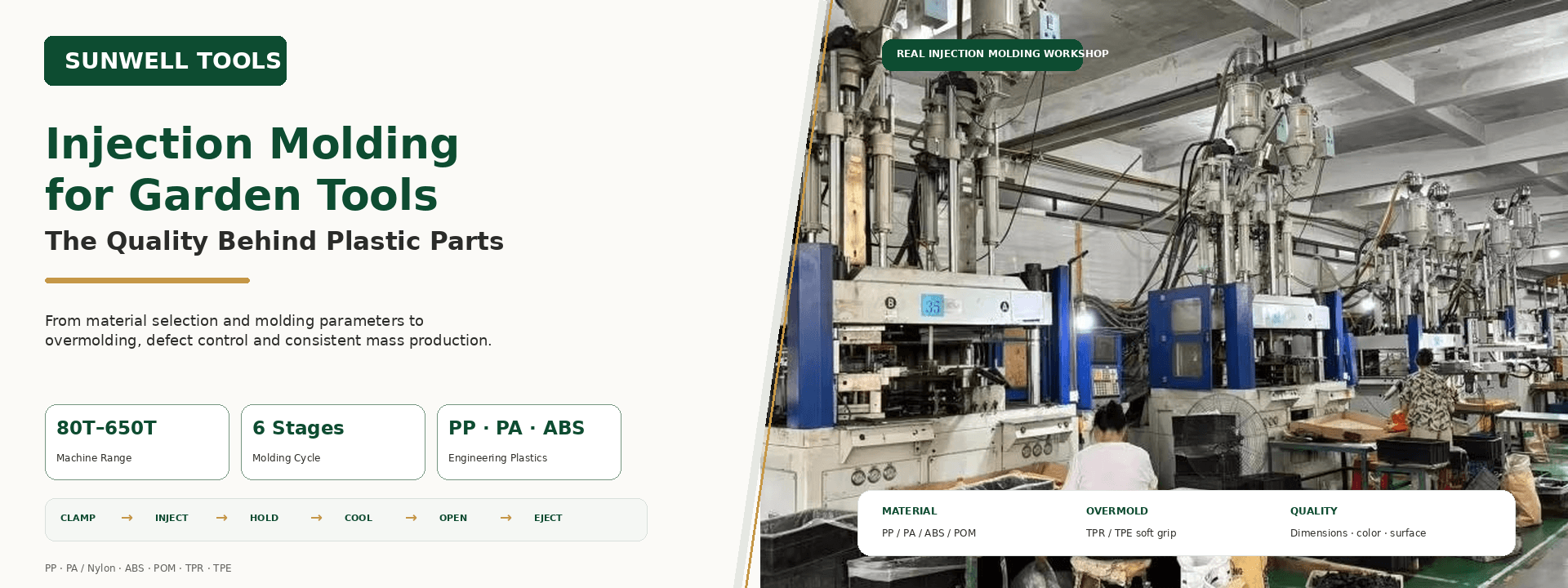
Injection Molding for Garden Tools: The Quality Behind Plastic Parts
Pick up almost any modern garden tool and you will find injection-molded plastic components.
They form pruning-shear handles, power-tool housings, watering nozzles, hose connectors, gears, battery enclosures and many of the ergonomic surfaces users interact with every day.
These components may look simple, but their material, dimensions, surface quality and molding consistency can directly affect how the finished product feels and performs.
For B2B buyers, understanding injection molding for garden tools can make it easier to evaluate material selection, tooling quality, process control, OEM/ODM customization and long-term product consistency.
This guide explains the injection molding process, common garden-tool plastics, two-shot overmolding, machine tonnage, molding parameters, defect prevention and quality control.
Why Injection Molding Matters in Garden Tool Manufacturing
Garden tools operate in environments that can expose plastic components to moisture, sunlight, temperature variation, dirt, chemicals and mechanical loading.
Plastic components therefore need more than the correct appearance.
Depending on the product, they may also need:
- Impact resistance
- Structural strength
- Dimensional stability
- Weather resistance
- Grip comfort
- Low friction
- Chemical resistance
- Consistent color
Poor molding control can create issues such as cracked handles, warped housings, leaking connectors, poor assembly fit or inconsistent surface appearance.
For retail brands and importers, those manufacturing details can ultimately affect returns, customer satisfaction and product reputation.
Where Are Injection-Molded Parts Used?
For buyers developing a new plastic component, tooling quality is equally important.
See: Garden Tool Mold Development for OEM/ODM →
The Injection Molding Process: Six Core Stages
Injection molding is a repeating manufacturing cycle.
Plastic material is melted, injected into a precision mold, cooled and then removed as a finished component.
How Long Does an Injection Molding Cycle Take?
Cycle time varies significantly by product.
A smaller thin-wall component can cycle much faster than a large housing or thick structural part.
Factors affecting cycle time include:
- Part dimensions
- Wall thickness
- Plastic material
- Mold design
- Cooling efficiency
- Number of cavities
- Injection and holding parameters
Faster cycle time can reduce unit cost, but reducing the cycle too aggressively can increase the risk of warpage, shrinkage, dimensional instability or other defects.
Common Plastic Materials Used in Garden Tools
Different garden-tool components require different combinations of strength, flexibility, appearance, friction, chemical resistance and cost.
| Material | Main Characteristics | Typical Garden Tool Applications |
|---|---|---|
| PP Polypropylene |
Lightweight, chemical resistant, cost-efficient and suitable for many general molded components | Handle substrates, spray-nozzle bodies, connector bodies and housings |
| PA / Nylon PA6 / PA66 |
Good strength, abrasion resistance and structural performance; glass-filled grades can provide greater rigidity | Structural inserts, gears, pump components and mechanism parts |
| ABS | Good impact resistance and surface appearance, suitable for visible housings | Power-tool housings, covers, battery-related housings and decorative components |
| POM Acetal |
Low friction, good dimensional stability and wear resistance | Gears, sliding parts, ratchet mechanisms and hose-reel internal components |
| TPR | Soft-touch, flexible and suitable for ergonomic grip zones | Handle overmolds, grip surfaces and vibration-damping areas |
| TPE | Family of flexible thermoplastic elastomers available in different hardness levels | Seals, grips, gaskets and anti-slip components |
Material selection should also consider molding conditions.
Different plastics require different:
- Drying conditions
- Melt temperatures
- Mold temperatures
- Injection speeds
- Holding pressures
- Shrinkage allowances
For a wider comparison of garden-tool materials, see: Garden Tool Materials Guide →
Two-Shot Injection Molding & TPR Overmolding
One of the most recognizable applications of injection molding in garden tools is the soft-touch ergonomic handle.
These handles often combine a rigid structural substrate with a softer grip material.
How Two-Shot Molding Works
A typical two-component process can involve:
- A rigid substrate such as PP or ABS is molded first.
- The substrate remains in or is transferred within the molding system.
- A compatible TPR or TPE material is molded onto defined grip areas.
- The finished component combines rigid structural zones with softer ergonomic surfaces.
The exact bonding performance depends on material compatibility, surface design and molding conditions.
Why Overmolding Matters for Garden Tools
A properly designed overmolded handle can provide:
- Improved grip comfort
- Better anti-slip performance
- Soft-touch surfaces
- Reduced pressure points
- Vibration damping on applicable powered products
- Greater visual differentiation
- More opportunities for brand-specific colors
For premium and mid-range garden-tool programs, grip design can strongly influence perceived product quality.
Machine Tonnage, Product Size & Molding Parameters
Injection molding machines are commonly differentiated by clamping force.
The source material describes equipment ranging from approximately 80T to 650T, allowing different plastic components to be assigned according to projected area, part size and mold structure.
| Machine Range | Typical Component Type |
|---|---|
| 80T–150T | Connectors, nozzle components, gears, clips and other smaller molded parts |
| 150T–350T | Garden-tool handles, spray-gun bodies, smaller housings and hose-reel components |
| 350T–650T | Larger housings, power-tool shells, hose-reel structures and other large molded components |
Four Parameter Groups That Affect Part Quality
Stable injection molding requires these parameters to work together.
Changing one parameter can affect several other aspects of the molded part.
For this reason, production settings should be developed around the material, mold and actual component rather than relying on one universal process recipe.
Common Injection Molding Defects & Their Causes
Every injection-molding process has potential defect modes.
The important issue is whether the manufacturer can identify the cause and control the process systematically.
| Defect | Typical Appearance | Possible Cause | Control Approach |
|---|---|---|---|
| Sink Marks | Depressions in thicker areas | Packing, cooling or wall-thickness issues | Review packing profile, cooling and component design |
| Flash | Thin excess plastic around parting lines | Clamp force, mold wear or excessive pressure | Check mold condition, machine selection and process pressure |
| Weld Lines | Visible lines where melt fronts meet | Part geometry, gate location or material flow | Review gate design and process settings |
| Air Traps / Burn Marks | Dark or scorched areas | Trapped gas or insufficient venting | Improve mold venting and filling profile |
| Short Shots | Incomplete component | Insufficient material flow, pressure or temperature | Review material, machine parameters and runner balance |
| Warpage | Part bends or twists | Uneven cooling, shrinkage or residual stress | Improve cooling balance and component design |
| Color Variation | Inconsistent color between parts or batches | Material handling, masterbatch ratio or processing conditions | Control material batches and color formulation |
Mold design also plays an important role in defect prevention.
Gate position, cooling-channel layout, draft angle, wall thickness and venting should ideally be considered during DFM and mold development rather than corrected only after mass production begins.
Injection Molding Quality Control: From First Article to Mass Production
Injection molding quality should be controlled throughout production rather than relying only on final visual inspection.
First-Article Inspection
A new mold or newly adjusted process should be evaluated before mass production.
Depending on the component, first-article inspection can include:
- Critical dimensions
- Assembly fit
- Color
- Surface appearance
- Part weight
- Functional features
- Applicable material requirements
In-Process Monitoring
During production, operators and quality teams can monitor:
- Cycle time
- Machine parameters
- Part dimensions
- Surface appearance
- Color consistency
- Assembly-related dimensions
Periodic Sampling
Production samples can be checked at defined intervals using suitable measurement equipment such as gauges, calipers, micrometers and other inspection tools.
For tighter-tolerance parts, more advanced dimensional inspection may be required.
Final Inspection
Finished components can be checked against the approved specification or reference sample before being released to assembly or shipment.
Depending on the OEM program, sampling plans can also be agreed with the buyer.
Read more: SUNWELL Garden Tool Quality Control & Testing →
SUNWELL Injection Molding & Garden Tool Manufacturing Platform
SUNWELL has focused on garden-tool manufacturing since 1988.
Injection molding supports a broader manufacturing system covering manual garden tools, electric garden tools and garden watering products.
The source material describes injection molding equipment covering approximately 80T to 650T, including capability for standard molded components and applicable two-shot / overmolding projects.
Depending on the product, injection molding can connect with other SUNWELL manufacturing processes such as:
- Mold development
- Metal stamping
- Heat treatment
- Surface finishing
- Assembly
- Functional testing
- Quality inspection
- Packaging
This integrated process is relevant to OEM/ODM programs where plastic components need to fit precisely with blades, motors, metal frames, hoses, connectors and other assemblies.
See more of SUNWELL's manufacturing process: SUNWELL Garden Tool Factory Tour →
How B2B Buyers Should Prepare an Injection Molding Project
The more complete the technical information, the easier it is to evaluate mold structure, material, equipment and project cost.
Before requesting a quotation, buyers should ideally prepare:
- 2D or 3D product drawings
- Plastic material or performance requirements
- Expected annual quantity
- Critical dimensions and tolerances
- Color or Pantone requirements
- Surface texture requirements
- Overmolding requirements
- Assembly relationship with metal or other components
- Testing requirements
- Target launch date
If the product is still at the concept stage, the engineering team can first evaluate whether the structure is suitable for injection molding and what tooling approach may be required.
Injection Molding and Mold Development Should Be Planned Together
Good injection-molded parts begin before the molding machine starts.
Part design, wall thickness, draft angle, gates, cooling, venting, shrinkage and ejection all influence the final component.
For this reason, injection molding and tooling development should be treated as one connected engineering process.
A good DFM review can help identify potential molding problems before the mold reaches T1.
Learn more: Garden Tool Mold Design & Development →
From Plastic Pellet to Finished Garden Tool
Injection molding is one of the manufacturing processes that quietly defines how a garden tool feels and performs.
The right material provides the required properties.
The right mold creates the geometry.
The right process parameters create consistency.
And the right quality system helps maintain that consistency across mass production.
For B2B buyers, this means plastic components should not be treated as secondary parts.
Handles, housings, gears and connectors can all influence product quality, brand perception and after-sales performance.
Start Your Garden Tool Injection Molding Project With SUNWELL
Whether you are developing a new pruning-tool handle, power-tool housing, hose-reel component, watering connector or another custom plastic part, SUNWELL can evaluate the injection molding requirements for your project.
Tell us your product concept, material requirements, expected volume, color, dimensions, overmolding needs and target launch schedule.
Our engineering team can then evaluate DFM, tooling, material, injection molding and quality-control requirements.
From mold development and injection molding to assembly and mass production — one garden-tool manufacturing partner.
Explore SUNWELL Products → Discuss Your Injection Molding Project →