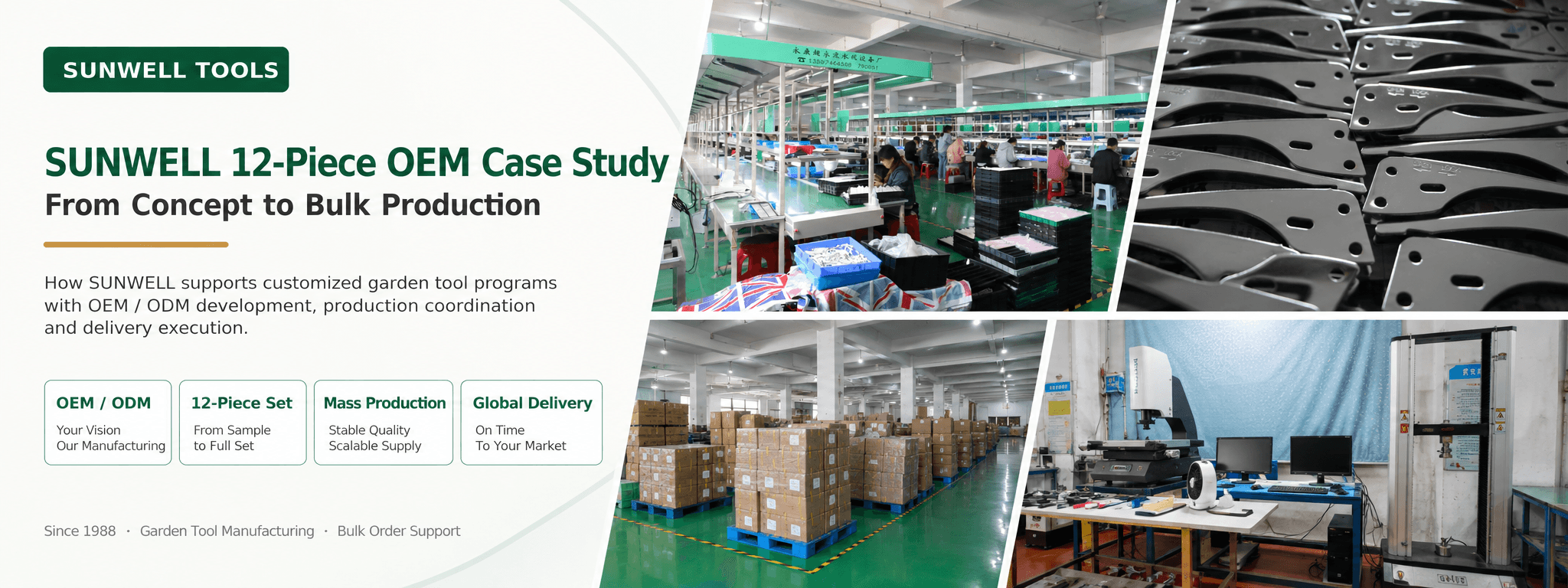
Garden Tool OEM Case Study: Building a Custom 12-Piece Set for a European Retailer
A garden-tool catalog can show a buyer what products already exist.
A real OEM/ODM project shows something different: how product selection, design, sampling, packaging, production, quality control and logistics work together to turn an idea into a retail-ready product.
This garden tool OEM case study follows a private-label project developed for a European retailer that wanted to launch a coordinated 12-piece garden-tool set for its spring selling season.
The project involved product selection, Pantone color matching, custom packaging, multiple sampling rounds, mass production and international delivery.
The retailer's identity has been kept anonymous in this public version of the case study.
The Brief: Build One Consistent Private-Label Garden Tool Range
The European retailer wanted to move away from sourcing individual garden tools from multiple suppliers.
Its objective was to create a more consistent private-label range with coordinated colors, packaging and product positioning.
The initial project required a 12-piece custom garden tool set suitable for mainstream European retail.
The key requirements included:
- One consistent private-label brand identity
- Coordinated colors across different materials
- A balanced selection of frequently used garden products
- Retail-ready packaging
- Reliable cutting and hand-tool performance
- A product structure suitable for repeat orders
- Spring-season delivery planning
Discovery & Design: Turning a Retail Concept Into Product Specifications
Before samples were produced, the first task was deciding exactly which products belonged in the set and how they should work together visually.
The retailer and SUNWELL reviewed the target market, intended price position, common consumer garden tasks and the desired private-label appearance.
Selecting the 12 Products
| # | Product | Material / Construction | Role in the Set |
|---|---|---|---|
| 1 | Bypass Pruning Shears | SK5 steel blade + TPR handle | Primary pruning product |
| 2 | Floral Snips | Stainless steel + PP handle | Detail trimming |
| 3 | Hand Trowel | Carbon steel + TPR handle | General planting |
| 4 | Hand Fork | Carbon steel + TPR handle | Soil preparation |
| 5 | Hand Weeder | Carbon steel + TPR handle | Weeding |
| 6 | Transplanting Spade | Carbon steel + TPR handle | Planting and transplanting |
| 7 | Short Garden Rake | Steel + wood | Soil and garden-bed work |
| 8 | Cultivator | Steel + wood | Soil loosening |
| 9 | Knee Pad | EVA foam + textile cover | User comfort |
| 10 | Gardening Gloves | Nitrile-coated textile | Hand protection |
| 11 | Plant Ties | Coated soft wire | Plant support |
| 12 | Storage Bag | Polyester | Storage and presentation |
Why the Product Mix Matters
The objective was not simply to place twelve unrelated products into one package.
The set needed to cover common garden activities while maintaining a clear visual and commercial structure.
Pruning shears acted as a key performance product, while trowels, forks and cultivators covered general garden maintenance.
Accessories such as gloves, plant ties and the storage bag increased the perceived completeness of the set.
Pantone Color Coordination
One of the most important private-label requirements was consistent color across multiple materials.
This is technically more difficult than applying the same Pantone number to every component.
A color can appear differently on:
- TPR
- Painted steel
- Injection-molded plastic
- Wood
- Textile
- Printed cardboard
For this reason, the project used approved color references to coordinate the visual appearance of the complete product family.
Custom Retail Packaging
The retailer also wanted the set to look unified on shelf.
Packaging development therefore considered:
- Brand logo placement
- Product arrangement
- Retail presentation
- Product photography
- Feature callouts
- Barcode placement
- Packaging dimensions
- Product protection during transport
The final package combined branded printed materials with an organized internal structure designed to keep the products positioned during handling and retail display.
Sampling: Three Rounds Before Mass Production
Sampling is where a private-label concept becomes a physical product.
For this project, three sampling stages were used to progressively confirm function, color, materials and final retail presentation.
What Changed During Sampling?
The purpose of sampling is not to prove that the first version is perfect.
It is to identify details that should be corrected before thousands of units are produced.
During the project, sample feedback included:
- Pruning-shear operating feel
- Handle ergonomics
- Color consistency
- Glove color tone
- Packaging presentation
- Storage-bag hardware
Each adjustment was reviewed before the project moved forward.
For a complete explanation of SUNWELL's OEM/ODM workflow, read: Garden Tool OEM/ODM Order Process →
Mass Production: 5,000 Sets Across 12 Product Types
After final sample approval, the order moved into mass production.
An order of 5,000 sets meant coordinating approximately 60,000 individual items before final assembly and packaging.
Because the set contained products manufactured through different processes, production planning needed to coordinate several workstreams.
Production Activities Included
- Raw-material preparation
- Steel processing
- Blade and tool-head manufacturing
- Injection molding
- Wood-handle preparation
- Surface treatment
- Textile product production
- Packaging printing
- Final assembly
- Kit packing
- Quality inspection
Quality Control Across the Project
Learn more about SUNWELL's Garden Tool Quality Control & Testing System →
Managing a Color Variation During Production
During production, one batch of molded handles showed a visible color difference compared with the approved reference under certain lighting conditions.
Instead of waiting until final inspection, the variation was identified during in-process quality control.
The batch was reviewed against the approved color reference before production continued.
This is an important example of why private label garden tools require more than functional QC.
For a coordinated retail collection, appearance consistency can be just as important as basic product function.
Delivery & Logistics: From Factory to European Distribution
Once production and inspection were complete, the project moved into export preparation and international transportation.
The complete shipment included the finished garden-tool sets, retail packaging and required shipment documentation.
Shipment Preparation Included
- Final product inspection
- Carton and packaging confirmation
- Quantity verification
- Shipping marks
- Commercial documentation
- Container-loading preparation
- Coordination with the buyer's nominated logistics provider
International transit time depends on routing, carrier schedules, destination and customs conditions, so the logistics stage was planned with additional time before the retailer's intended spring launch.
The Project Outcome
The finished 12-piece set gave the retailer something it did not have before: one coordinated private-label garden-tool range rather than a collection of unrelated products from different suppliers.
The most important outcome was not simply the number of products produced.
The project created a repeatable product platform with approved colors, packaging, product specifications and manufacturing references that could support future reorders and range expansion.
Following the initial launch, the retailer continued discussions around repeat orders and additional garden-tool products using the same brand language and color system.
For a private-label program, this type of continuity can be more valuable than treating every order as a completely separate sourcing project.
What This Garden Tool OEM Case Study Means for B2B Buyers
How to Prepare Your Own Custom Garden Tool Set Project
If you are planning a similar OEM/ODM project, prepare the following information before contacting a manufacturer:
- Target market — country or region where the products will be sold.
- Retail channel — supermarket, garden center, hardware store, e-commerce or distributor.
- Product list — individual tools or the type of complete set required.
- Target price positioning.
- Expected order quantity.
- Material requirements.
- Brand colors.
- Logo and branding requirements.
- Packaging concept.
- Target launch or delivery schedule.
If you do not yet know the exact specifications, a reference image, competitor sample or rough product list can provide a useful starting point.
Why Work With SUNWELL on a Private-Label Garden Tool Project?
SUNWELL has focused on garden-tool manufacturing since 1988 and supports OEM/ODM development for international B2B buyers.
Depending on the project, support can include:
- Product selection
- Product engineering
- Material evaluation
- Color customization
- Mold development
- Sample development
- Private-label branding
- Packaging development
- Mass production
- Quality control
- Shipment preparation
For European sourcing programs, you can also read: European Garden Tool Quality Standards at SUNWELL →
For new custom products, learn more about: Garden Tool Mold Development for OEM/ODM →
Existing Product, Private Label or Full ODM?
| Project Type | Typical Requirement | Development Complexity |
|---|---|---|
| Existing Product | Standard product with minimal changes | Lower |
| Private Label | Existing product with custom colors, logo and packaging | Medium |
| Custom Product Set | Multiple products coordinated as one branded assortment | Medium to high |
| Full ODM Development | New structures, engineering and applicable new tooling | Higher |
The right approach depends on launch timing, budget, expected volume, brand differentiation and how much product development is required.
Ready to Build Your Own Custom Garden Tool Range?
Whether you are developing a 12-piece private-label garden set, refreshing an existing retail assortment or creating a completely new garden-tool product, SUNWELL can help evaluate the right development route.
Tell us your target market, product list, expected quantity, brand requirements, packaging concept and launch schedule.
Our team can then evaluate suitable existing products, private-label customization or a full OEM/ODM development plan.
From concept to sample, production, quality control and retail-ready packaging — one garden-tool manufacturing partner.
Explore SUNWELL Products → Start Your OEM Project →