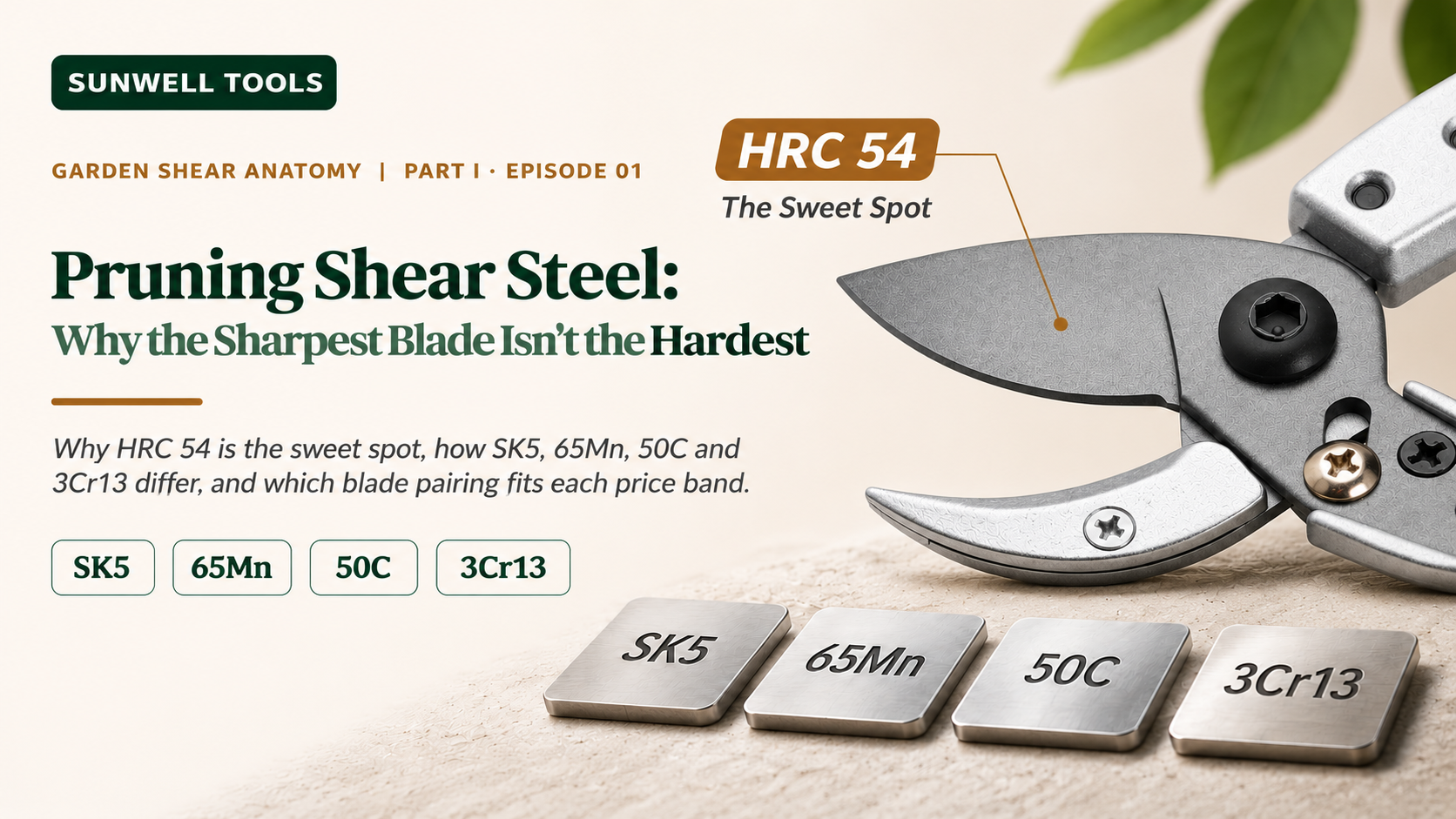
Why HRC 54 is the sweet spot for pruning shear blades, how SK5, 65Mn, 50C and 3Cr13 differ, and which upper/lower blade pairing fits each price band.
SUNWELL | GARDEN SHEAR ENGINEERING
PART I · EPISODE 01 · THE STEEL
Pruning Shear Steel: Why the Sharpest Blade Isn't the Hardest
Every buyer asks the same first question: what steel? The more useful question is what hardness — and what the second blade is doing.
Part I · The six details your customers judge
Cutting Blade
HRC 54
Keen enough to slice, tough enough to meet hardwood without chipping.
Lower Blade
HRC 46
Softer by design. Yields by microns and protects the cutting edge.
Quick Answer
For pruning shear blades, HRC 54 on the cutting blade and HRC 46 on the supporting blade is the professional default. HRC 54 is the point where a blade can take a keen edge and still survive hardwood without chipping; the softer lower blade protects that edge so the pair wears in rather than wearing out.
The steel grade decides which properties you can reach and at what cost: SK5 for maximum edge retention, 65Mn for toughness, 50C for value and easy resharpening, 3Cr13 for corrosion resistance. Hardness decides whether you actually get there.
What Does HRC 54 Actually Mean?
HRC is the Rockwell C hardness scale — a measure of how deeply a diamond point can press into steel. For blade steel, each point of hardness buys a finer, longer-lasting edge, and costs toughness.
Around HRC 54, the trade-off stops being a trade-off. Below it, edges roll and dull quickly. Above it, edges take a beautiful grind and then chip the first time they meet a dead branch at an angle.
That is why professional shears cluster at 54 rather than climbing toward 58–60, where hardness figures look better on a spec sheet and perform worse in a garden.
Hardness Trade-Off Across the HRC Scale
Hardness is a trade-off, not a score. The cutting blade sits at the point where edge retention and toughness meet; the lower blade is deliberately softer. Values shown are the positions discussed in this article.
The practical translation for a buyer: a 58 HRC claim is not an upgrade. It is usually a different failure mode — and one that arrives sooner.
Why Isn't Harder Better?
Because a blade fails in two directions, and only one of them is “too soft”.
Two Failure Directions
| Failure | What the User Sees | What Causes It |
|---|---|---|
| Rolling / Dulling | The blade slides over bark instead of biting; needs resharpening within weeks. | Hardness too low, or tempering overdone. |
| Chipping | A nick in the edge that no amount of honing removes. | Hardness too high, or coarse grain from overheating. |
| Deformation | The edge bends rather than cuts when twisted. | Insufficient toughness in the blade body. |
Both failures end in the same review: “dull after a few uses.” The user cannot tell a rolled edge from a chipped one, and does not care. What they experience is a tool that stopped cutting.
This is why the hardness decision is made per blade position, not per product.
Which Steel for Which Job?
Four grades cover most garden shear programmes. Each one is a different answer to “what do we need this blade to survive?”
Four Grades, Four Answers
| Steel | What It Is | Why Choose It | What the End User Gets | Typical Position |
|---|---|---|---|---|
| SK5 | High-carbon tool steel, approximately 0.85% carbon. | Takes the finest edge and holds it longest. | Cuts cleanly for years; needs sharpening rarely. | Premium cutting blades. |
| 65Mn | Manganese spring steel. | Flexes under shock instead of chipping; still hardens to HRC 54. | Survives tough, dry, awkward branches. | Performance lower blades, value cutting blades. |
| 50C | Medium-carbon steel. | Balanced, affordable, easy to resharpen. | A few passes on a whetstone bring the edge back. | Value lines, lower blades. |
| 3Cr13 | Martensitic stainless steel, approximately 13% chromium. | Chromium forms a passive layer against rust while still hardening to cutting hardness. | No rust after a wet season; less maintenance. | Mid-range stainless programmes, lower blades. |
Two Clarifications Buyers Ask For
- SK5 is not stainless. It will rust without a finish. If the retail proposition is “stainless”, the blade has to be 3Cr13 (or another stainless grade).
- 65Mn at HRC 54 is a cutting blade, not only a spring. The grade is associated with shovels and springs, but hardened properly it holds a keen edge — which is why it appears in both positions.
Related reading: Garden Tool Materials: Steel, Stainless Steel and Aluminum
Why Is the Lower Blade Softer?
In a bypass shear, the two blades are deliberately unequal.
- Upper blade, HRC 54 — does the cutting. Hard enough to hold a fine edge through the season.
- Lower blade, HRC 46 — receives the cut. Slightly softer, so it yields by microns instead of dulling the cutting edge.
The result is a pair that wears in, not out: the two edges conform to each other over thousands of cuts and keep meeting cleanly.
Two equally hard blades, by contrast, fight each other — both edges dull, and the cut degrades from both sides at once.
This is the single most overlooked line in a pruning shear specification. It is also one of the cheapest to get right, because it costs nothing but a decision.
A blade pair should be designed as a system — not as two independent pieces of steel.
Which Recipe for Which Tool?
Shear type changes the mechanics, so it changes the recipe. Long blades need flex; anvil blades need a plate that absorbs impact rather than an edge that meets another edge.
Blade Recipes by Tool Type
| Tool Type | Upper / Cutting Blade | Lower Blade / Anvil | Positioning |
|---|---|---|---|
| Bypass Pruning Shear | SK5 · HRC 54 | 3Cr13 · HRC 46 | Flagship: sharp and rust-free. |
| Bypass Pruning Shear | SK5 · HRC 54 | 65Mn · HRC 46 | Flagship: maximum edge support. |
| Bypass Pruning Shear | 65Mn · HRC 54 | 50C · HRC 46 | Best performance-to-cost balance. |
| Anvil Pruning Shear | SK5 · HRC 54 | 6061 aluminum anvil (heat-treated) | Flagship anvil. |
| Anvil Pruning Shear | 65Mn · HRC 54 | 50C · HRC 46 | Value anvil. |
| Hedge Shear | SK5 · HRC 48 | 65Mn · HRC 40 | Professional long blades. |
| Hedge Shear | 65Mn · HRC 48 | 50C · HRC 40 | Value long blades. |
| Flower / Garden Shear | SK5 · HRC 54 | 65Mn · HRC 46 | Precision. |
| Flower / Garden Shear | 3Cr13 · HRC 54 | 3Cr13 · HRC 46 | Fully stainless. |
| Flower / Garden Shear | 65Mn · HRC 54 | 65Mn · HRC 46 | Balanced. |
Note the hedge shear row: the whole recipe steps down to HRC 48 / 40.
That is not cost-cutting — a 25-inch blade hardened to 54 will chip or snap under the leverage a two-handed cut applies.
Long blades need toughness, and toughness is bought with a lower hardness.
A shear range built on this logic covers four tool types and three price positions with a manageable number of steel combinations — which matters for both tooling cost and spare-blade logistics.
Sourcing consideration: Material combinations, blade hardness and heat-treatment requirements should be confirmed for each specific product model.
What Should a Buyer Put in the RFQ?
Three lines, in this order:
Blade positions and hardness — “upper SK5 HRC 54 ±2, lower 3Cr13 HRC 46 ±2”, not simply “SK5 blade”.
Acceptance method — sampled or per blade, and what records come with the shipment.
Finish and destination climate — because an SK5 blade without a finish is a corrosion claim waiting to happen in a damp shed.
If the target retail price is fixed, give the supplier the price band and let the recipe follow:
| Target Retail Price | Suggested Blade Combination |
|---|---|
| $10–15 | 65Mn cutting blade over 50C lower blade. |
| $20–40 | 65Mn or SK5 cutting blade over 65Mn or 3Cr13 lower blade. |
| $55+ | SK5 cutting blade over 3Cr13 lower blade with tight hardness control. |
Price bands above are positioning examples from the original article, not confirmed product quotations or guaranteed SUNWELL retail prices.
For a broader purchasing framework, see the SUNWELL Garden Tool RFQ Checklist .
Frequently Asked Questions
Is SK5 the best steel for pruning shears?
SK5 is the strongest choice when edge retention is the priority, and it is widely used on premium cutting blades. It is not automatically better for every position — a softer, tougher steel on the lower blade usually produces a better pair than SK5 on both.
What does HRC 54 mean in practice?
It is the hardness at which a blade takes a fine, durable edge without becoming brittle. Practically: it cuts cleanly out of the box and keeps cutting through a season of mixed branches, provided the heat treatment is consistent.
Is 65Mn good enough for a cutting blade?
Yes, when hardened to HRC 54. It is the standard choice for value and mid-range bypass shears, and it offers better shock resistance than higher-carbon grades.
Why do some pruners rust even though they say “stainless”?
Because “stainless” is often used loosely. Only the stainless grades — 3Cr13, 420 and similar — carry meaningful chromium content. SK5 and 50C are carbon steels and need a coating or plating.
Does a harder blade stay sharp longer?
Only up to a point. Past roughly HRC 56–58, chipping becomes the dominant failure and the usable life of the edge drops, even though the hardness number looks better.
Choosing a Steel Recipe for Your Range
SUNWELL has built garden cutting tools for 38 years, working with SK5, 65Mn, 50C and 3Cr13 across bypass, anvil, hedge and flower shears — with heat treatment, grinding and finishing in-house, so the recipe and the process are specified together.
Send us your tool type, target retail price and destination market, and we will come back with a blade recipe and a hardness window.
NEXT IN THE SERIES
The Craft — why two blades labelled HRC 54 can last a year or twenty.
Upcoming topic: Pruning Shear Heat Treatment.