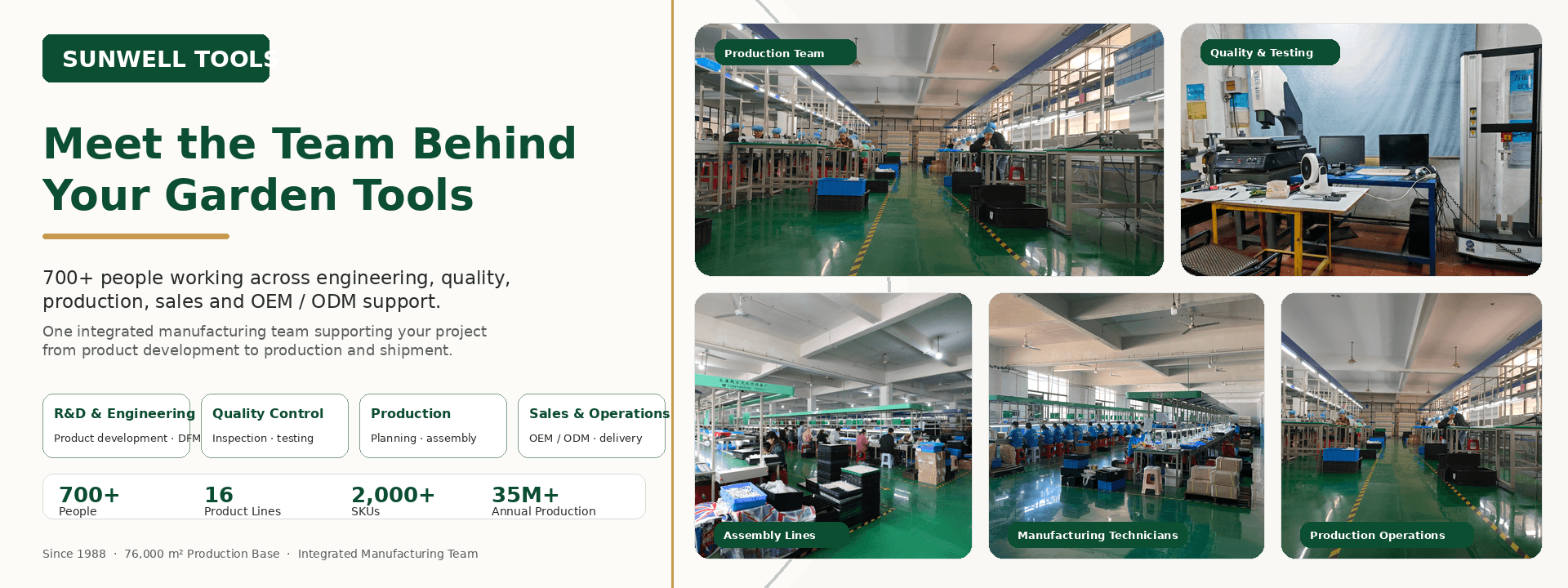
Meet the Team Behind Your Garden Tools
At SUNWELL Tools, that combination of experience, judgment and manufacturing expertise is embodied in a team of more than 700 people working across management, R&D, quality control, production, sales and order operations.
Since 1988, SUNWELL has grown into an integrated garden-tool manufacturer with a 76,000 m² production base, 16 product lines and a portfolio of more than 2,000 SKUs.
But scale alone does not make a manufacturing partner reliable.
This article introduces the garden tool manufacturing team behind SUNWELL — what each department does, how the teams collaborate, and why the people behind your products matter just as much as the machines used to manufacture them.
Why the Team Matters More Than the Machine
CNC machines, forging presses, injection molding equipment and automated production systems are essential to modern garden-tool manufacturing.
But equipment alone does not make decisions.
People decide which material is appropriate for a new product, how a component should be designed for production, how a blade should be heat-treated, when a production deviation requires corrective action, and whether a finished batch meets the customer's requirements.
A machine can repeat a process. Experienced engineers, technicians and quality professionals determine whether that process is the right one.
This is why SUNWELL invests in both people and manufacturing infrastructure.
Our 700+ person team supports the full product lifecycle — from concept development and mold design to production, inspection, packaging and international delivery.
Leadership: Decades of Garden Tool Manufacturing Experience
The Management Team
SUNWELL's management team has accumulated long-term experience in garden-tool manufacturing, OEM/ODM cooperation and international B2B supply.
That experience is particularly valuable when a project moves beyond a standard existing product.
Customized programs require decisions about:
- Product positioning
- Materials
- Manufacturing processes
- Tooling investment
- Quality requirements
- Cost control
- Production feasibility
- Compliance
- Delivery planning
The role of management is therefore not simply to oversee the factory. It is to ensure that commercial commitments, technical requirements and production capability remain aligned throughout the project.
What Decades of Experience Means in Practice
Long-term manufacturing experience creates something difficult to measure: pattern recognition.
When a customer presents a new product concept, experienced teams can identify potential issues before mass production begins.
They can evaluate whether a design will be difficult to manufacture consistently, whether a material choice could create unnecessary cost, whether tooling needs modification, or whether a packaging concept may create problems during mass production.
Research & Development: Where New Garden Tools Begin
SUNWELL's R&D team connects customer requirements, market needs and manufacturing feasibility.
For OEM/ODM programs, R&D is often the first technical department involved after the initial customer requirement has been clarified.
The Engineering Team
The engineering team works across mechanical design, materials, manufacturing processes and product development.
Its role is to turn a concept into a structure that can actually be manufactured, assembled, tested and produced consistently.
Engineering capabilities can include:
- Product structure development
- 3D CAD design
- Design for Manufacturing (DFM)
- Material evaluation
- Prototype development
- Mold and tooling coordination
- Product improvement
- Production feasibility evaluation
This engineering stage is particularly important for garden tools because products often combine metal components, molded handles, fasteners, springs, coatings, moving mechanisms and other structures within one product.
The Industrial Design Team
Garden-tool development is not only about mechanical performance.
Appearance, ergonomics, grip comfort, color, shelf presentation and brand identity can all influence whether a product succeeds in the market.
The industrial design team works alongside engineering to balance:
- Appearance
- Ergonomics
- User experience
- Brand identity
- Production feasibility
- Cost targets
How R&D Works With OEM/ODM Customers
When a buyer approaches SUNWELL with a new project, the R&D team can evaluate the product together with the commercial requirements.
Typical questions include:
- Who is the target user?
- Which market will the product be sold in?
- What performance is required?
- What material is preferred?
- What target price level needs to be achieved?
- Does the project require a new mold?
- What branding and color requirements are involved?
- What testing or compliance requirements apply?
This allows technical development to begin with a clear understanding of the final commercial objective.
Quality Control: The Team Protecting Your Brand
One of the most important responsibilities inside any garden-tool factory is the ability to stop a product when something is wrong.
Quality control is not simply about checking finished products at the end of the line.
At SUNWELL, quality activities extend across incoming materials, production processes, finished products and shipment preparation.
Incoming Quality Control — IQC
The IQC team checks applicable incoming raw materials and purchased components before they enter production.
Depending on the product, these may include:
- Steel materials
- Plastic materials
- Springs
- Fasteners
- Rubber or TPR components
- Electrical components
- Packaging materials
The objective is simple: identify a material problem before it becomes a production problem.
In-Process Quality Control — IPQC
IPQC inspectors monitor production processes while manufacturing is underway.
Depending on the product, inspection can cover:
- Metal forming
- Machining
- Heat treatment
- Blade grinding
- Injection molding
- Surface treatment
- Assembly
- Functional performance
When deviations are identified, corrective action can be taken before the issue affects a larger quantity of finished products.
Final Product Inspection
Before shipment, finished products are checked according to the applicable product specification, customer requirements and inspection plan.
Inspection can include:
- Appearance
- Dimensions
- Function
- Safety-related components
- Packaging
- Labels and barcodes
- Quantity
- Carton condition
Customers can also arrange third-party inspections according to their own purchasing procedures.
Quality Lab & Testing Engineers
SUNWELL's testing capabilities support product development and production verification across different garden-tool categories.
Depending on the product, testing can include:
- Hardness testing
- Material testing
- Salt spray corrosion testing
- Tensile testing
- Cutting-performance testing
- Cycle-life testing
- Electrical-performance testing
- Pressure testing for watering products
- Environmental testing
- Transport simulation
The quality team's role is not simply to find defects. It is to help prevent recurring problems from moving through the production system.
You can also read more about SUNWELL's garden tool quality control and testing system →
Production Management: Turning Plans Into Finished Orders
An approved sample does not automatically become a successful mass-production order.
Production management is responsible for turning specifications, quantities and delivery targets into a workable manufacturing plan.
Production Planning & Scheduling
Production planners coordinate:
- Product requirements
- Material readiness
- Production-line availability
- Process sequence
- Quality checkpoints
- Packaging schedules
- Target delivery dates
This is especially important when one purchase order contains multiple SKUs or when several customer projects are running simultaneously.
Learn more about SUNWELL's production capacity and lead-time planning →
Line Supervisors & Skilled Technicians
Production supervisors connect the production plan with day-to-day execution on the factory floor.
They coordinate operators, equipment, materials, output and quality requirements within each production area.
Experienced technicians also play an important role in processes such as:
- Forging
- Stamping
- Grinding
- Heat treatment
- Injection molding
- Surface treatment
- Assembly
- Testing
Their practical manufacturing experience is one of the key links between engineering design and stable mass production.
Equipment Maintenance & Tooling Team
Stable manufacturing requires stable equipment.
SUNWELL's production platform relies on machinery, fixtures, molds and tooling across multiple manufacturing processes.
Maintenance and tooling personnel support:
- Preventive equipment maintenance
- Machine inspection
- Production fixtures
- Jigs
- Molds
- Tooling adjustments
- Production-line support
Preventive maintenance helps reduce unexpected equipment downtime while supporting repeatable production conditions.
Sales & Business Development: Your Direct Connection to the Factory
More Than Pricing and Quotations
For a B2B buyer, the sales contact is often the bridge between commercial requirements and the factory.
That means the sales team needs to understand more than unit prices.
SUNWELL's customer-facing teams work with information involving:
- Product specifications
- Materials
- OEM/ODM requirements
- Mold development
- Packaging
- MOQ
- Testing
- Production planning
- Lead time
- Shipping
When a project requires technical evaluation, sales coordinates internally with R&D, production, quality and other relevant teams.
What Happens After You Send an Inquiry?
A typical inquiry can move through the following process:
- Requirement review: product, quantity, destination and customization requirements are clarified.
- Internal evaluation: technical and production teams evaluate feasibility where required.
- Product or solution confirmation: existing products or customized-development options are discussed.
- Quotation: commercial terms are prepared based on the confirmed project scope.
- Sample development: for applicable OEM/ODM projects, samples may be developed before mass production.
This cross-department coordination helps buyers receive answers based on actual manufacturing capability rather than sales assumptions.
Customer Service & Order Operations: Supporting the Project After Confirmation
Once an order moves into production, communication remains important.
Order Tracking & Communication
Order operations can coordinate information relating to:
- Material preparation
- Production progress
- Inspection scheduling
- Packaging
- Shipping preparation
- Commercial documents
- Test or inspection documentation where applicable
The objective is to keep the customer informed as the project moves from order confirmation toward shipment.
After-Sales Support
The manufacturing relationship does not necessarily end when goods leave the factory.
Post-delivery support can include:
- Quality-feedback investigation
- Corrective-action coordination
- Claim handling according to agreed commercial terms
- Repeat-order specification management
- Packaging-file retention
- Product-development follow-up
For repeat programs, maintaining approved specifications and production records can help reduce unnecessary reconfirmation and support faster future orders.
The GARTOL Brand Team: Staying Connected to the End User
In addition to OEM/ODM manufacturing, SUNWELL also operates the GARTOL garden-tool brand.
The brand team works with product selection, consumer-facing presentation and channel development.
Operating an own-brand business gives SUNWELL another perspective on:
- End-user requirements
- Product positioning
- Retail presentation
- Packaging
- Customer feedback
- Market trends
These insights can also inform the company's broader product-development and OEM/ODM work.
How SUNWELL's Teams Work Together on Your Project
The strength of a large manufacturing organization is not simply the number of departments it has.
The real value comes from how those departments work together.
Because these functions operate within the same manufacturing organization, product information can move directly between commercial, technical, manufacturing and quality teams.
For OEM/ODM buyers, that helps reduce the communication gaps that often appear when design, tooling, manufacturing and quality are managed by separate suppliers.
You Are Not Just Buying Tools — You Are Working With a Manufacturing Team
When a buyer places an OEM/ODM garden-tool order, the finished product represents the work of many different people.
Together, these functions form SUNWELL's 700+ person garden tool manufacturing team.
The company supports a portfolio of more than 2,000 SKUs across manual garden tools, electric garden tools and garden watering products.
Annual production exceeds 35 million pieces, with approximately 30 million pieces shipped annually.
But the value behind those numbers still comes down to people — the engineers who develop products, the technicians who manufacture them, the quality teams who inspect them, and the customer-facing teams who keep projects moving.
Ready to Meet the Team Behind Your Next Garden Tool Project?
Whether you are developing a new product, evaluating a garden-tool manufacturer or preparing your next OEM/ODM order, SUNWELL can connect your project with the appropriate sales, engineering, production and quality teams.
Tell us what products you are sourcing, your target market, order quantity and customization requirements.
700+ people. 16 product lines. 2,000+ SKUs. One integrated garden-tool manufacturing platform.
Contact the SUNWELL Team →