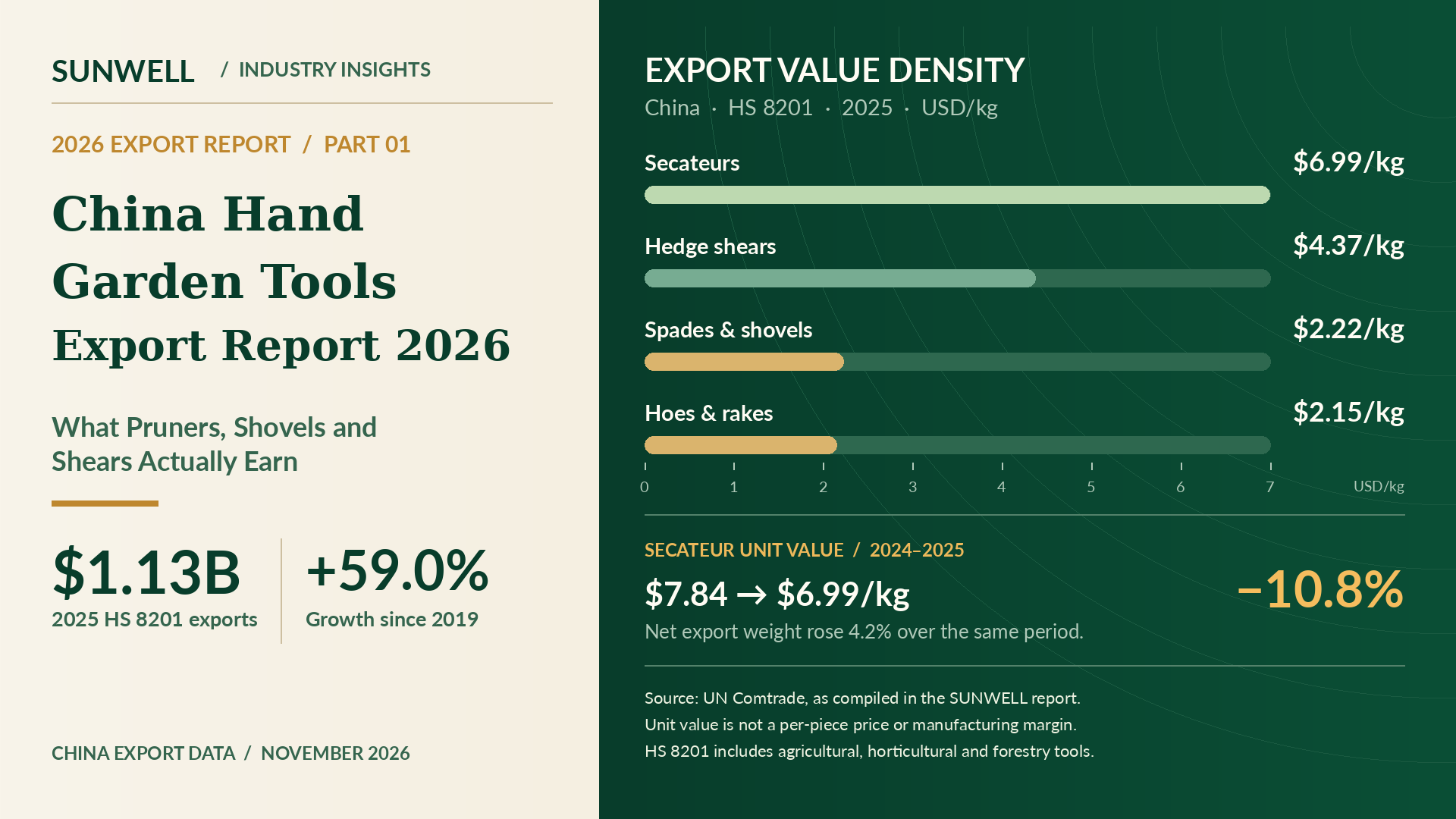
China's hand garden tool exports reached USD 1.13 billion in 2025, up 59.0% since 2019. This report examines HS 8201 export trends, pruning shear value density, international market shares, tariff considerations and five practical sourcing recommendations for B2B garden tool buyers in 2027.
SUNWELL | GARDEN TOOLS INDUSTRY INSIGHTS
2026 EXPORT REPORT · PART 01 · HAND GARDEN TOOLS
China Hand Garden Tools Export Report 2026: What Pruners, Shovels and Shears Actually Earn
Seven years of export growth, product-level value density, international market shares and what B2B buyers should consider when sourcing hand garden tools for 2027.
Executive Overview
China exported USD 1.13 billion of hand garden tools under HS 8201 in 2025, up 59.0% from USD 711 million in 2019 — an approximately 8.0% compound annual growth rate, according to UN Comtrade data compiled in this report.
But the value is not distributed evenly: spades and shovels averaged USD 2.22 per kilogram, while one-handed secateurs averaged USD 6.99 per kilogram.
Secateur export value fell 7.1% in 2025 even as shipped weight rose 4.2%.
The contrast between export growth, shipment weight and declining value density is particularly important for importers, retailers and private-label brands evaluating their 2027 sourcing programmes.
This is the hand tool section of our three-part 2026 garden tools export report. It covers HS 8201, including hand-operated digging, cutting, agricultural, horticultural and forestry tools.
Garden power tools and garden watering products are covered in separate reports.
Key Findings
The category has grown every year except one. China's HS 8201 exports increased from USD 711 million in 2019 to USD 1.13 billion in 2025. The only annual decline occurred in 2023 (−19.2%), a pattern consistent with an inventory and restocking correction.
Digging tools dominate volume, while cutting tools offer higher value density. Spades and shovels (8201.10), together with hoes and rakes (8201.30), account for approximately 55.6% of export value and 78.1% of export weight in the report's compilation. Secateurs and hedge shears account for approximately 20.4% of value but only 11.1% of weight.
The value density gap is approximately 3.3×. In 2025, secateurs averaged USD 6.99/kg, hedge shears USD 4.37/kg, spades and shovels USD 2.22/kg, and hoes and rakes USD 2.15/kg. Higher value density does not automatically mean higher manufacturing profit.
Secateurs are experiencing export price pressure. Shipped weight increased from 18,905 tonnes to 19,691 tonnes in 2025, while export value declined from USD 148.2 million to USD 137.7 million. Average unit value fell 10.8%, from USD 7.84/kg to USD 6.99/kg.
Cutting tool exports are geographically diversified. In 2024, the United States accounted for 19.7% of Chinese spade exports but only 13.1% of secateur exports. The top five secateur destinations were the US, Vietnam, the Netherlands, Germany and the UK.
China supplies only 29.0% of US secateur imports. This compares with 64.0% of Australia's imports, 54.6% of the UK's and 47.1% of Canada's in 2024. Established international brands and alternative manufacturing locations remain important competitive factors.
1. The Market These Tools Sell Into
Grand View Research estimates the global gardening hand tools market at USD 17.9 billion in 2025, increasing to USD 33.1 billion by 2033, with a reported compound annual growth rate of 8.3%.
The research identifies hand tools as a fast-growing segment within its broader USD 102.1 billion gardening equipment estimate.
Data Bridge Market Research, using a different product definition, places hand tools at 39.1% of the garden tools market in 2024.
Market size and export value are different measures. The two research figures use different market definitions, while UN Comtrade records international trade flows. A retail market estimate may include accessories, gift sets and other products outside HS 8201.
China's USD 1.13 billion FOB export value is numerically equivalent to approximately 6% of Grand View Research's USD 17.9 billion estimate. However, the two figures should not be treated as a directly comparable market share because their valuation bases and product scopes differ.
For sourcing decisions, the direction of growth is more useful than a direct comparison of these totals.
The market forecasts cited in this report suggest strong growth potential for hand tools relative to powered gardening equipment, for which reported growth estimates are approximately 6.6–6.7%.
Manual garden tools do not require battery platforms and associated battery-specific compliance processes. They still remain subject to applicable product safety, materials, labelling and other destination-market requirements.
2. Seven Years of China's HS 8201 Exports
| Year | Exports (USD Million) | Year-on-Year Change |
|---|---|---|
| 2019 | 711.1 | — |
| 2020 | 833.8 | +17.3% |
| 2021 | 1,093.7 | +31.2% |
| 2022 | 1,300.9 | +18.9% |
| 2023 | 1,050.8 | −19.2% |
| 2024 | 1,067.2 | +1.6% |
| 2025 | 1,130.5 | +5.9% |
Source: UN Comtrade, reporter China, HS 2017/2022, partner World, FOB basis, as compiled in the November 2026 report.
The rapid growth through 2021 and the peak in 2022, followed by the 2023 decline, indicate a substantial adjustment in the international hand tool market.
Export value then stabilised in 2024 and returned to moderate growth in 2025. This pattern is consistent with an inventory correction following the earlier period of rapid demand growth.
Buyers negotiating multi-year purchasing agreements should consider where their quotations sit within this market cycle rather than assuming that historical supplier prices remain representative.
Cross-Checking Against Chinese Industry Data
The China Forestry Machinery Association, compiling Chinese customs data, reported 2025 exports of garden machinery including chainsaws, mowers and parts at USD 4.882 billion, representing growth of 16.17%.
Exports of hand-held power tools for woodworking and gardening were reported at USD 8.97 billion, down 2.15%.
Hand garden tools are not separately identified in that industry release. These figures therefore provide broader industry context rather than an independent validation of HS 8201 export totals.
3. What Is Inside the USD 1.13 Billion?
HS 8201 includes several product groups with different production processes, shipment weights and commercial characteristics.
| HS Code | Product | 2019 | 2024 | 2025 | 2019–2025 |
|---|---|---|---|---|---|
| 8201.10 | Spades and shovels | 233.9 | 336.4 | 364.2 | +55.7% |
| 8201.30 | Mattocks, picks, hoes and rakes | 167.6 | 241.8 | 264.0 | +57.6% |
| 8201.90 | Other agricultural, horticultural and forestry hand tools | 92.4 | 154.1 | 166.3 | +79.9% |
| 8201.50 | Secateurs and one-handed pruners | 72.5 | 148.2 | 137.7 | +89.9% |
| 8201.60 | Hedge shears and two-handed pruners | 68.9 | 88.1 | 92.4 | +34.1% |
| 8201.40 | Axes, bill hooks and hewing tools | n/a | 98.6 | n/a | — |
Export Value Growth by Product Category
China · HS 8201 selected subheadings · 2019 vs 2025 · USD million
Spades and Shovels · 8201.10
Hoes, Rakes and Related Tools · 8201.30
Other Hand Tools · 8201.90
Secateurs and One-Handed Pruners · 8201.50
Hedge Shears and Two-Handed Pruners · 8201.60
The growth ranking differs from what many product catalogues might suggest.
Among the subheadings with complete observations, secateurs recorded the strongest growth between 2019 and 2025, at 89.9%, followed by other hand tools at 79.9%.
Hoes and rakes grew 57.6%, spades and shovels grew 55.7%, while hedge shears and two-handed pruners grew 34.1%.
Secateurs, however, recorded a decline in export value in 2025 despite their strong six-year growth. This makes the recent pricing trend particularly important when evaluating future orders.
Why HS 8201.90 Matters for Product Development
HS 8201.90 is a broad category covering other agricultural, horticultural and forestry hand tools. Relevant products can include weeders, dibbers, hand forks, trowels, transplanters and cultivators, depending on their exact classification.
Unlike a category dominated by one product type, this group can reflect a supplier's ability to develop and manufacture a diverse range of SKUs.
A manufacturer offering a wide selection of planting tools may support different product development requirements from a supplier specialising in only a few shovel models.
Buyers should evaluate the supplier's actual engineering capabilities, tooling resources, manufacturing processes and product portfolio rather than relying on SKU count alone.
4. Price per Kilogram: Understanding Value Density
Export value per kilogram provides a useful comparison between heavy digging tools and higher-value cutting tools.
| HS Code and Product | 2025 Exports | 2025 Net Weight | USD/kg |
|---|---|---|---|
| 8201.50 Secateurs | USD 137.7 m | 19,691 t | 6.99 |
| 8201.60 Hedge shears | USD 92.4 m | 21,124 t | 4.37 |
| 8201.10 Spades and shovels | USD 364.2 m | 163,944 t | 2.22 |
| 8201.30 Hoes and rakes | USD 264.0 m | 123,099 t | 2.15 |
Weight is the declared net weight of goods. USD/kg is export value divided by net weight, not a selling price per piece or a direct measure of manufacturing margin.
Export Weight vs Value Density
Selected hand garden tool categories · China · 2025
Container Economics Favour Higher-Value-Density Tools
Using an illustrative equal net cargo weight of approximately 25.75 tonnes, a shipment of secateurs valued at USD 6.99/kg would represent roughly USD 180,000 in export value.
The same net cargo weight of spades valued at USD 2.22/kg would represent approximately USD 57,000.
These are illustrative calculations rather than guaranteed container loading capacities or actual supplier quotations. Product dimensions, carton size, container volume, payload limits and transport requirements determine actual loading quantities.
Buyer consideration: Evaluate product value density alongside carton dimensions, actual loading quantities, freight costs and customs valuation. Freight per piece alone does not provide a complete landed-cost comparison.
But the Recent Secateur Value Trend Runs the Other Way
Secateur export unit value fell 10.8% in 2025 while declared shipment weight increased 4.2%.
This may indicate competitive pricing pressure or changes in product mix, order composition and manufacturing capacity utilisation. Aggregate trade statistics alone do not establish the exact cause.
Hedge shears showed a different longer-term pattern, with unit value increasing by a reported 13.5% between 2019 and 2025.
This suggests that different cutting tool categories may offer different opportunities for product differentiation and supplier negotiations.
Spades and Hoes Show Relatively Stable Value Density
Spades and shovels averaged USD 2.22/kg in 2025, while hoes and rakes averaged USD 2.15/kg.
The corresponding figures cited for 2019 were USD 2.14/kg and USD 2.08/kg respectively, indicating relatively limited changes over six years.
For these heavier product groups, tooling amortisation, handle sourcing, manufacturing efficiency and container loading can be important competitive factors. Design and material differentiation should also be considered where relevant.
Explore SUNWELL's garden shears and long-handle garden tools when developing a product portfolio across these categories.
5. Where the Cutting Tools Ship
China's HS 8201.50 Secateur Exports by Destination, 2024
| Rank | Market | USD Million | Share |
|---|---|---|---|
| 1 | United States | 19.5 | 13.1% |
| 2 | Vietnam | 16.9 | 11.4% |
| 3 | Netherlands | 12.1 | 8.1% |
| 4 | Germany | 7.3 | 4.9% |
| 5 | United Kingdom | 6.8 | 4.6% |
| 6 | Russia | 6.5 | 4.4% |
| 7 | Malaysia | 5.6 | 3.8% |
| 8 | Singapore | 5.4 | 3.6% |
| 9 | Thailand | 4.5 | 3.0% |
| 10 | Japan | 4.2 | 2.8% |
China's Top 10 Secateur Export Destinations
2024 · HS 8201.50 · Export value in USD million
China's HS 8201.10 Spade and Shovel Exports by Destination, 2024
| Rank | Market | USD Million | Share |
|---|---|---|---|
| 1 | United States | 66.4 | 19.7% |
| 2 | Russia | 12.6 | 3.7% |
| 3 | Germany | 9.8 | 2.9% |
| 4 | United Kingdom | 9.2 | 2.7% |
| 5 | Netherlands | 7.5 | 2.2% |
| 6 | Singapore | 7.4 | 2.2% |
| 7 | Vietnam | 7.1 | 2.1% |
| 8 | Malaysia | 7.0 | 2.1% |
| 9 | Australia | 6.8 | 2.0% |
| 10 | Canada | 6.8 | 2.0% |
Spades Have Greater Exposure to the US Market
The United States accounts for 19.7% of China's spade and shovel exports, while the top ten destinations account for approximately 41.8%.
A US-focused spade programme can therefore have substantial exposure to changes in US import duties and retailer sourcing policies.
Secateurs Have a More Distributed Export Profile
The largest secateur export destination, the United States, accounts for approximately 13.1% of the product group's exports.
The top ten destinations account for approximately 59.9% based on the reported export values, with the remaining shipments distributed across other markets.
Vietnam and Malaysia are significant destinations. Their trade flows may include regional assembly, distribution and re-export activity as well as domestic consumption. Destination data alone cannot determine the final use of these products.
Practical sourcing implication: A cutting tool programme designed for a single large retailer may face concentrated tariff and purchasing risks. A geographically distributed programme may reduce dependence on one market, although it can introduce additional logistics and distribution costs.
6. Who Holds the Import Shelves?
Export destinations show where Chinese products are shipped. Import market shares provide a complementary view of how much each selected market sources from China.
| Importing Market | Total Imports (USD m) | From China (USD m) | China Share |
|---|---|---|---|
| Australia | 7.3 | 4.7 | 64.0% |
| United Kingdom | 13.7 | 7.5 | 54.6% |
| Canada | 5.1 | 2.4 | 47.1% |
| Germany | 37.8 | 13.3 | 35.2% |
| Japan | 9.2 | 3.1 | 34.1% |
| Netherlands | 22.2 | 7.4 | 33.4% |
| France | 44.2 | 13.5 | 30.5% |
| United States | 52.0 | 15.1 | 29.0% |
| Spain | 10.5 | 1.9 | 18.1% |
| Italy | 9.4 | 1.3 | 13.8% |
Source: UN Comtrade, importer-reported, 2024, CIF basis. Percentages are retained from the underlying report and may reflect unrounded trade values.
Italy: A Market With Established Local Competition
Italy records a relatively low Chinese supply share of 13.8% among the markets examined.
Italy has an established pruning tool manufacturing industry, with European brands and experienced regional forging and grinding suppliers.
Manufacturers seeking to enter this market should consider product quality, brand positioning, cutting performance and technical differentiation rather than competing on price alone.
The United States: A Large Import Market With Lower Chinese Supply Share
The United States recorded USD 52.0 million in secateur imports in 2024, with USD 15.1 million supplied by China, equivalent to approximately 29.0%.
Approximately 71% of the reported import value came from origins other than China. Japanese, Swiss and Taiwanese brands and their manufacturing networks are relevant competitive factors identified in the underlying report.
This makes the US a market worth examining for suppliers developing differentiated cutting tools. A relatively low supply share does not, however, guarantee accessible demand or market entry.
France: Another Significant Import Market
France recorded USD 44.2 million of secateur imports, with approximately 30.5% supplied by China.
Among the markets listed, France and the United States combine substantial import values with relatively moderate Chinese supply shares.
Australia and the United Kingdom offer a contrasting market structure, with Chinese supply accounting for 64.0% and 54.6% of reported imports respectively.
7. Tariffs, and What the 2026 Changes Mean for Hand Tools
Tariffs are an important consideration for international buyers sourcing hand garden tools, particularly for programmes serving the US market.
The underlying November 2026 report discusses existing Section 301 duties of 25% for relevant China-origin hand tool classifications and ordinary MFN rates within Chapter 82.
It also identifies a reported additional 12.5% tariff measure dated 24 July 2026, together with a reported extension of 178 product exclusions to 9 January 2027.
Tariff scenario and verification. If a product were subject to a 25% additional duty, a further 12.5% additional duty and an ordinary duty rate between 0% and 12%, the illustrative combined rate would be 37.5% to 49.5%, assuming all rates apply cumulatively to the same customs value.
This is a scenario based on the assumptions in the underlying report, not a confirmed applicable tariff rate. The existence, effective dates, scope and cumulative application of the reported measures and exclusions must be verified against current official records.
Consult the US Harmonized Tariff Schedule and Office of the United States Trade Representative before using these figures in a purchasing or landed-cost calculation.
What the Trade Data Shows
US hand tool imports increased by a reported 38.6% between 2019 and 2024, from USD 319.2 million to USD 442.5 million.
Imports from China increased from USD 146.5 million to USD 148.0 million, representing growth of approximately 1.0%.
As a result, China's reported share of US imports declined from 45.9% to 33.4%.
These figures indicate that US import growth during the period was accompanied by increasing supply from other origins.
Manufacturing relocation can be more complex for certain hand garden tools because their production requires specialised metalworking, grinding, heat treatment, tooling and assembly capabilities.
Commodity product groups and technically differentiated cutting tools may therefore respond differently to changes in sourcing costs. More detailed product-level evidence is needed to quantify those differences.
European Product Compliance Considerations
Buyers serving European markets should evaluate the applicable product safety and compliance requirements separately from US tariff exposure.
The Machinery Regulation (EU) 2023/1230 and the EU Battery Regulation are relevant considerations for certain powered gardening equipment and mixed product portfolios.
The underlying report identifies 20 January 2027 as the general application date of the new Machinery Regulation and 18 February 2027 as the application date for the relevant battery removability and replaceability provisions.
Ordinary directly hand-operated tools and powered products may fall under different regulatory scopes. The applicability of these rules, exceptions and implementation dates should be confirmed for each product and accessory.
Buyers should also confirm destination-market safety, materials, labelling and packaging obligations for their manual garden tool range.
8. Five Things to Put in Your 2027 Hand Tool RFQ
For importers, distributors, retailers and private-label brands planning their 2027 hand garden tool ranges, the following five considerations can help improve supplier evaluation and quotation comparisons.
Evaluate value density alongside unit price. Two suppliers quoting USD 3.80 and USD 4.10 FOB for a bypass pruner may have different product specifications, packaging arrangements and manufacturing costs. Request net product weight, gross carton weight, carton dimensions and pieces per carton. Use these figures to evaluate shipment efficiency and total landed cost.
Separate metalworking from assembly capabilities. Spades, hoes and axes may require forging, forming and heat treatment, while secateurs and shears can involve stamping, forging, grinding, hardening and assembly. Ask which processes are performed in-house, which are subcontracted and how each production stage is controlled.
Use product diversity as a capability test. Other hand tools under HS 8201.90 recorded 79.9% export value growth between 2019 and 2025. A supplier with a diverse range of relevant hand tools may be able to support broader product development requirements. Evaluate its engineering resources, tooling capability and actual manufacturing experience before approving new SKUs.
Consider the 2025 secateur value correction during negotiations. Average export value per kilogram declined by 10.8% in 2025. Buyers working with quotations established in 2024 may wish to request updated offers. However, an aggregate export unit value decline does not establish an equivalent price reduction for the same individual product specification.
Model applicable US duties and supply-chain options. Confirm the exact tariff classification, current additional duties, customs valuation and any valid product-specific exclusions. For larger programmes, evaluate alternative manufacturing locations where commercially viable, together with applicable rules of origin, operational readiness, quality controls and production lead times.
Recommended Information for a Hand Garden Tool RFQ
- Product type and reference model.
- Target order quantity for each SKU.
- Steel grade, blade hardness and material requirements.
- Manufacturing process and surface finish.
- Handle material and ergonomic requirements.
- Product dimensions and net weight.
- Packaging configuration and carton dimensions.
- Required quality inspections and test documentation.
- Destination market and applicable compliance requirements.
- Tooling, sampling and production schedule.
A complete RFQ allows manufacturers to prepare more comparable quotations and helps buyers distinguish material, process and packaging differences before placing orders.
For a more detailed purchasing framework, see our Garden Tool RFQ Checklist and Garden Tool Manufacturing Cost Guide .
Methodology and Sources
Trade Values
Trade values in this report are compiled from UN Comtrade annual records using HS 2017/2022 classifications.
China is the reporting economy for export statistics on an FOB basis. The named importing economies are the reporters for import market tables on a CIF basis.
The report uses annual export observations through 2025 and selected destination and importer observations for 2024, based on the November 2026 compilation.
Export-basis and import-basis figures should not be treated as equivalent observations.
The underlying report cites China's 2024 HS 8201 exports to the United States at USD 201.3 million, while US-reported imports from China total USD 148.0 million.
Differences between the two reporting systems may reflect valuation bases, timing, classification, country-of-origin treatment, routing and other reporting factors. The relative contribution of each factor cannot be determined from these totals alone.
Export Unit Value
USD/kg is calculated by dividing total export value by declared net weight.
It measures value density rather than the selling price of an individual product. It can vary with the mix of SKUs, materials, product weights and reporting practices.
Packaging weight should be distinguished from declared net product weight. Export unit value is also different from manufacturing cost, wholesale price and profit margin.
Product Classification
HS 8201 covers hand tools used in agriculture, horticulture and forestry, including spades, shovels, hoes, rakes, axes, secateurs and related products.
Its trade values should not be interpreted as the exact market size of garden-only hand tools.
Market Research and Regulatory Information
Market size estimates are drawn from the research publications listed below. Their scope and valuation methodology may differ from international trade statistics.
Regulatory information and tariff assumptions should be checked against current official requirements before commercial decisions are made.
Data Sources and References
- UN Comtrade Database. HS 8201 and related subheadings, reporter China and selected partner economies, annual records covering 2018–2025. UN Comtrade Plus .
- National Forestry and Grassland Administration of China. Report on China's major forestry machinery exports in 2025, citing Chinese customs data and industry statistics, dated 3 April 2026. Original industry report .
- Grand View Research. Gardening Hand Tools Market Size, Share Report, 2026–2033. Gardening Hand Tools Market Report .
- Data Bridge Market Research. Global Garden Tools Market Report to 2032. Global Garden Tools Market .
- US Harmonized Tariff Schedule. Chapter 82 and applicable tariff provisions. US International Trade Commission .
- China Council for the Promotion of International Trade, Zhejiang Provincial Committee. Report concerning Section 301 product exclusions, dated 12 November 2026, as cited in the underlying report. CCPIT Zhejiang .
- TÜV SÜD. Information on the EU Machinery Regulation (EU) 2023/1230 and EU Battery Regulation Article 11 requirements. TÜV SÜD Regulatory Resources .
Report compilation: November 2026. Figures may be rounded. Trade statistics, market research estimates and regulatory information should be checked against their original records before use in commercial or compliance decisions.
Frequently Asked Questions
How Much Does China Export in Hand Garden Tools?
China's HS 8201 exports reached approximately USD 1.13 billion in 2025, up from USD 711 million in 2019. This represents growth of approximately 59.0% at a compound annual rate of 8.0%, according to UN Comtrade data compiled in this report.
What Is the Most Valuable Hand Garden Tool Subheading by Weight?
Among the four product groups compared, one-handed secateurs (HS 8201.50) recorded the highest export value density at USD 6.99/kg in 2025, followed by hedge shears at USD 4.37/kg, spades and shovels at USD 2.22/kg, and hoes and rakes at USD 2.15/kg. The highest value density is approximately 3.3 times the lowest.
Are Chinese Pruning Shears Getting Cheaper?
At the aggregate export level, average secateur unit value fell from USD 7.84/kg in 2024 to USD 6.99/kg in 2025, a decline of 10.8%, while shipped weight rose 4.2%. This may reflect price pressure and changes in product mix, but does not establish a price reduction for every individual model.
Which Country Buys the Most Chinese Hand Tools?
The United States accounted for a reported 18.9% of China's total HS 8201 exports in 2024. For secateurs specifically, the US share was approximately 13.1%, while the top ten destinations accounted for approximately 59.9% of export value.
How Much Tariff Does a Chinese Hand Tool Pay in the US?
The applicable duty depends on the exact tariff classification, country of origin, ordinary duty rate, additional tariff measures and any valid exclusions. Buyers should verify the current US Harmonized Tariff Schedule and official tariff notices before calculating the total landed cost of a shipment.
Why Is China's Share of US Secateur Imports Only 29%?
China's share of US HS 8201.50 imports was approximately 29.0% in 2024. Established Japanese, Swiss and Taiwanese brands, alternative manufacturing networks and product positioning may contribute to the competitive structure of this market. Import statistics alone do not identify the precise causes. Australia and the UK recorded higher Chinese supply shares of 64.0% and 54.6% respectively.
Source Hand Garden Tools With SUNWELL
Planning to develop or re-source a hand garden tool product range for 2027?
SUNWELL has been involved in garden tool manufacturing since 1988, supporting international importers, distributors, retail programmes and private-label brands with OEM/ODM product development and manufacturing services.
Relevant product categories include pruning shears, hedge shears, loppers, long-handle garden tools, digging tools and planting tools.
Buyers can discuss metal forming, blade materials, heat treatment, grinding, mould development, assembly, branding and packaging requirements according to their specific product projects.
Share your product specifications, target order quantity, destination market, manufacturing requirements and required testing documentation to discuss your next garden tool sourcing project.