Garden Tool Brand Landscape: Premium, Mid-Range & Value Tiers Explained
The global garden-tool market is not a single flat marketplace.
It is a layered market in which different garden tool brands compete through product quality, pricing, design, distribution, packaging, technical performance and brand positioning.
Premium brands focus on differentiation and long-term brand equity. Mid-range products compete on quality-to-price balance. Value and private-label programs emphasize accessibility, volume and cost efficiency. Professional products prioritize performance and demanding end-use applications.
For B2B buyers, distributors, retail chains and private-label brand owners, understanding these tiers can help determine what products to source, how much to invest in specifications and which manufacturing capabilities actually matter.
Why Understanding Garden Tool Brand Tiers Matters for B2B Buyers
Brand positioning affects almost every sourcing decision.
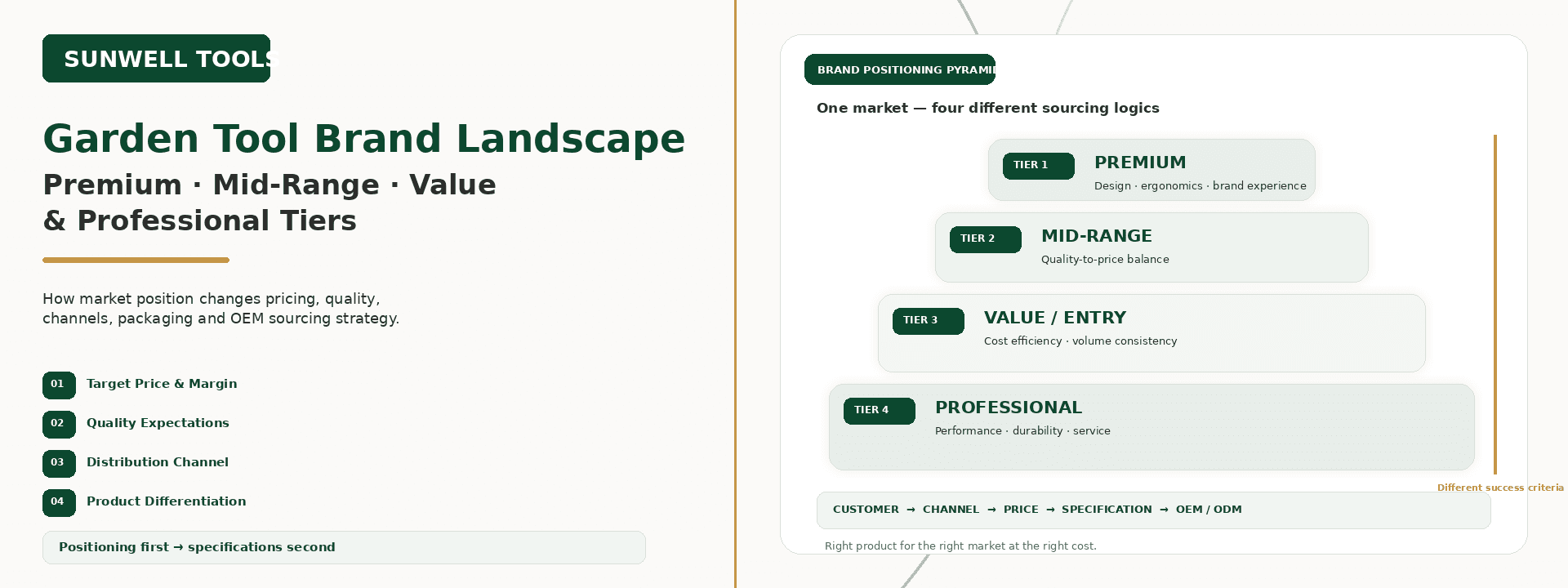
The Garden Tool Brand Pyramid: Four Market Tiers
The garden-tool market can be simplified into four broad positioning groups.
These categories are not rigid. Many brands operate across multiple price points, but the framework is useful for understanding sourcing requirements.
Tier 1: Premium Consumer Brands
Premium brands compete through design, engineering, product systems, strong retail presentation and long-term consumer recognition.
Well-known examples in this part of the market include brands such as GARDENA, FISKARS and Husqvarna, although individual product lines may occupy different price positions.
Typical premium-tier characteristics include:
- Higher investment in product development
- Distinctive design language
- Greater focus on ergonomics
- Stronger packaging presentation
- Consistent brand colors and product systems
- Detailed quality and compliance requirements
- Broad omnichannel distribution
For an OEM manufacturer, this tier generally requires strong control over material consistency, surface finish, dimensions, appearance, packaging and testing.
Tier 2: Mid-Range Garden Tool Brands
The mid-range tier often targets serious home gardeners and customers who want better quality than basic promotional tools without moving into the highest price levels.
Examples commonly associated with this positioning include brands such as Spear & Jackson, Burgon & Ball and Wolf-Garten.
Typical characteristics include:
- Strong quality-to-price positioning
- Reliable materials and construction
- Product credibility over luxury presentation
- Garden-centre and hardware-store distribution
- More product differentiation than entry-level ranges
- Greater cost optimization than the premium tier
For many private-label brands, this can be one of the most attractive market positions because it creates room for visible product differentiation while still maintaining accessible retail pricing.
Tier 3: Value & Entry-Level Products
The value tier is driven heavily by affordability, accessibility and volume.
It includes discount-retail programs, seasonal promotions, retailer-owned private labels and many online marketplace products.
Typical characteristics include:
- Price-sensitive product development
- High production-volume potential
- Proven product structures
- Cost-efficient materials and packaging
- Strong emphasis on manufacturing consistency
- Mass retail and online distribution
Value does not automatically mean low quality.
Major retail programs can still require detailed testing, documentation, audits and strict product-performance requirements while maintaining aggressive target costs.
Learn more: European Garden Tool Quality Standards →
Tier 4: Professional Garden & Outdoor Equipment
Professional products serve landscapers, arborists, grounds-maintenance teams and other users who may operate equipment for long periods under demanding conditions.
Brands such as STIHL and Echo are examples of companies strongly associated with professional outdoor power equipment.
Typical characteristics include:
- High durability expectations
- Performance-oriented engineering
- Specialist or dealer distribution
- Greater emphasis on service and spare parts
- More demanding field-use requirements
- Higher product values
This category differs significantly from mainstream consumer garden tools and normally requires specialized engineering and after-sales capability.
Premium vs Mid-Range vs Value vs Professional Garden Tools
| Dimension | Premium | Mid-Range | Value / Entry | Professional |
|---|---|---|---|---|
| Main Customer | Brand-conscious home gardeners | Serious gardeners and semi-professional users | Mass-market and seasonal buyers | Professional users |
| Price Position | Higher | Medium | Accessible / price-sensitive | High |
| Main Competitive Factor | Brand, design and product experience | Quality-to-price balance | Price and functionality | Performance and durability |
| Typical Channels | Omnichannel and specialist retail | Garden centres and hardware stores | Mass retail, discount and marketplaces | Dealer and professional channels |
| Packaging | Strong brand presentation | Quality retail packaging | Cost-efficient and functional | Functional / trade-oriented |
| Product Development | Higher differentiation | Balanced refinement | Proven designs and cost optimization | Application-specific engineering |
| OEM Priority | Precision, appearance and documentation | Quality and cost balance | Efficiency and volume consistency | Technical performance |
The Growth of Private-Label Garden Tools
One of the most important developments in the garden-tool market is the continued growth of retailer-owned and private-label products.
Large retailers can use private labels to create products around their own target price, packaging system, customer profile and promotional strategy.
This creates several advantages:
- Greater control over retail pricing
- Exclusive product configurations
- Custom packaging
- Brand-specific color systems
- Product bundles unavailable from competing retailers
- Closer control over product specifications
For OEM manufacturers, private-label programs create a different challenge from selling standard catalog products.
The manufacturer may need to balance:
- Strict target cost
- Retail quality requirements
- High production volume
- Packaging requirements
- Testing and documentation
- Seasonal delivery schedules
This is why strong private-label manufacturing depends on much more than simply adding a customer's logo to an existing product.
How Competition Between Garden Tool Tiers Is Changing
The boundaries between traditional brand tiers are becoming less clear.
Premium Brands Expanding Their Reach
Premium brands increasingly offer broader product ranges and multiple price levels.
This can allow them to reach customers who previously considered premium products too expensive while still maintaining stronger brand recognition.
Value Products Improving
At the same time, improvements in manufacturing, materials, product design and quality control have raised consumer expectations for entry-level products.
Retail private labels are particularly important in this trend because a retailer has a strong incentive to protect its own reputation even when the product is positioned at a competitive price.
The Mid-Range Becomes More Competitive
As premium brands introduce more accessible products and value-tier products improve, mid-range brands need clearer differentiation.
That differentiation may come from:
- Specialist product expertise
- Design
- Heritage
- Materials
- Warranty or service
- Retailer relationships
- Product bundles
Chinese Garden Tool Manufacturers: From Production to Product Development
China's garden-tool manufacturing industry has developed far beyond simple low-cost production.
More established OEM/ODM manufacturers increasingly support:
- Product engineering
- 3D design
- Mold development
- Material selection
- Surface treatment
- Packaging development
- Quality testing
- Private-label programs
- Multi-category sourcing
This allows international buyers to use Chinese suppliers not only for production, but also as part of the product-development process.
At the same time, some manufacturers and related businesses have also developed their own consumer-facing brands through e-commerce and direct-to-consumer channels.
For buyers, this makes supplier evaluation more important.
It is useful to understand whether a potential partner is primarily focused on OEM/ODM, its own brands, or a combination of both.
What the Garden Tool Brand Landscape Means for Procurement Teams
A Practical Sourcing Framework
Before requesting a quotation, buyers should be able to answer five questions:
- Who is the target customer?
- What is the target retail price?
- Which sales channel will sell the product?
- What level of product differentiation is required?
- Which performance or compliance requirements are non-negotiable?
Once these points are clear, the manufacturer can make more useful recommendations on materials, structures, packaging and production methods.
SUNWELL's Multi-Tier Garden Tool Manufacturing Capability
SUNWELL has focused on garden-tool manufacturing since 1988.
Its broader manufacturing platform supports manual garden tools, electric garden tools and garden watering products for international B2B and OEM/ODM programs.
Different customers require different product strategies.
SUNWELL can evaluate projects around:
- Target retail price
- Material selection
- Product structure
- Surface finish
- Handle and grip design
- Colors
- Packaging
- Testing requirements
- Order quantity
- Production planning
For a value-oriented program, the objective may be to simplify specifications while maintaining the required function and quality.
For a higher-positioned product, the project may place more emphasis on materials, finish, ergonomics, packaging and product differentiation.
This allows buyers to develop different price tiers without treating every SKU as if it needs the same specification.
Explore SUNWELL's product platform: Manual Garden Tools, Power Tools & Watering Solutions →
How to Build a Multi-Tier Private-Label Garden Tool Range
Retailers and brand owners do not necessarily need to choose only one tier.
A well-structured assortment can use multiple price levels within the same product category.
| Assortment Level | Possible Product Direction | Main Objective |
|---|---|---|
| Entry | Proven structure, cost-efficient materials, simple packaging | Accessible retail price |
| Good | Improved grip, finish or material specification | Better perceived value |
| Better | Stronger materials, ergonomic upgrades, better packaging | Quality differentiation |
| Best | Premium materials, distinctive design and retail presentation | Higher brand positioning |
For example, a pruning-shear range could use different blade grades, coatings, handle structures and packaging to create several retail price points from one product category.
See our material guide: Garden Tool Materials: Steel vs Stainless Steel vs Aluminum →
Final Thoughts: Positioning Comes Before Product Specification
The garden-tool brand landscape is constantly changing.
Premium products become more accessible. Value products improve. Private labels become more sophisticated. Manufacturers take a larger role in product development.
For B2B buyers, the most important lesson is not to copy another brand's specification blindly.
Start with your own market.
Define your customer, retail channel, price position and product promise.
Then build the materials, features, packaging and quality requirements around that position.
A successful garden-tool sourcing strategy is not about creating the most expensive product.
It is about creating the right product for the right market at the right cost.
Build the Right Garden Tool Range for Your Market
Whether you are developing an entry-level retail range, a mid-market private label or a higher-positioned garden-tool collection, SUNWELL can help evaluate the product specifications needed for your target market.
Tell us your target country, retail channel, expected price position, product category, order volume and customization requirements.
Our team can then evaluate suitable materials, structures, packaging, quality requirements and OEM/ODM options for your program.
Different markets. Different price tiers. One garden-tool manufacturing partner.
Explore SUNWELL Products → Discuss Your Product Range →