From Manual to Electric: The Electrification of Garden Tools
The garden-tool industry is undergoing an important technological transition.
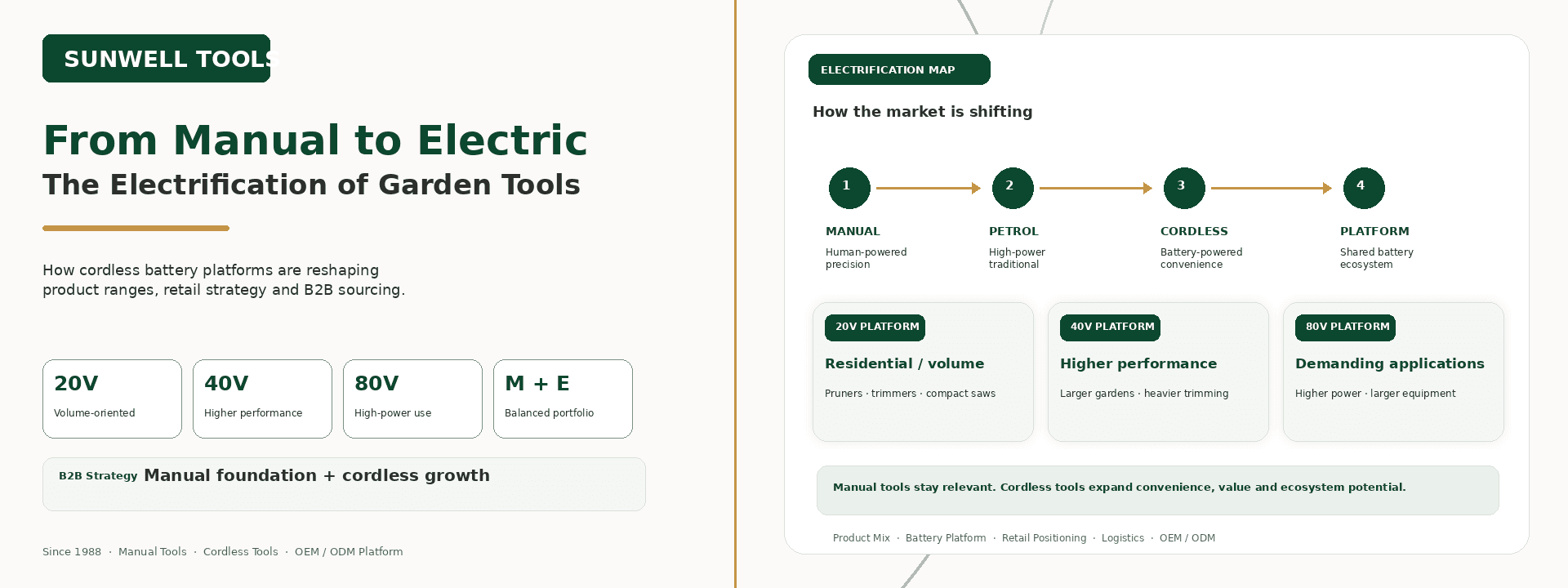
For decades, garden maintenance relied mainly on manual tools and petrol-powered equipment. Today, a third product system is expanding rapidly: cordless lithium-ion garden tools.
Electric pruning shears, hedge trimmers, grass trimmers, leaf blowers, chainsaws and lawn-care equipment are creating new opportunities for retailers, distributors and private-label brands.
For B2B buyers, the electric garden tools trend affects much more than individual product selection. It influences battery-platform strategy, inventory planning, price positioning, merchandising, logistics and OEM/ODM sourcing.
This guide explains the forces behind garden tool electrification, the role of battery platforms and how buyers can build a balanced manual and electric garden-tool portfolio.
1. The Transition From Manual & Petrol to Cordless Garden Tools
Garden maintenance has traditionally relied on two main product systems.
Manual pruning shears, loppers, hand saws, hoes, rakes and other hand tools use direct human effort.
Larger outdoor tasks have often been handled by petrol-powered equipment such as lawn mowers, grass trimmers, chainsaws and leaf blowers.
Lithium-ion battery technology has created another option.
Modern cordless garden tools combine:
- Portable operation
- No direct power cable
- Reduced manual effort
- Lower routine maintenance than many petrol-powered alternatives
- Lower operating noise in many applications
- Battery compatibility across multiple tools
The result is not simply a replacement of manual products.
Instead, the market is developing into a broader ecosystem in which manual tools, cordless tools and other powered equipment serve different users, price points and applications.
For a direct comparison, read: Electric vs Manual Garden Tools: B2B Buying Guide →
2. How Battery Platforms Are Reshaping the Garden Tool Industry
The development of cordless garden tools is closely connected to lithium-ion battery technology.
For buyers, the important question is no longer only whether to source an electric garden tool.
It is also: which battery platform should the product range use?
20V vs 40V vs 80V Garden Tool Platforms
20V-class cordless systems are well suited to lighter and medium-duty garden applications.
Typical products can include electric pruning shears, hedge trimmers, grass trimmers, compact chainsaws and leaf blowers.
40V-class systems can support products requiring greater power or longer runtime.
They are relevant to larger gardens, heavier trimming and more demanding residential or prosumer applications.
Higher-voltage cordless systems can be used where buyers need more power for larger cutting, mowing and professional-style outdoor applications.
The higher performance also brings greater battery cost, weight and platform complexity.
Battery Ecosystems Create Repeat-Purchase Opportunities
One of the most important commercial advantages of cordless garden tools is battery compatibility.
A customer who already owns a battery and charger may be more willing to purchase another compatible tool without buying another complete battery kit.
For example, one battery system could potentially support:
- Electric pruning shear
- Hedge trimmer
- Grass trimmer
- Leaf blower
- Compact chainsaw
This creates opportunities for brands to build a garden-tool platform rather than selling isolated SKUs.
For retailers, battery compatibility should therefore be considered during assortment planning, packaging design and merchandising.
3. Where Garden Tool Electrification Stands by Category
Electrification is not progressing at the same speed across every garden-tool category.
| Category | Electrification Direction | Main B2B Consideration |
|---|---|---|
| Lawn Mowers | Strong cordless adoption | Battery capacity, runtime and garden size |
| Hedge Trimmers | Well-established cordless category | Blade length, weight, motor and battery platform |
| Leaf Blowers | Strong cordless opportunity | Air performance, runtime, weight and noise |
| Grass Trimmers | Growing cordless category | Power, runtime, cutting width and line system |
| Electric Pruning Shears | Fast-developing convenience category | Cutting capacity, blade, motor and ergonomics |
| Chainsaws | Growing across selected applications | Battery power, cutting capacity and intended user |
| Watering Products | Mostly manual systems | Pumps, controllers and automation create adjacent opportunities |
| Hand & Digging Tools | Manual tools remain dominant | Materials, ergonomics and price positioning remain more important |
A clear pattern can be seen across many categories.
Tasks involving repeated motion, sustained physical effort or larger working areas often create a stronger case for electrification.
At the same time, simple hand tools remain relevant because they are affordable, easy to store, straightforward to maintain and well suited to precision tasks.
4. What Is Driving Demand for Cordless Garden Tools?
These factors do not affect every customer in the same way.
A professional landscaper, urban homeowner, orchard operator and occasional home gardener may all evaluate cordless products differently.
For B2B buyers, the correct assortment should therefore be based on the actual end user rather than the assumption that every market is moving toward the same product mix.
5. Regulation & Environmental Pressure Are Supporting Electrification
Environmental requirements, emissions standards, battery regulations and local noise policies increasingly influence outdoor power equipment.
For buyers of petrol-powered and battery-powered garden products, destination-market requirements may affect:
- Product compliance
- Engine-related emissions requirements
- Battery transportation
- Battery labeling
- Recycling obligations
- Noise requirements
- Electrical safety
These requirements can vary by country and product category.
For this reason, buyers planning long-term cordless programs should consider compliance and logistics at the product-development stage rather than after mass production has begun.
6. What Electrification Means for Retailers
Cordless garden tools create different merchandising and inventory requirements from manual products.
Battery Ecosystem Merchandising
A retailer carrying several tools that use the same battery can merchandise them as one coordinated system.
This makes compatibility part of the product value proposition.
Retailers may offer:
- Complete kits with tool, battery and charger
- Bare-tool versions
- Additional batteries
- Fast chargers
- Multi-tool promotional bundles
Higher Product Values
Electric garden tools generally contain more components than manual alternatives.
Motors, batteries, charging systems, control electronics and housings create a higher-value product structure.
This can support higher retail price points, but it also means more attention is required for:
- Product specifications
- Inventory
- After-sales
- Battery compatibility
- Replacement parts
- Technical customer questions
Manual Tools Still Matter
Electrification does not remove the role of pruning shears, loppers, garden saws, trowels, rakes, hoes and other manual products.
Manual tools continue to provide accessible price points, simple operation and broad consumer familiarity.
The stronger assortment strategy is therefore usually manual + electric, not manual versus electric.
7. A B2B Buyer's Playbook for the Electric Garden Tools Trend
7.1 Maintain & Refresh the Manual Tool Range
Manual products can continue to compete through:
- Better blade materials
- Improved surface treatments
- Ergonomic grips
- Lighter handles
- Updated packaging
- Private-label colors
Learn more about material choices: Garden Tool Materials: Steel vs Stainless Steel vs Aluminum →
7.2 Expand Electric Categories Strategically
Buyers entering the cordless category do not necessarily need to launch every electric tool at once.
A more manageable approach can be to begin with products where cordless operation provides an obvious consumer benefit, then expand the platform over time.
Examples include:
- Electric pruning shears
- Hedge trimmers
- Leaf blowers
- Grass trimmers
- Compact chainsaws
7.3 Align the Platform With the Market
A lightweight residential product range may prioritize compact batteries, lower tool weight and accessible retail pricing.
A prosumer or higher-performance range may place more emphasis on runtime, power and larger batteries.
E-commerce programs should also make technical information easy to compare, including:
- Voltage
- Battery capacity
- Cutting capacity
- Runtime
- Charging configuration
- Product weight
- Included accessories
8. SUNWELL's Manual + Electric Garden Tool Platform
SUNWELL has focused on garden-tool manufacturing since 1988.
Over time, the product platform has expanded from manual garden tools into cordless electric products and garden watering systems.
SUNWELL's broader product platform includes:
- Manual pruning tools
- Digging and hand tools
- Electric pruning shears
- Cordless hedge trimmers
- Grass-trimming products
- Leaf blowers
- Chainsaw products
- Garden watering products
OEM/ODM support can include:
- Product selection
- Product engineering
- Battery-platform planning
- Housing and color customization
- Blade and cutting-system specifications
- Private-label branding
- Packaging
- Sampling
- Production
- Quality control
Explore the complete product system: SUNWELL Product Lines: Manual Garden Tools, Power Tools & Watering Solutions →
How to Evaluate a Cordless Garden Tool Supplier
Electrification adds more sourcing variables than a standard manual tool project.
Before choosing a supplier, B2B buyers should evaluate:
- Battery platform consistency — can several tools share batteries and chargers?
- Product engineering — can the supplier evaluate motors, cutting systems, housings and safety requirements?
- Testing — are functional, electrical and durability checks appropriate for the product?
- OEM/ODM support — can housing, colors, specifications and packaging be adapted to the brand?
- Quality control — are manual and electric products managed with category-specific inspection processes?
- Production planning — can the supplier coordinate batteries, motors, chargers and other components alongside mass production?
Learn more about SUNWELL's quality system: Garden Tool Quality Control & Testing →
Conclusion: Electrification Is an Expansion, Not a Replacement
The transition toward battery-powered garden tools is changing how buyers plan product ranges.
Cordless products create opportunities around convenience, productivity, higher-value product tiers and battery ecosystems.
But manual garden tools remain important.
They continue to serve customers who value simplicity, precision, accessible pricing and low product complexity.
For most B2B buyers, the strongest strategy is therefore not to choose between the two.
It is to develop a deliberate manual + electric garden-tool portfolio.
Manual products provide the foundation.
Cordless products add convenience, technology and new price tiers.
Together, they allow retailers, distributors and private-label brands to serve more customer groups and more garden-maintenance applications.
Build Your Manual + Electric Garden Tool Range With SUNWELL
Whether you are expanding an existing garden-tool assortment or developing a new cordless private-label range, SUNWELL can evaluate suitable products and OEM/ODM options for your market.
Tell us your target country, retail channel, product categories, expected volume, battery-platform requirements and price positioning.
Our team can then evaluate the most suitable combination of manual tools, cordless electric products and garden watering solutions for your program.
Manual expertise. Cordless development. One garden-tool manufacturing partner.
Explore SUNWELL Products → Discuss Your Project →